
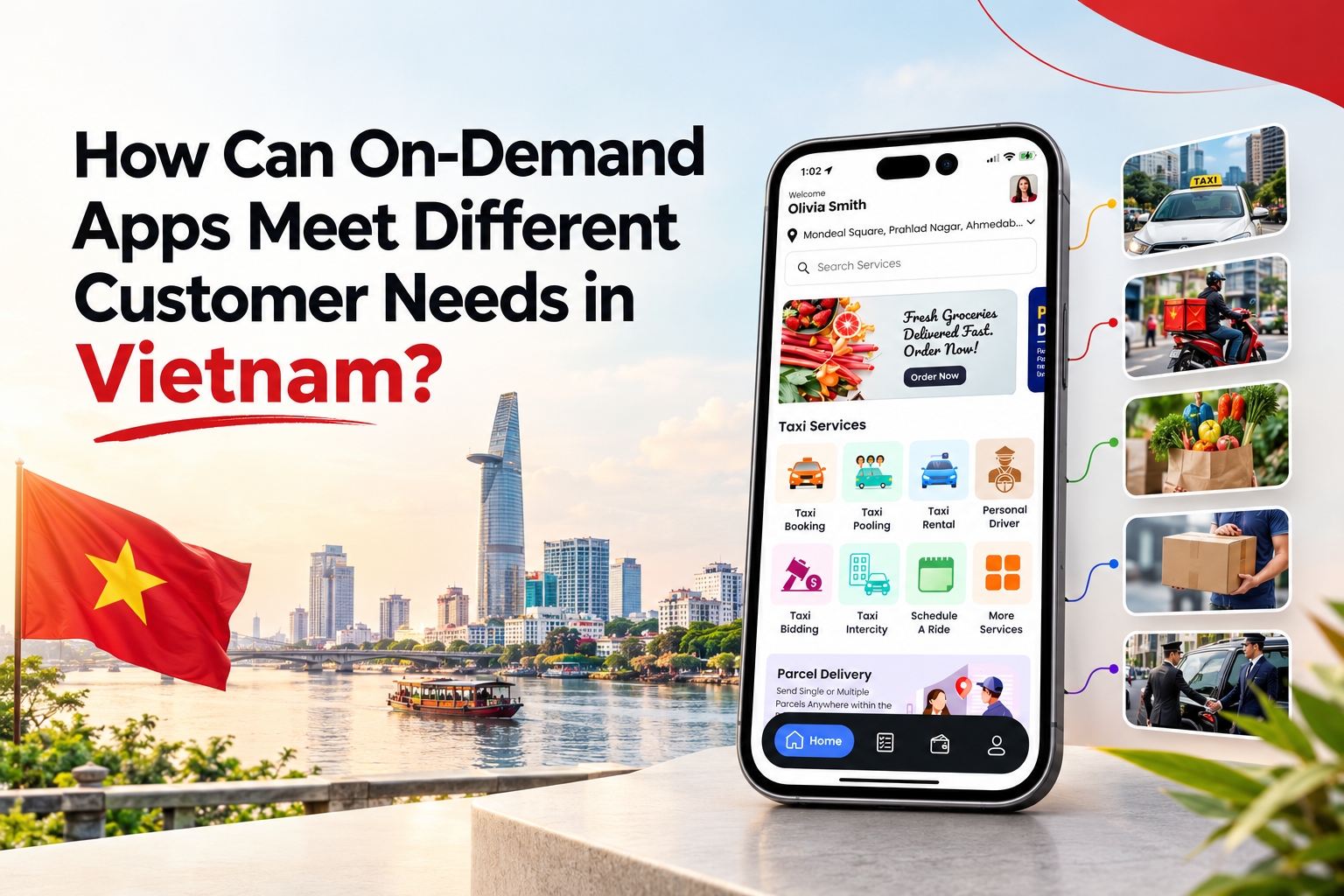
Vietnam’s digital economy is creating new opportunities for businesses that want to make everyday services easier to access. From booking a motorbike ride through busy city streets to ordering lunch, buying groceries, or arranging a home service, customers increasingly value convenience and flexibility. However, not every customer expects the same experience from an on-demand platform.
A university student in Ho Chi Minh City may prioritize affordable rides and quick food delivery. A working parent in Hanoi might prefer grocery delivery that saves time after work. Meanwhile, a small business owner may need reliable logistics services to fulfill customer orders. Although these users have different priorities, they share a common expectation: services should be easy to access, dependable, and suited to their daily routines.
This creates an opportunity for businesses to develop on-demand applications that serve multiple needs through a single digital platform. A Gojek clone app is one model entrepreneurs can explore when planning a multi-service business that brings transportation, delivery, and other everyday services together.
The key is not simply to add more features. It is to understand how Vietnamese customers behave, identify the services they need most, and build an application that makes those services genuinely useful.
Understanding the Changing Needs of Vietnamese Customers
Vietnam is not a single, uniform market. Customer expectations can differ significantly depending on location, age, income, occupation, and lifestyle.
In major cities such as Hanoi, Ho Chi Minh City, and Da Nang, customers may prioritize speed, digital convenience, and access to several services from their smartphones. In smaller cities and developing urban areas, affordability, service availability, and trust may carry greater weight.
These differences matter when planning an on-demand business. An application designed around the expectations of one customer group may struggle to attract another if it overlooks local habits.
For example, a customer who regularly orders meals may appreciate saved addresses and quick reordering. Someone who books motorbike rides several times a week may be more interested in transparent fares, accurate driver locations, and convenient payment options. A household ordering groceries may prioritize product availability and dependable delivery times.
Businesses can respond to these differences by designing flexible service options instead of assuming that every customer wants the same features.
1. Offer Multiple Services Through One Application
Customers often use different platforms to meet different everyday needs. One application handles transportation, another delivers food, and a third helps them order household essentials. Switching between services can become inconvenient, especially for people who use them regularly.
A multi-service application offers an alternative by bringing selected services together in one place. Depending on the business model, customers might be able to book rides, order meals, purchase groceries, request parcel delivery, or schedule local services through a single account.
This is one reason entrepreneurs consider a Gojek clone app development model when planning an on-demand business. Inspired by the multi-service platform concept, a Gojek-style application can be configured to support several service categories within a connected digital ecosystem.
However, launching every possible service at once is not necessarily the best strategy. Businesses should begin with services that address clear local demand and expand when their operations can support additional categories.
For instance, a startup operating in a busy urban district might launch with motorbike bookings and food delivery. Once it develops a reliable customer base and delivery network, it could introduce grocery delivery or parcel services.
The objective is to make the platform more useful over time without compromising the quality of its core services.
2. Make Affordability a Practical Priority
Price can strongly influence whether customers try an on-demand service and continue using it. This is particularly relevant when a platform competes with traditional transportation providers, neighborhood stores, independent delivery workers, and established digital services.
An application should make its charges easy to understand before customers confirm an order or booking. Unexpected fees, confusing fare calculations, and unclear cancellation charges can undermine confidence, even when the service itself is convenient.
Businesses can address this concern through transparent pricing, clearly displayed delivery charges, and suitable promotions for new and returning users.
A ride-booking service, for example, could display the estimated fare before confirmation. A food delivery platform could show delivery charges and applicable minimum-order requirements early in the checkout process.
A well-planned Gojek clone solution can incorporate configurable pricing rules, promotional codes, service-specific charges, and payment records. These features allow operators to manage different services without treating every transaction in the same way.
Affordability should not mean competing exclusively through discounts. Businesses also need to account for driver compensation, delivery expenses, platform maintenance, and customer support. A sustainable pricing model helps maintain service quality while giving customers a clear understanding of what they are paying for.
3. Support Transportation Habits Across Different Locations
Transportation is an important part of daily life in Vietnam, particularly in urban areas where motorbikes are widely used. Customers may need a short ride to work, transport to a bus or railway station, a trip to a shopping area, or a convenient way to travel during unfavorable weather.
An on-demand transportation service should reflect these everyday situations rather than simply copying the interface of an existing international app.
For example, a platform could offer motorbike rides for short urban journeys and car bookings for customers traveling with family, carrying luggage, or requiring additional space. Depending on local demand and operational capacity, businesses could also consider scheduled rides or options for regular commuters.
Useful features include GPS-based driver tracking, estimated arrival times, fare estimates, ride history, digital receipts, and clear communication between drivers and passengers.
Local usability matters just as much. Pickup instructions should accommodate familiar landmarks and practical meeting points, particularly in areas where a customer may find it difficult to identify an exact entrance or roadside location.
A Gojek clone app can be customized around these requirements, allowing businesses to configure vehicle categories, booking workflows, service zones, and driver management tools.
The most effective transportation experience is not necessarily the one with the greatest number of options. It is the one that helps customers complete their journeys with less uncertainty.
4. Personalize Food and Grocery Delivery
Food and grocery delivery customers have different priorities depending on what they are ordering and when they need it.
Someone ordering lunch during a short work break may want quick checkout and accurate delivery estimates. A family buying groceries may care more about product availability, substitution options, and the ability to order several items together. Customers ordering dinner may prefer familiar restaurants, saved favorites, and convenient payment methods.
An on-demand app can accommodate these needs by providing service-specific interfaces and workflows.
For food delivery, helpful features include restaurant categories, searchable menus, clear item descriptions, order customization, delivery tracking, and reorder functionality. For groceries, businesses may need product categories, stock visibility, quantity selection, and a process for handling unavailable items.
Local preferences should also influence the customer experience. Businesses can work with participating restaurants and retailers to present relevant products, familiar dishes, and locally appropriate descriptions.
Delivery estimates should reflect actual operating conditions rather than unrealistic promises. Traffic, restaurant preparation times, weather, and delivery partner availability can all affect fulfillment.
A multi-service app development strategy allows food and grocery delivery to share essential infrastructure, such as customer accounts, notifications, and payment records, while maintaining separate processes where each service requires them.
This balance helps create a consistent experience without making every service operate identically.
5. Make Payments Convenient and Trustworthy
Payment flexibility can influence how easily customers adopt an on-demand application. Some users may prefer cash, while others may want to use bank cards, digital wallets, or supported local payment services.
Businesses should research the payment methods their intended customers already use rather than assuming that a single option will suit everyone.
Where appropriate, a platform can support cash payments alongside selected digital payment methods. The available options will depend on the payment provider, business requirements, and local arrangements.
The payment process should be straightforward. Customers need to know the total amount, understand whether a transaction has succeeded, and receive a clear record of their purchase or booking.
Security is equally important. Businesses should work with appropriate payment providers, protect customer information, and avoid storing sensitive payment details unnecessarily.
For operators, the administrative side matters too. A well-designed on-demand service app should record transactions accurately, support refunds where applicable, and make it easier to reconcile payments with drivers, merchants, and service partners.
A Gojek clone app development project can include these capabilities as part of a broader payment and operations workflow. The precise implementation should be selected according to the business model and the payment methods the company intends to support.
6. Build Trust Through Safety and Service Reliability
Convenience can attract customers to an application, but trust helps persuade them to return.
Customers need confidence that a driver will arrive, a parcel will reach its destination, or an order will be handled appropriately. If a platform regularly provides inaccurate arrival times or makes it difficult to resolve complaints, users may quickly look elsewhere.
Trust begins with clear processes. For transportation, these may include driver verification procedures, trip details, location sharing, emergency contact options, and a way to report safety concerns. Delivery services may require order tracking, proof of delivery, and procedures for handling damaged or missing items.
Customer support should also be easy to find. Users should have a clear route for reporting payment problems, cancellations, delays, or disputes.
Businesses can strengthen reliability by monitoring service performance, reviewing recurring complaints, and setting practical service standards for their partners.
A multi-service platform should not assume that one support workflow will address every problem. A missing grocery item requires a different resolution process from a transportation safety concern.
When building a Gojek clone app, entrepreneurs should treat safety, support, and service accountability as essential operational requirements rather than optional additions to the interface.
7. Design for Vietnamese Language and Local Usage
Localization involves much more than translating buttons and menus. An application should feel natural to the people expected to use it.
For Vietnam, Vietnamese-language interfaces can make booking and ordering easier for customers who prefer using their native language. Clear wording, familiar address formats, locally relevant examples, and understandable payment instructions can reduce friction throughout the customer journey.
Businesses should also consider how their application performs on different devices and network conditions. Pages that load slowly, oversized images, or complicated checkout steps can discourage users, particularly when they are trying to complete a quick transaction.
A practical interface should make essential actions easy to identify. Customers should be able to find nearby services, review prices, confirm an order, and contact support without navigating through unnecessary screens.
Localization also applies to business operations. Merchants need understandable order-management tools, while drivers and delivery partners need interfaces that make their tasks clear.
For entrepreneurs considering a white-label Gojek clone app, language support, regional settings, and interface customization are useful capabilities to evaluate before selecting a solution. Businesses should confirm which elements can be configured and whether additional development is needed for their specific requirements.
8. Improve the Experience With Relevant Personalization
Personalization can make an application more useful when it responds to genuine customer preferences.
For example, a platform could display frequently ordered meals, suggest a previously used pickup location, or make repeat grocery purchases easier. A commuter who regularly travels between the same locations might benefit from saved addresses and a simplified booking process.
These features reduce the effort required to complete common tasks. They also help customers discover relevant services without navigating through a large catalog every time they open the application.
However, personalization should be introduced carefully. Too many notifications, irrelevant recommendations, or repeated promotional messages can make an application feel intrusive.
Businesses should give customers appropriate control over notifications and handle personal information responsibly. Recommendations should be based on relevant usage patterns and transparent data practices, with suitable permissions and safeguards.
For a Gojek clone app, personalization can begin with straightforward features such as saved favorites, booking history, and frequently used addresses. More advanced recommendations can be introduced when the platform has sufficient reliable data and a clear reason to use it.
The goal is to reduce friction, not to add technology simply because it is available.
9. Help Small Businesses Reach More Customers
On-demand platforms can serve business users as well as individual consumers. Restaurants, grocery stores, convenience shops, and local retailers may want a convenient way to receive orders and connect with customers beyond their immediate walk-in audience.
A multi-service application can provide participating businesses with a digital channel for presenting products, receiving orders, and coordinating fulfillment.
For example, a neighborhood restaurant could receive meal orders through the platform, while a nearby grocery store could accept household shopping requests. Delivery partners could then handle fulfillment according to the platform's operating model.
To make this arrangement useful, businesses need practical merchant tools. These may include product or menu management, order notifications, availability updates, sales records, and clear commission or fee information.
Entrepreneurs should also think about how to onboard local partners. A technically capable application will not deliver much value if customers cannot find enough reliable merchants or if participating businesses struggle to manage incoming orders.
A Gojek clone solution can provide a starting point for connecting customers, merchants, and service providers. Its business value, however, depends on how effectively the operator builds and manages that network.
Supporting local businesses can help create a more relevant service offering while giving customers additional reasons to use the platform.
10. Use Customer Feedback to Guide Service Expansion
Customer needs change, and businesses cannot predict every requirement before launching an application. The platform should therefore provide a practical way to learn from actual usage.
Customer reviews, support requests, repeat bookings, abandoned orders, and delivery performance can reveal where the experience needs improvement.
For example, repeated complaints about unclear pickup points may indicate a need for better location instructions. A high number of abandoned grocery orders could suggest that stock information, delivery charges, or checkout steps need attention.
Operators should combine these signals with direct customer feedback rather than relying on download numbers alone. An application may attract many initial users without becoming part of their regular routines.
Businesses can use this information to prioritize improvements and decide whether a new service category is worth introducing.
A sensible expansion strategy might involve improving the reliability of existing ride and delivery services before adding more categories. Once the platform has dependable operations, the business can test additional services in selected locations and evaluate the results.
This approach helps a Gojek clone app development project remain aligned with customer needs instead of becoming an increasingly complicated collection of features.
11. Choose a Scalable Technology and Business Model
Meeting diverse customer needs requires more than an attractive customer-facing application. The platform also needs reliable systems for managing bookings, service providers, transactions, notifications, and customer support.
A typical multi-service platform may include a customer app, driver or delivery partner app, merchant interface, and administrative dashboard. Each component serves a different role, but all must exchange information accurately.
For example, a food order should move from the customer to the merchant and then to the appropriate delivery partner. A ride booking needs to connect the passenger with a suitable driver while updating the booking status and estimated arrival time.
Businesses evaluating a white-label Gojek clone app should examine how these workflows operate in practice. Important considerations include the ability to configure service categories, manage different user roles, monitor transactions, control service areas, and maintain the platform as demand grows.
Scalability does not mean preparing for unlimited growth from the first day. It means selecting an approach that can accommodate realistic expansion without requiring the business to rebuild its entire operation.
Entrepreneurs should also review ongoing maintenance, customization requirements, technical support, data protection, and integration capabilities before committing to a solution.
The right technology is the one that supports the company's service strategy and operational capacity, not simply the one that advertises the longest feature list.
Conclusion
On-demand apps can meet different customer needs in Vietnam by combining convenience with a clear understanding of local lifestyles. Affordable transportation, dependable food and grocery delivery, flexible payment options, Vietnamese-language interfaces, reliable customer support, and relevant personalization can all contribute to a better user experience.
For businesses, the challenge is to bring these capabilities together without making the application confusing or difficult to operate. A multi-service model inspired by the Gojek platform offers one possible route, allowing entrepreneurs to connect several everyday services through a single digital ecosystem. Businesses can explore a customizable Gojek clone app development solution to build a multi-service platform around their target customers, preferred service categories, and local market requirements.
A successful Gojek clone app is not defined by how many services it offers. Its value comes from how effectively those services solve real problems for customers, merchants, and service providers.
Businesses that start with clear customer needs, establish reliable operations, and expand based on feedback will be better positioned to develop an on-demand platform that remains useful as Vietnam's digital service market evolves.