
Buying a car no longer begins when someone walks into a dealership. It often starts much earlier, with a search on Google, a question typed into a search bar, a YouTube review, or a quick “dealership near me” query from a smartphone.
Today’s automotive customers can compare models, check prices, read reviews, explore financing options, look at dealership inventories, and even estimate trade-in values before speaking with a salesperson. This has made online visibility an important part of the automotive buying journey.
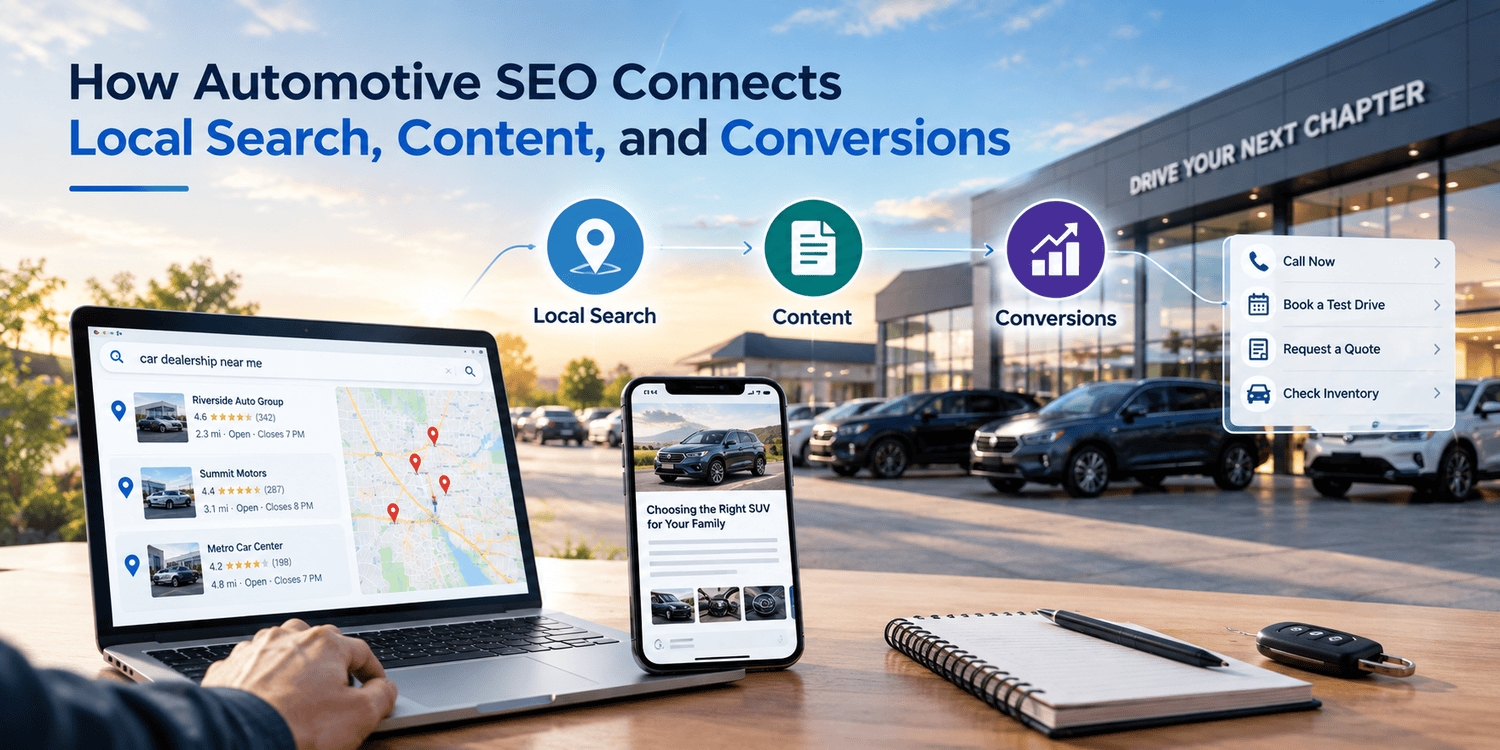
But visibility alone is not enough. A dealership might appear in search results and still struggle to generate calls, test drives, inquiries, or vehicle sales. The real challenge is connecting different parts of digital marketing so that local search brings the right audience, content answers their questions, and optimized landing pages turn that interest into action.
This is where a well-planned automotive SEO strategy becomes valuable. Instead of treating rankings, content, and conversions as separate goals, dealerships can build a connected search experience that follows customers from their first query to the point where they are ready to contact the business.
Why Automotive Search Is Different
Automotive SEO has several characteristics that make it different from general business SEO.
A customer searching for “SUVs” may be researching models months before making a purchase. Someone searching for “Toyota dealer near me” may have a much stronger local intent. Another person searching for “2026 Toyota RAV4 price” could be comparing options, while a query such as “RAV4 financing near me” may indicate that the buyer is getting closer to making a decision.
This creates multiple layers of search intent.
Automotive businesses need to understand these differences because a single generic landing page cannot effectively address every type of search.
A strong strategy considers:
Location-based searches
Vehicle-specific searches
Brand searches
Model comparisons
Pricing queries
Financing searches
Service-related searches
Used-car searches
Trade-in searches
Informational questions
High-intent dealership searches
The goal is to create useful content and landing pages for different stages of the customer journey.
The Role of an Automotive SEO Agency
An Automotive SEO Agency can help dealerships bring these different search activities into a coordinated strategy.
Rather than focusing exclusively on keywords, an automotive-focused SEO team can examine how customers search, which pages attract organic traffic, where local visibility is weak, and what happens after visitors arrive on the website.
For example, a dealership may rank well for informational searches but receive very few inquiries. Another dealership may have strong local visibility but poorly optimized vehicle inventory pages.
These problems require different solutions.
An effective strategy can connect:
Local SEO
Website optimization
Vehicle inventory pages
Educational content
Technical SEO
Conversion optimization
Reputation management
Internal linking
Structured data
Performance analysis
When these elements work together, SEO becomes more than a traffic-generation channel. It becomes part of the dealership's broader digital sales process.
Local Search: Where Automotive Visibility Begins
For dealerships, local search is particularly important because most customers eventually need a physical location or service area.
Someone searching for a dealership is rarely interested in a business hundreds of miles away. They typically want an option they can visit, contact, or purchase from within a reasonable geographic area.
This makes local search optimization a fundamental part of automotive SEO.
Optimizing the Google Business Profile
A dealership's Google Business Profile can influence how customers discover the business in local search and map results.
Accurate business information should be maintained, including:
Business name
Address
Phone number
Website
Opening hours
Service information
Relevant business categories
High-quality photos and regular updates can also help provide customers with a better understanding of the dealership.
Reviews are another important part of the local experience. Customers frequently use reviews when deciding which dealership to contact, so businesses should have a consistent process for encouraging genuine customer feedback and responding professionally.
Building Location-Relevant Pages
A dealership serving multiple areas may need more than a single location page.
For example, a business serving several nearby communities can create genuinely useful location pages that explain its services, inventory, directions, and relevance to those customers.
However, simply creating dozens of pages with the same text and replacing the city name is unlikely to provide much value.
Location pages should be meaningfully different and useful to the audience they are designed to serve.
Content Bridges the Gap Between Search and Sales
Local visibility can bring potential customers to an automotive website, but content helps them understand what to do next.
Consider the questions a potential buyer might have:
Which SUV is suitable for a family?
Is a hybrid worth the additional cost?
Should I buy new or used?
What should I check before buying a used vehicle?
How does dealership financing work?
What documents are required?
How much should I budget for maintenance?
What is the difference between two similar models?
These questions create opportunities for useful content.
Instead of producing articles simply to insert keywords, automotive websites can build content around real customer concerns.
Matching Content With Search Intent
Not every visitor is ready to contact a dealership.
This is one of the most important concepts in automotive content strategy.
A person searching for “best family SUVs” is likely researching. A person searching for “used Honda CR-V dealer near me” has a much stronger local and commercial intent.
Both searches can be valuable, but they require different content.
Top-of-Funnel Content
Early-stage content can answer broad questions and help customers understand their options.
Examples include:
Best vehicles for long-distance driving
EV vs. hybrid vehicles
How to choose a family SUV
New vs. used car buying
Important features for first-time buyers
This type of content can attract people who have not yet selected a vehicle or dealership.
Mid-Funnel Content
Once customers narrow their choices, they often start comparing specific models, features, and ownership costs.
Content could include:
Model comparisons
Trim-level explanations
Feature guides
Fuel-economy comparisons
Ownership-cost breakdowns
Financing guides
Vehicle technology explainers
This content can help customers move from general research toward a specific purchase decision.
Bottom-of-Funnel Content
High-intent visitors need direct and useful information.
Examples include:
Current inventory pages
Vehicle detail pages
Financing pages
Trade-in pages
Test-drive booking pages
Contact pages
Dealership location pages
These pages should make the next step obvious.
Vehicle Inventory Pages Are Critical
Automotive websites have an advantage that many other industries do not: they can publish a large amount of highly specific inventory information.
Each vehicle can potentially have its own page containing details such as:
Make
Model
Year
Trim
Mileage
Price
Features
Images
Availability
Financing information
Location
These pages can capture highly specific searches.
However, inventory pages can also create SEO challenges. Vehicles are frequently sold, added, removed, or replaced. Websites with large inventories need a clear strategy for handling changing URLs and outdated listings.
Technical SEO therefore becomes particularly important for automotive websites.
Technical SEO Supports the Entire Journey
Even excellent content can struggle if search engines have difficulty crawling, understanding, or indexing a website.
Automotive websites can become technically complex because they may contain thousands of vehicle pages, filters, dealership locations, service pages, blogs, and third-party integrations.
Important areas include:
Website Architecture
The website should have a logical structure that allows both users and search engines to move between important sections.
For example:
Homepage → New Vehicles → Brand → Model → Vehicle Detail
A similar structure can be created for used inventory, services, financing, and dealership locations.
Internal Linking
Internal links can connect informational articles with commercial pages.
An article explaining the benefits of hybrid SUVs could link to relevant vehicle inventory. A financing guide could connect visitors to financing information. A local dealership page could link to available inventory.
This creates a more connected user journey.
Page Speed
Customers increasingly expect websites to load quickly, especially on mobile devices.
Slow pages can create friction before visitors even see the vehicle or offer they came to explore.
Image optimization, efficient code, caching, and careful use of third-party scripts can all contribute to better performance.
Structured Data
Structured data can help search engines understand important information about webpages.
Depending on the page and applicable search features, automotive businesses may use structured data to provide clearer information about products, businesses, locations, and other relevant content.
The implementation should always match the actual information visible on the page.
Turning Organic Traffic Into Conversions
Ranking is only one part of the equation.
Imagine an automotive website receives 50,000 organic visitors but generates very few inquiries. Increasing traffic alone may not solve the underlying problem.
The website needs to guide visitors toward meaningful actions.
Potential conversion points include:
Requesting a quote
Scheduling a test drive
Calling the dealership
Checking vehicle availability
Applying for financing
Requesting a trade-in estimate
Contacting a salesperson
Booking a service appointment
Make Calls Easy on Mobile
A significant portion of automotive searches happen on mobile devices.
A visitor who wants to contact a dealership should not have to search through multiple pages to find a phone number.
Clickable phone numbers, visible contact options, and mobile-friendly forms can reduce unnecessary friction.
Create Clear Calls to Action
Calls to action should match the visitor's intent.
For example:
Researching:
“Explore Vehicle Features”
Comparing:
“Compare Available Models”
Ready to buy:
“Check Current Inventory”
Ready to visit:
“Schedule a Test Drive”
A single generic “Contact Us” button may not be appropriate for every stage.
Content and Local SEO Should Work Together
One common mistake is treating local SEO and content marketing as separate activities.
They can actually strengthen each other.
Suppose a dealership creates an article about choosing an SUV for winter driving. That article can link to relevant SUV inventory, service information, and a local dealership page.
Likewise, a local dealership page can connect visitors to helpful guides about financing, vehicle maintenance, or choosing a specific model.
This creates a network of related information.
The customer gets a smoother experience, while search engines gain additional context about the relationships between different pages.
The Importance of Reputation
Automotive purchases involve substantial financial decisions, so trust plays an important role.
Customers may research a dealership extensively before making contact.
They can look at:
Customer reviews
Ratings
Testimonials
Dealership history
Service information
Photos
Staff information
Online discussions
Customer experiences
SEO cannot replace a good customer experience.
If a dealership consistently provides poor service, no amount of content can permanently solve the reputation problem.
Instead, SEO should help make genuine customer experiences easier to discover.
Building a Digital Ecosystem Around Automotive Sales
The future of automotive digital marketing is not limited to dealership websites.
Customers increasingly interact with businesses through multiple digital touchpoints.
They may discover a dealership through search, watch a vehicle video, browse inventory, check social media, read reviews, compare prices, and eventually visit the physical location.
This creates a digital ecosystem.
For businesses developing technology around automotive commerce, a White Label Car Dealership Marketplace can provide another route for bringing vehicle listings, dealers, customers, and digital buying experiences together under a customizable platform.
Such platforms can be designed around specific business models and markets rather than relying entirely on a traditional dealership website.
The underlying SEO principles remain similar: clear information architecture, useful content, strong technical foundations, location relevance, and an easy path toward conversion.
Measuring What Actually Matters
Automotive SEO should not be measured only by keyword rankings.
Rankings can provide useful information, but businesses ultimately need to understand whether organic visibility is contributing to meaningful outcomes.
Important metrics can include:
Organic traffic
Local search visibility
Non-branded traffic
Vehicle page visits
Engagement
Phone calls
Test-drive requests
Financing inquiries
Inventory interactions
Form submissions
Service bookings
Leads generated from organic search
Connecting SEO With Business Data
A more mature SEO strategy connects website data with actual business outcomes.
For example, a dealership may discover that one content topic generates thousands of visits but very few leads, while another attracts fewer visitors but produces substantially more inquiries.
This information can help the team understand which types of content deserve additional attention.
The objective is not simply to produce more traffic. It is to understand which search journeys create meaningful business opportunities.
How AI Is Changing Automotive Search
Search behavior is evolving as AI-powered search and conversational tools become more common.
Customers can now ask detailed questions instead of relying exclusively on short keyword phrases.
For example, someone might ask:
“What are some reliable SUVs for a family that regularly drives long distances and wants good fuel economy?”
This type of search is broader than a traditional keyword query.
Automotive businesses may therefore need to create content that answers complete questions rather than focusing exclusively on individual keyword variations.
Clear explanations, first-hand information, accurate specifications, useful comparisons, and well-organized content can become increasingly important.
AI does not eliminate the fundamentals of SEO. Instead, it makes useful and trustworthy information even more important.
Common Automotive SEO Mistakes to Avoid
Even businesses investing in SEO can make mistakes that limit their results.
Publishing Generic Content
Articles that repeat information already available across hundreds of websites may have difficulty providing meaningful value.
Automotive content should bring something useful to the discussion, such as detailed explanations, original insights, practical examples, or local relevance.
Ignoring Old Inventory Pages
Vehicle inventory changes quickly. Leaving sold vehicles indexed without a strategy can create poor user experiences and unnecessary technical issues.
Creating Thin Location Pages
Location pages should serve a genuine purpose. Adding city names to nearly identical pages does not create meaningful local value.
Focusing Only on Rankings
A ranking without relevant traffic or conversions does not necessarily translate into business results.
Neglecting Mobile Users
A website that works well on desktop but creates friction on mobile can lose potential customers.
Overusing Keywords
Automotive SEO should prioritize clarity and relevance rather than repeatedly inserting the same keyword into every paragraph.
A Connected Approach to Automotive SEO
The strongest automotive SEO strategies connect several layers rather than treating each activity independently.
Local SEO helps customers discover nearby businesses.
Content answers questions and supports research.
Vehicle pages capture specific commercial searches.
Technical SEO helps search engines understand the website.
Internal linking connects related information.
Conversion optimization helps visitors take the next step.
Analytics reveals which parts of the journey are producing meaningful outcomes.
When these components work together, SEO becomes a connected system rather than a collection of isolated tactics.
Final Thoughts
The modern automotive customer journey rarely follows a straight line. Someone may discover a vehicle through search, research it through multiple articles, compare alternatives, check dealership reviews, browse inventory, and only then decide whether to make contact.
That means automotive businesses need to think beyond individual keywords and rankings.
The real opportunity lies in connecting local search, useful content, technical SEO, inventory pages, and conversion paths into one coherent digital experience.
For businesses working with an Automotive SEO Agency, the focus should be on understanding the complete customer journey rather than chasing rankings in isolation. And as automotive commerce continues to move online, solutions such as a White Label Car Dealership Marketplace may create additional opportunities for businesses looking to build connected digital experiences.
Companies such as Triple Minds can also play a role in developing and optimizing technology-driven solutions for businesses adapting to this changing environment.
Ultimately, successful automotive SEO is about helping the right customer find the right information at the right moment—and making it easy for that customer to take the next step.