
Running an online store means competing on speed, experience, and trust. Shoppers decide within seconds whether to stay or leave, and they rarely give a second chance to a site that loads slowly, looks dated, or makes checkout feel like a chore. If your store is not converting the way it should, the problem is often not your product or your marketing. It is the technical foundation underneath them.
That is why more e-commerce owners are choosing to bring in dedicated technical talent rather than patching problems as they appear. A developer who focuses on your store every day can fix issues before customers notice them, ship improvements steadily, and keep your platform aligned with your business goals. This guide explains what a dedicated Shopify developer does, why the model works, how to choose the right person, and which related technologies can strengthen your store as it grows.
Why E-commerce Brands Need Dedicated Developers
Shopify makes it easy to launch, but launching is only the beginning. As your catalog grows and traffic increases, you need custom features, cleaner code, faster pages, and smarter integrations. Handling all of this with occasional freelancers or a rotating cast of agency staff leads to inconsistent quality and lost time.
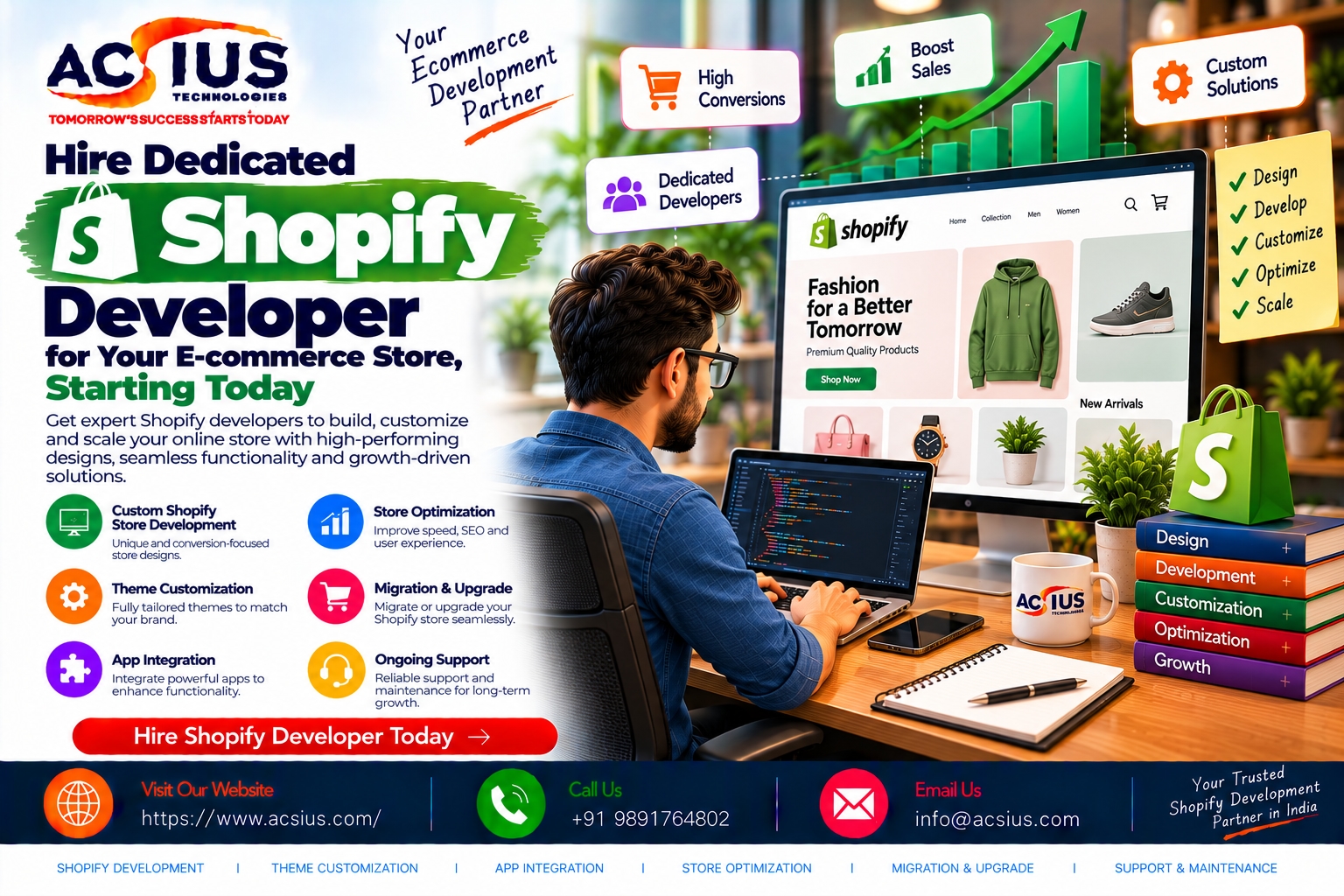
Businesses that want dependable results often hire professional shopify developers who work as an extension of their internal team. These specialists understand Liquid, Online Store 2.0, the Shopify APIs, and conversion-focused design. Because they stay with your project, they build deep knowledge of your products, customers, and workflows. The result is faster delivery, fewer errors, and a store that improves month after month instead of decaying between projects.
Core Services a Shopify Developer Delivers
Most store owners search for a handful of services again and again. Here are the ones that matter most.
Custom theme development. A custom theme gives your brand a unique identity and a layout built around how your customers actually shop, rather than a generic template shared with thousands of competitors.
Store setup and migration. Moving from WooCommerce, Magento, or BigCommerce requires careful handling of products, customer data, orders, and URLs. A skilled developer protects your SEO rankings throughout the move.
App integration and custom apps. From reviews and subscriptions to loyalty programs and inventory tools, apps extend what your store can do. Developers pick the right ones, avoid unnecessary bloat, and build custom apps when your workflow demands it.
Shopify Plus development. Larger merchants benefit from checkout customization, automation, multi-store management, and wholesale features that Plus unlocks.
Speed optimization. Faster pages mean better conversions and stronger search visibility. Developers compress images, trim unused scripts, and improve Core Web Vitals.
Maintenance and support. Ongoing bug fixes, security checks, and small updates keep your store stable during peak seasons.
When WordPress Strengthens Your E-commerce Strategy
Many successful online brands pair their Shopify store with a content-driven website. Blogs, buying guides, and resource pages bring in organic traffic that paid ads alone cannot match, and WordPress remains one of the best platforms for building that content engine. It offers flexible themes, a huge plugin library, and strong SEO capabilities.
If your growth plan includes publishing regularly, building a membership area, or running a separate corporate site, it makes sense to hire professional wordpress developers who can customize themes, build custom post types, harden security, and speed up page loads. They can also connect your WordPress site with your CRM, email platform, and Shopify store, so visitors who arrive through blog content move smoothly into your product pages and checkout. This combination of content and commerce is a proven way to lower customer acquisition costs over time.
Cloud Infrastructure for Growing Stores
As traffic and data volumes rise, some brands outgrow simple hosting setups for their supporting systems. Custom apps, inventory tools, analytics dashboards, and headless storefronts often need reliable cloud infrastructure behind them. Amazon Web Services is a popular choice because it scales on demand and offers a wide range of services for storage, computing, security, and automation.
Brands building custom backends or integrations often decide to hire aws developers India to design cloud architecture, set up serverless functions, automate deployments, and manage databases securely. Cost-effective, experienced cloud engineers can help you handle flash sales without downtime, process large order volumes, store media efficiently, and monitor system health around the clock. For merchants planning a headless commerce setup or a custom middleware layer between Shopify and other business systems, strong cloud expertise keeps everything fast and dependable.
Key Skills to Look for Before You Hire
Not every developer who lists Shopify on a profile can deliver top-tier results. Check for these abilities during evaluation.
Liquid and Shopify ecosystem knowledge. Fluency in Liquid, sections, metafields, and the Storefront and Admin APIs is essential.
Front-end strength. HTML, CSS, and JavaScript skills, combined with a mobile-first mindset, matter because most shoppers browse on phones.
Conversion awareness. The best developers think about product pages, cart behavior, trust signals, and checkout friction, not just whether a feature technically works.
SEO understanding. Clean URLs, structured data, fast load times, and correct redirects should be part of their standard practice.
Communication and ownership. Look for someone who explains clearly, documents their work, flags risks early, and takes responsibility for outcomes.
Dedicated Developer vs. Freelancer vs. In-House Team
Each hiring model has trade-offs, and the right choice depends on your size and budget.
Freelancers are flexible and often affordable for small tasks, but availability and accountability can be inconsistent. In-house teams provide control and cultural fit, yet salaries, benefits, and recruitment time make them expensive for many growing brands. A dedicated developer through a specialist partner combines the strengths of both: full-time focus on your store, without the overhead of direct employment. You can scale resources up before big sales events and scale down afterward, keeping costs predictable.
How Development Improves Conversions
Traffic is expensive, so getting more from every visitor is one of the smartest investments you can make. A dedicated developer can improve conversions in several ways:
Simplifying navigation and adding predictive search for large catalogs
Building product pages with clear images, reviews, size guides, and trust badges
Adding slide-out carts, upsells, and cross-sells to raise average order value
Streamlining checkout with express payment options and fewer form fields
Setting up abandoned cart and back-in-stock flows
Running A/B tests on layouts and calls to action
Even small technical changes can produce noticeable gains. Cutting a second from load time or removing one checkout step often lifts revenue without any additional ad spend.
Steps to Hire the Right Developer Today
Starting is simpler than most store owners expect. Follow this process to move quickly without sacrificing quality.
Define your goals. Decide whether you need a redesign, migration, new features, speed work, or ongoing support.
Set your budget and timeline. Know your range and be cautious of rates that seem too good to be true.
Review portfolios. Visit live stores the developer has built and test them on mobile, checking speed and checkout flow.
Check references and case studies. Measurable results are stronger evidence than sales pitches.
Start with a trial. A short paid project reveals communication style and code quality before a long-term commitment.
Agree on reporting. Set expectations for updates, tools, and documentation.
Protect your assets. Confirm that you own all code, theme files, and store access.
What It Costs and What You Gain
Pricing varies with experience, location, and engagement model. Dedicated models usually charge a predictable monthly rate for full-time availability, which often costs less than building a local team while delivering far more consistency than hiring ad hoc. Instead of comparing hourly rates alone, consider how quickly work gets done, how much rework is avoided, and how much revenue improves. A skilled developer typically pays for themselves through better conversion rates and fewer costly mistakes.
Final Thoughts
Your e-commerce store deserves more than occasional fixes. Speed, usability, security, and steady improvement all depend on skilled people who understand your business and stay focused on it. Whether you need a custom theme, a smooth migration, content support through WordPress, or scalable cloud infrastructure on AWS, the right team turns technology into a growth advantage.
If you are ready to move forward, ACSIUS can connect you with experienced developers who work as a dedicated part of your team. From Shopify builds and optimization to WordPress, cloud, and ongoing support, ACSIUS helps e-commerce brands launch faster, convert better, and scale with confidence. Contact ACSIUS today and start building the store your customers expect.