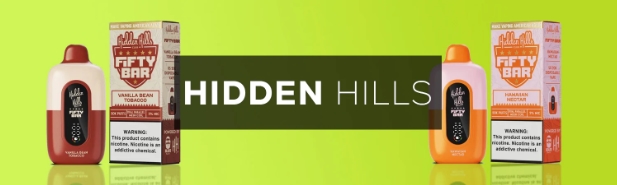
The Hidden Hills cart category includes cartridge and disposable formats that differ in hardware, capacity, extract type, and flavor selection. Current listings associated with Hidden Hills include 2G cartridge formats as well as disposable products developed in collaboration with Fifty Bar.
Understanding the construction of Hidden Hills cart makes it easier to distinguish between cartridge-based hardware and ready-to-use disposable designs. The main differences involve connection type, coil construction, battery arrangement, extract format, and flavor profile.
What Is a Hidden Hills Cart?
A Hidden Hills cart generally refers to a cartridge-format vape product designed to connect to a compatible battery. Current third-party product documentation describes Hidden Hills 2G cartridges using a standard 510-thread connection, meaning the cartridge itself requires a separate compatible battery. Ceramic coil construction and polycarbonate tank materials are also reported for the current cartridge formats.
This makes a cartridge different from an all-in-one disposable. With a cartridge, the battery and cartridge are separate components, while a disposable integrates its power source and vaporization hardware into one device.
Cartridge and Disposable Formats
There are several formats associated with the Hidden Hills name, so the term does not describe just one piece of hardware.
2G Cartridge Format
The 2G cartridge format uses a 510-thread connection and a separate battery. Available product information identifies ceramic coils and polycarbonate tanks as part of the construction.
The replaceable-battery arrangement gives this format a different hardware configuration from a disposable. Users can also encounter different extract formulations across cartridge variants, making the oil or concentrate type another important specification to compare.
Disposable Format
The Hidden Hills collection currently lists Hidden Hills x Fifty Bar Disposable 20K products, including Vanilla Bean Tobacco and Tobacco variants.
Unlike a standalone cartridge, this type of device combines the reservoir, coil, battery, and outer housing in one unit. The Fifty Bar collaboration therefore represents a higher-capacity disposable format rather than a traditional 510 cartridge.
Extract Types and Formulations
One of the key differences between Hidden Hills cartridge products is the type of formulation used inside the cartridge. Current product information identifies both Live Resin and VVS Liquid Diamond cartridge formats.
The Live Resin format is described as using a live-resin base, while the VVS Liquid Diamond format uses a liquid-diamond formulation. These differences can affect the composition, texture, flavor character, and overall hardware requirements of the cartridge.
For anyone comparing a Hidden Hills cart, checking the formulation is therefore just as important as checking the listed capacity.
Flavor Profiles to Know
Flavor selection is another major point of variation. Current Hidden Hills cartridge listings include profiles such as Cherry Splash, Limeade Palmer, Mojito Melon, Snapple Pop, Straw Candyland, Green Dream OG, Whipped Orange, Keylime Zest, Sugar Monster, Peach Bombay, Pinkonade Razzberry, and Cantaloupe Slushy.
These names cover several broad flavor categories:
Fruit: Cherry Splash, Peach Bombay, Cantaloupe Slushy
Citrus: Limeade Palmer, Keylime Zest, Whipped Orange
Tropical: Mojito Melon
Candy-inspired: Snapple Pop and Straw Candyland
Berry-forward: Pinkonade Razzberry
Dessert-oriented: Sugar Monster
Tobacco: Vanilla Bean Tobacco and Tobacco formats in the disposable range
This range shows how the same product family can cover very different flavor directions rather than relying on a single profile.
Hardware Features and Construction
The hardware specification is one of the clearest ways to compare different Hidden Hills cart formats.
A 510 cartridge uses a threaded base that attaches directly to a compatible battery. Ceramic coils are used in the documented 2G cartridge formats, while the tank holds the formulated material separately from the battery.
Disposable versions have a more integrated construction. The battery, reservoir, airflow path, coil, and mouthpiece are contained within the device body. The Hidden Hills x Fifty Bar disposable listed by the retailer is identified as a 20K model, placing it in a substantially different capacity category from a 2G cartridge.
This distinction is useful when comparing specifications because cartridge capacity and disposable puff ratings measure different aspects of a product.
510 Threading and Battery Compatibility
For cartridge users, threading is an important specification. A standard 510-thread cartridge is designed to attach to a compatible 510 battery rather than operating independently.
Battery compatibility can involve more than simply matching the thread. Battery design, output controls, activation method, and physical fit can all vary between devices. As a result, the cartridge specification should be checked alongside the battery specifications before treating two cartridge systems as interchangeable.
This is one of the biggest hardware differences between a Hidden Hills cart and an integrated disposable device.
Comparing Cartridge and Disposable Designs
Feature | Cartridge Format | Disposable Format |
Battery | Separate | Integrated |
Connection | 510 thread | Built into device |
Coil | Ceramic reported in 2G formats | Integrated coil system |
Capacity style | Measured by cartridge contents | Often listed by puff rating |
Replaceability | Cartridge can be separated from battery | Integrated unit |
Hardware style | Modular | All-in-one |
Current examples | 2G Live Resin/VVS formats | Hidden Hills x Fifty Bar 20K |
The comparison demonstrates why product descriptions should be read by specification rather than by product name alone. Two products carrying the Hidden Hills name can have substantially different hardware architectures.
What to Check When Comparing Models
When evaluating a Hidden Hills cart, several specifications provide useful points of comparison. Start with the format and capacity, then check the connection type, coil construction, formulation, and flavor.
For cartridges, the 510 connection and battery compatibility are particularly important. For disposable devices, the listed puff rating, integrated battery configuration, charging design if applicable, and hardware construction provide more relevant points of comparison.
Flavor should also be considered separately from hardware. A fruit-forward cartridge and a tobacco-oriented disposable may have completely different flavor profiles even when they belong to the same broader product family.
Conclusion
The Hidden Hills cart category covers more than one hardware configuration, ranging from 2G 510-thread cartridges to integrated disposable formats such as the Hidden Hills x Fifty Bar 20K. The most useful distinctions involve cartridge connection, coil construction, formulation, capacity, battery configuration, and flavor profile. For readers comparing available models, Zmarksthespot listings can provide another reference point for checking the currently listed Hidden Hills formats and specifications. The key is to compare the actual hardware and formulation details rather than assuming every product in the category uses the same design.