
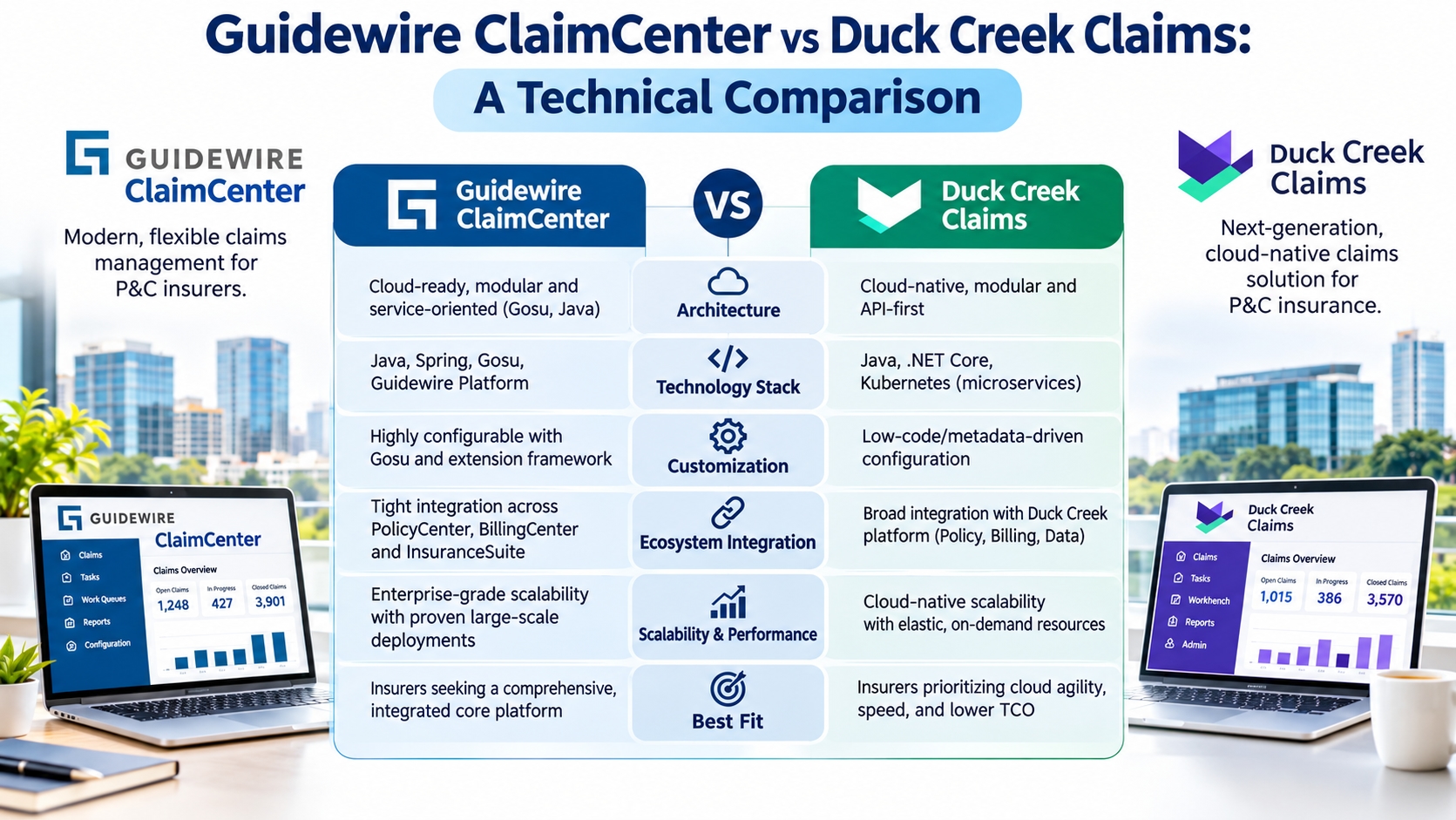
The Property and Casualty (P&C) insurance technology ecosystem relies heavily on core enterprise claim management platforms to automate first notice of loss (FNOL), reserve management, subrogation, and financial settlement workflows. Modernizing legacy insurance claim systems requires evaluating enterprise platforms capable of handling multi-line claims with high performance. Two platforms dominate this landscape: Guidewire ClaimCenter and Duck Creek Claims. While both systems target global Tier-1 and Tier-2 insurance carriers, their underlying software architectures, rule execution engines, and integration paradigms differ fundamentally. Choosing between them requires a deep technical understanding of data models, extensibility frameworks, continuous deployment mechanics, and long-term operating costs.
Engineering leaders, solution architects, and software developers evaluating these platforms must balance immediate customization capabilities with future upgradeability. Guidewire ClaimCenter offers a deeply configurable Object-Oriented paradigm using Gosu on Java Virtual Machine (JVM) infrastructure, whereas Duck Creek Claims emphasizes cloud-native microservices, configuration tooling, and API-first designs. Understanding how these choices impact end-to-end processing efficiency, developer velocity, and platform security is essential for enterprise transformation programs. For tech professionals seeking structured skill development in enterprise insurance platforms, enrolling in specialized Guidewire training in Hyderabad offers hands-on technical exposure to real-world deployment scenarios, data modeling, and enterprise integration patterns.
Architectural Core and System Infrastructure
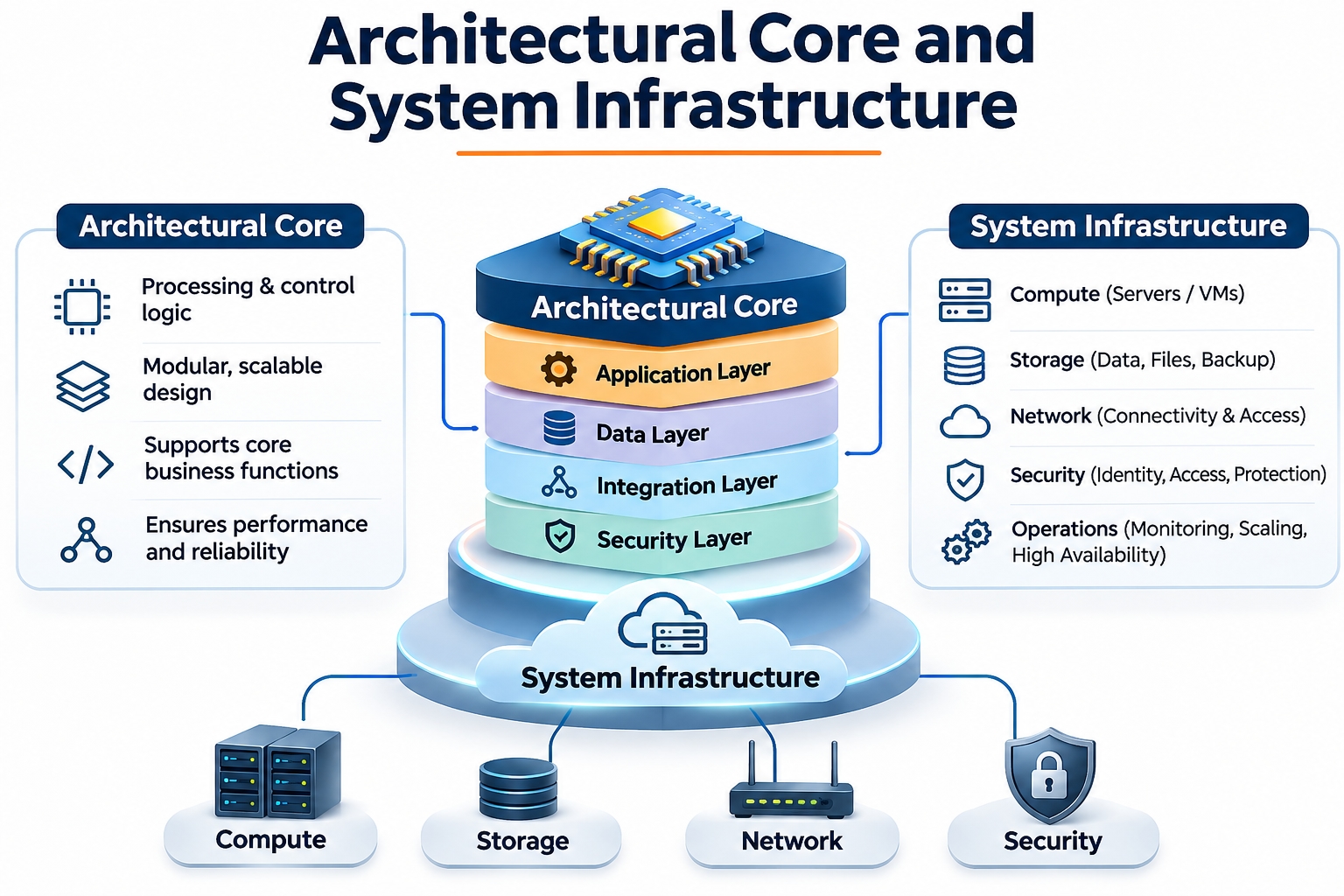
Guidewire ClaimCenter operates on an enterprise application architecture built around the Java ecosystem. The engine utilizes Gosu, an object-oriented, strongly typed programming language compiled down to JVM bytecode, granting developers direct access to native Java libraries, custom classes, and object relational mapping tools. ClaimCenter's architectural layout uses explicit data entities, typecodes, and display keys organized into structured metadata packages. Database persistence is managed via custom object-relational mapping (ORM) mechanisms, allowing high-throughput transaction handling for millions of claim records across complex multi-line P&C books of business. The framework provides operational flexibility through hybrid cloud and managed cloud (Guidewire Cloud Platform / GWCP) environments using containerized Kubernetes clusters.
Duck Creek Claims, in contrast, utilizes a cloud-native, microservices-driven framework optimized for public cloud deployments such as Microsoft Azure and Oracle Cloud Infrastructure (OCI). Its core architecture uses XML-based configuration files, JSON payloads, and continuous delivery deployment pipelines via the Duck Creek Active Delivery model. Rather than compiling custom programming code into JVM bytecode, Duck Creek decouples logic using proprietary configuration tools like Duck Creek Author alongside serverless computing layers and event-driven microservices. This structural design enables independent horizontal scaling of distinct business functions—such as claim intake, policy validation, and payment processing—reducing system contention during high-volume loss events like natural disasters.
Rule Engines, Logic Execution, and Customization
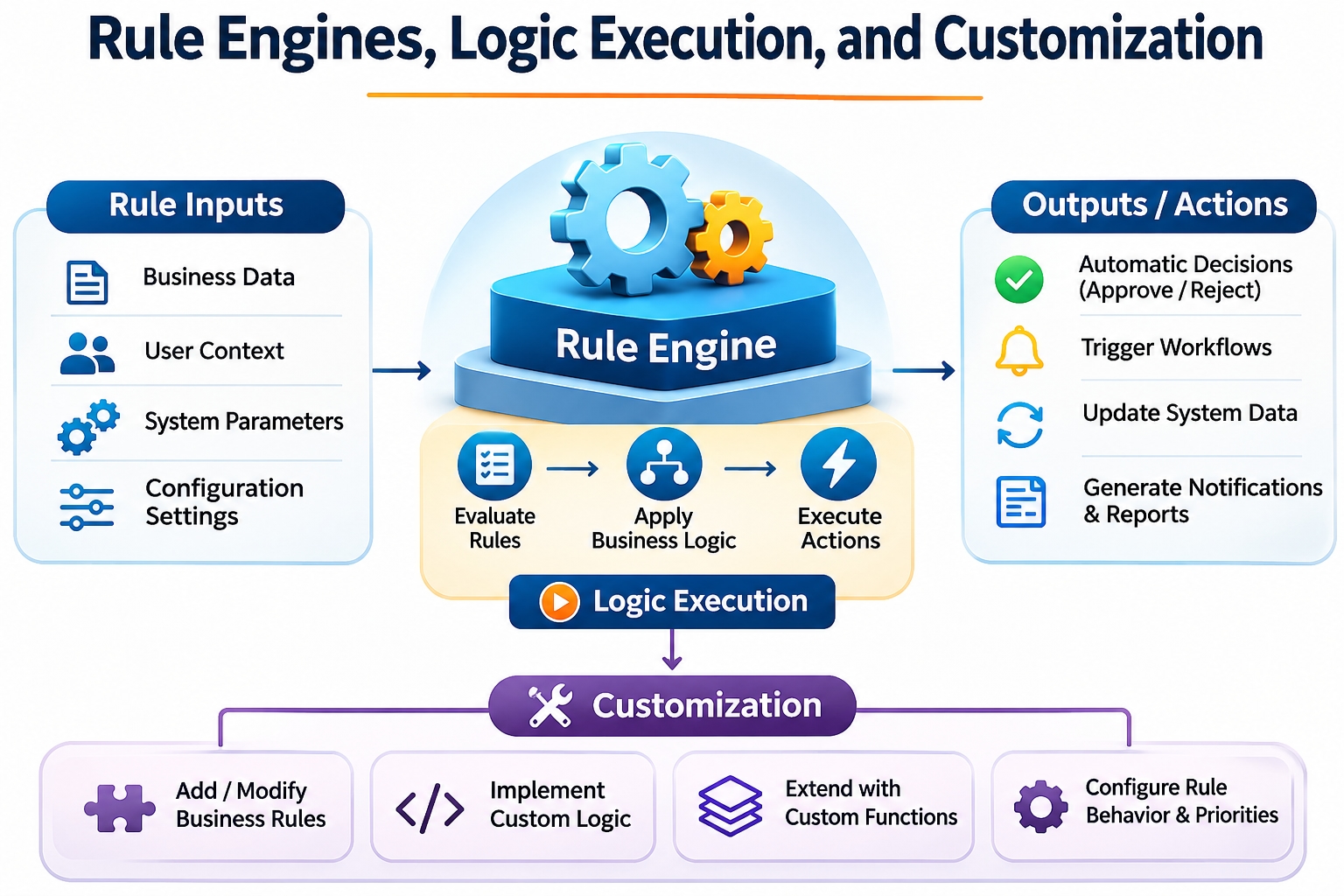
Business logic execution in Guidewire ClaimCenter centers around Gosu-based rule sets, rule trees, and custom plugin implementations. Claim routing, reserve validation, assignment logic, and financial thresholds are programmed directly into version-controlled Gosu scripts. System developers define entity extensions (.etx files) to add custom fields to core objects like Claim, Exposure, and Transaction without altering base schema definitions. This code-first customization approach yields robust compiler-checked type safety and high runtime efficiency, though it demands experienced software engineers who understand relational object structures and JVM memory profiles.
Duck Creek Claims processes business rules through a low-code metadata configuration layer managed via Duck Creek Author. Rules are defined through visual logic trees, mathematical variables, and declarative decision tables rather than imperative code compilation. This allows business analysts and functional configurators to adjust claim handling parameters, payment limits, and workflow triggers without requiring deep software engineering builds. For engineers pursuing specialized roles in insurance technology, mastering these configuration patterns through Guidewire ClaimCenter training builds deep competency in configuring complex rules, managing loss reserves, and extending underlying data models.
Integration Capabilities and Event-Driven Processing
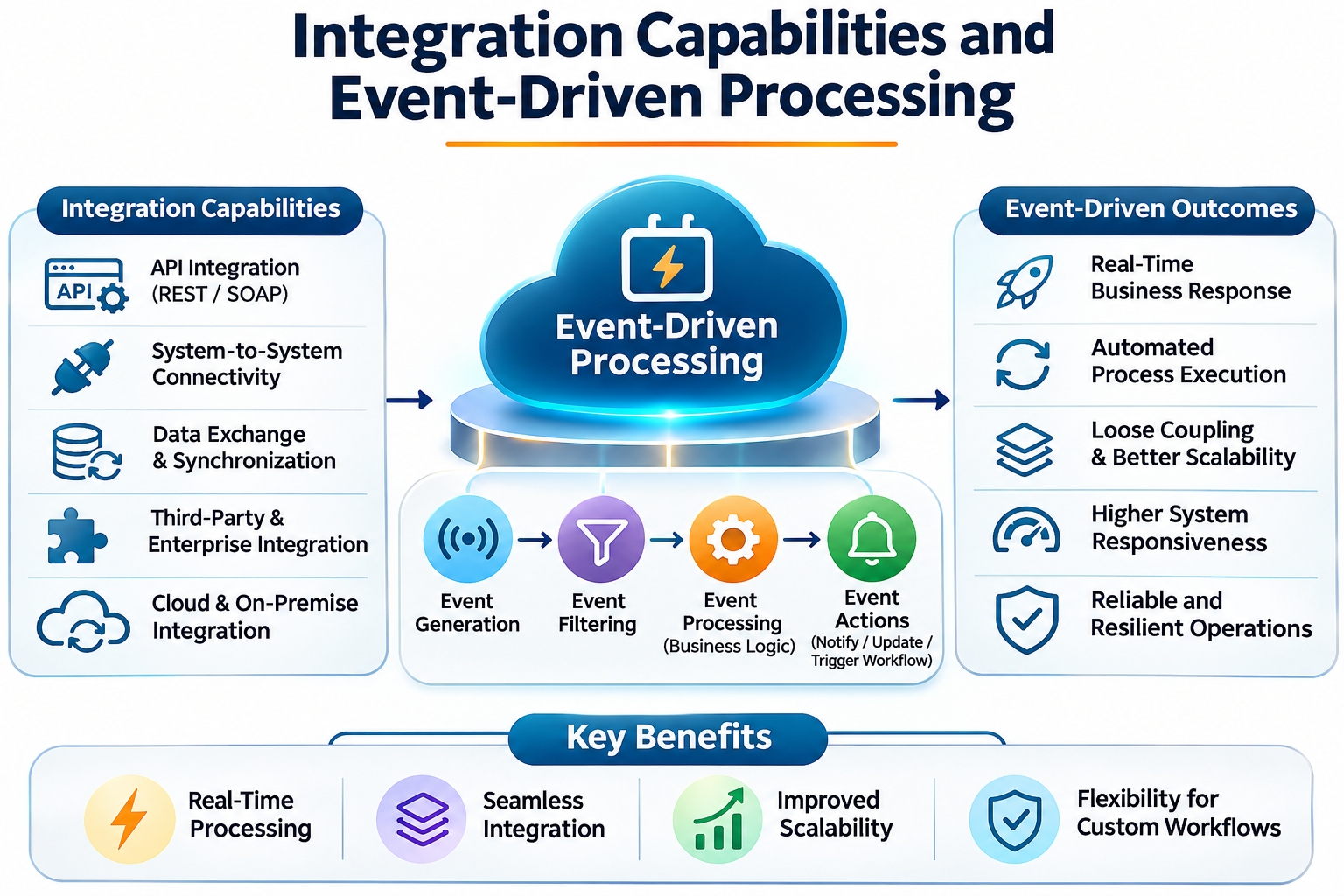
Integrating Guidewire ClaimCenter into external core systems—such as policy administration suites, general ledgers, fraud detection engines, and third-party administrators (TPAs)—is accomplished via REST Web Services, SOAP APIs, and specialized integration plugins. Guidewire's Integration Framework uses messaging infrastructure to handle asynchronous event processing. Developers configure message destinations, event triggers, and transport plugins using Gosu to stream real-time operational state changes. The platform also integrates with Apache Kafka and enterprise service buses (ESB), providing stable, high-reliability event publishing for downstream analytics engines.
Duck Creek Claims leverages an API-first design pattern natively exposed through OpenAPI/Swagger specifications and cloud API gateways. Integration endpoints rely on light JSON data transfers over HTTP/REST protocols, simplifying connections to modern InsurTech APIs like automated damage estimation services, telematics inputs, and AI-based image processing tools. Duck Creek's event-driven pipeline uses cloud-native messaging services like Azure Event Hubs and Kafka to stream claim events asynchronously. Discovering Guidewire career opportunities for software professionals in Hyderabad highlights how mastery over these enterprise integrations drives high market demand across key technology hubs.
Scalability, Performance, and Operational SLAs
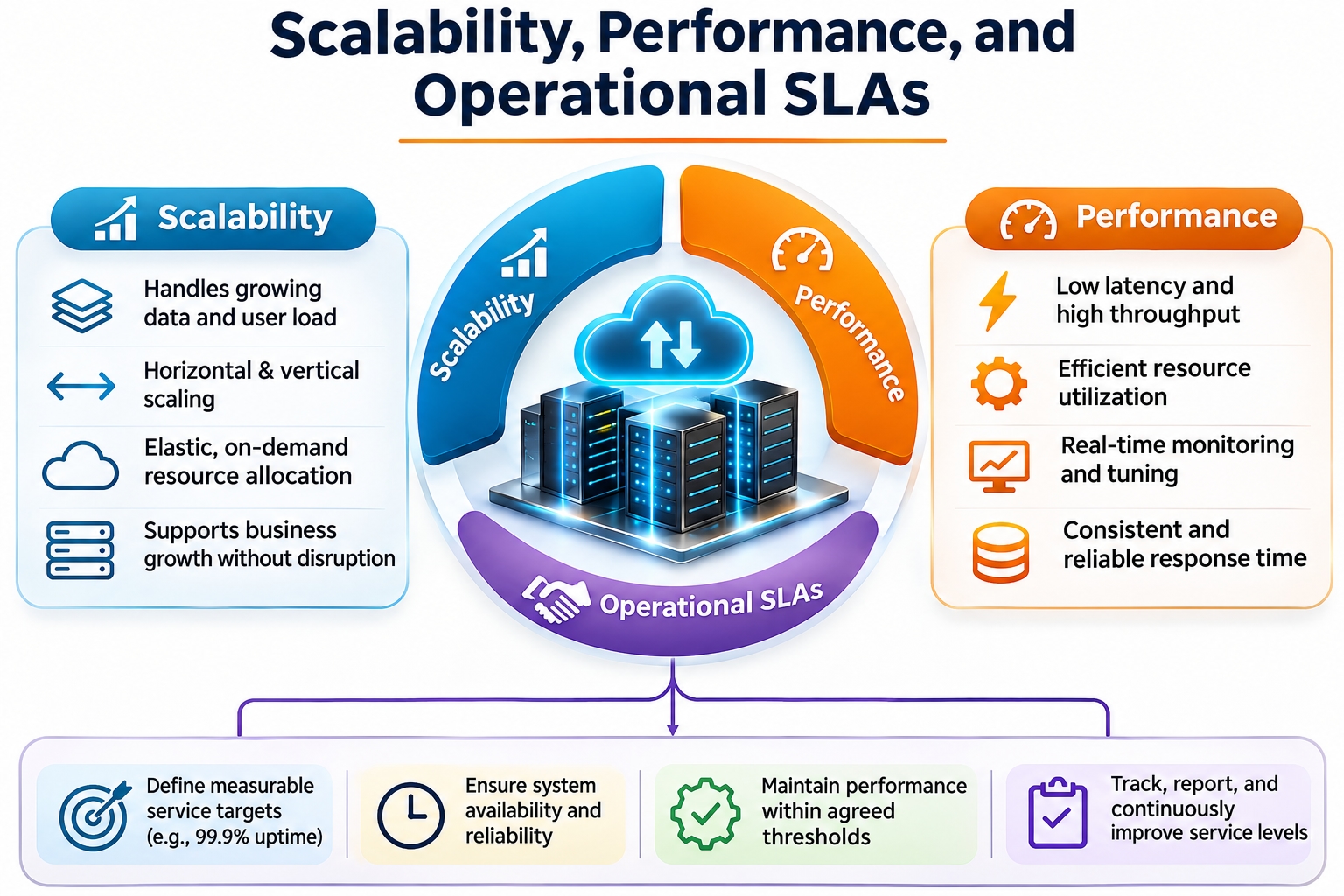
Guidewire ClaimCenter is engineered to support massive enterprise transaction volumes, carrying proven production track records across global top-tier insurance carriers. It handles billions of claim history records, concurrent user interactions, and complex batch processing runs such as automated reserve revaluations and statutory reporting extractions. Operational performance is maintained by optimizing JVM memory allocations, database indexing configurations, and object caching mechanisms. Under managed cloud offerings (GWCP), Guidewire guarantees up to 99.9% uptime Service Level Agreements (SLAs), supported by automated disaster recovery failovers and continuous monitoring.
Duck Creek Claims leverages cloud elasticity to dynamically scale containerized microservices up or down based on workload demand. During surge events—such as localized hail storms or hurricanes—FNOL microservices scale independently without requiring full core application re-indexing or complete platform scaling. Duck Creek OnDemand delivery models maintain 99.9% availability SLAs backed by public cloud infrastructure capabilities. Its microservice partitioning isolates background batch reporting operations from interactive user sessions, mitigating UI latency spikes for call-center adjusters during peak transaction periods.
Deployment Models, Upgrades, and DevOps
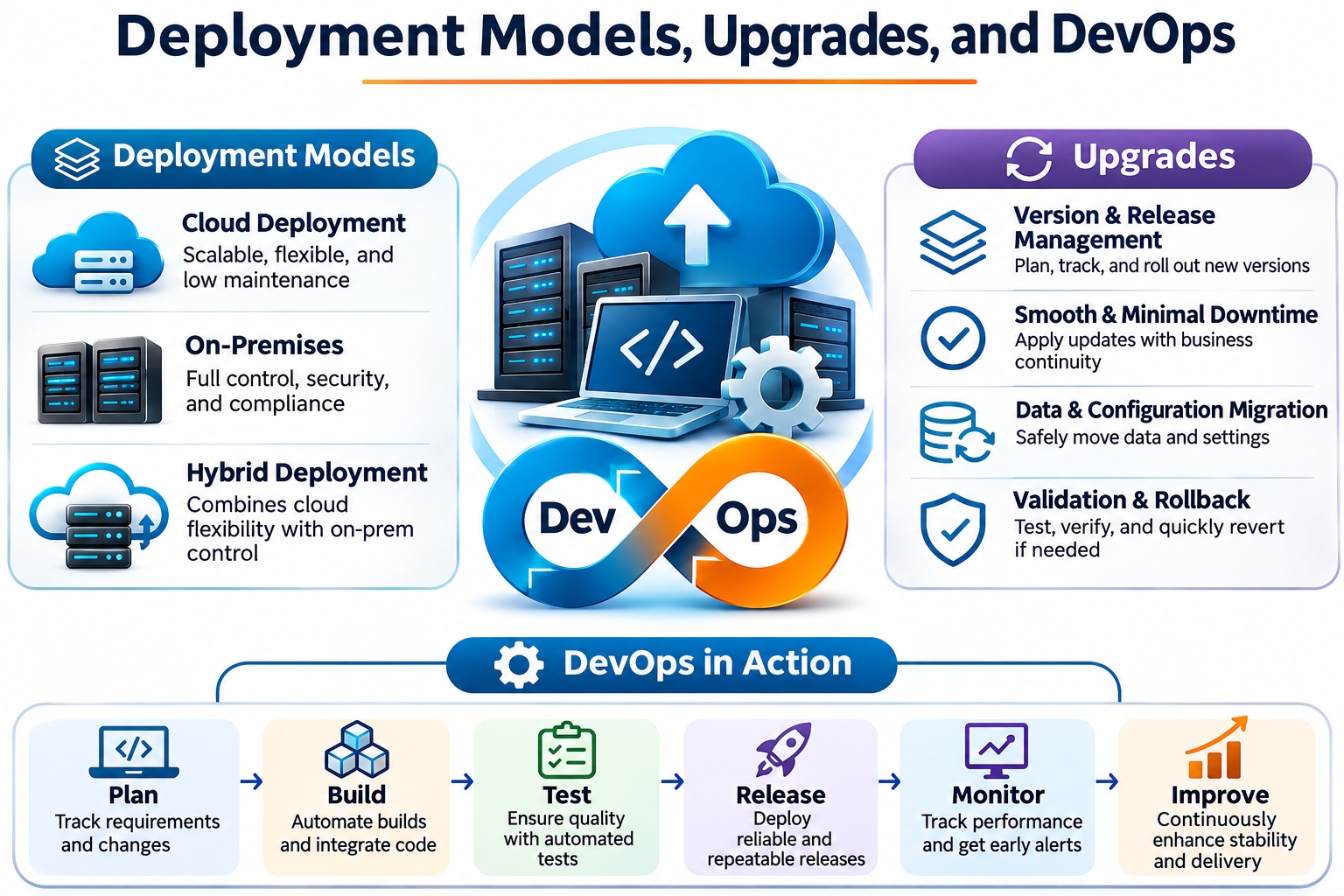
Upgrading legacy versions of Guidewire ClaimCenter historically required extensive technical refactoring of custom Gosu code and data schema migrations. Modern Guidewire Cloud deployments utilize Cloud Integration Frameworks and standardized REST APIs to decouple core business logic from platform updates. Guidewire's cloud update model delivers biannual release updates, requiring automated deployment pipelines, CI/CD integration testing, and Gosu compilation checks. Development teams utilize Git repositories, Jenkins or Azure DevOps pipelines, and Docker containers to manage environments across sandbox, staging, and production tiers.
Duck Creek Claims utilizes the Active Delivery update framework, engineered to push product updates and security patches continuously without disruptive multi-year re-implementation projects. Because Duck Creek relies primarily on XML/JSON configuration layers rather than compiled code modifications, platform engine updates can be applied while maintaining existing business configurations. CI/CD pipelines in Duck Creek environments validate configuration packages through automated unit testing frameworks, deploying updates quickly across cloud tenants with minimal scheduled system downtime.
Developer Skill Sets, Ecosystem, and Career Prospects
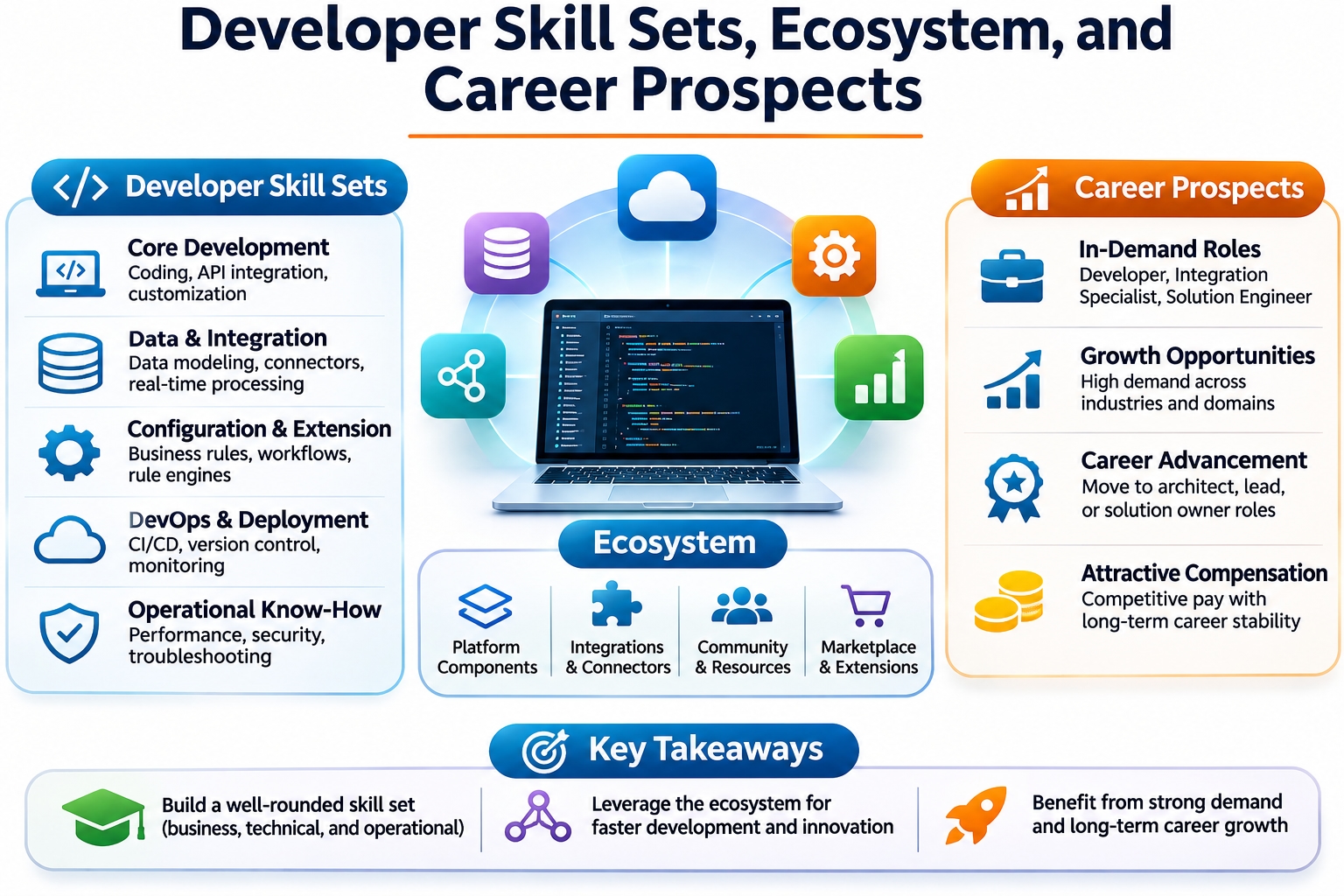
Building software within Guidewire ClaimCenter requires strong expertise in Core Java, Object-Oriented Programming (OOP), SQL, relational data structures, and Gosu language mechanics. Developers must understand ClaimCenter-specific object hierarchies, such as claim history logging, exposure creation, reserve calculation patterns, and financial transaction lifecycles. Because Guidewire holds a major share of the global tier-1 P&C market, software engineers proficient in Gosu and Guidewire configuration/integration skills command high demand across enterprise IT consulting firms and global delivery centers. Exploring industry trends across tech centers reveals competitive compensation ranges, active project roles, and global implementation standards.
Developing within Duck Creek Claims emphasizes working knowledge of XML, JSON, JavaScript, Node.js, React, and Duck Creek Author configuration tooling. Systems integrators working on Duck Creek projects focus on API gateway configurations, low-code rule logic modeling, and cloud-native serverless deployments. While Duck Creek offers an accessible learning curve for functional analysts due to its low-code interface tools, developers transitioning into the platform benefit from familiarity with Azure cloud services, RESTful API design, and web technology stacks.
Conclusion
Both Guidewire ClaimCenter and Duck Creek Claims represent robust, market-leading solutions for modernizing Property and Casualty insurance operations. Insurers prioritizing deep architectural flexibility, extensive custom rule modeling, and proven Tier-1 scale frequently select Guidewire ClaimCenter for its robust code-driven platform. Conversely, carriers seeking rapid low-code deployments, cloud-native microservice independence, and API-first integrations often lean toward Duck Creek Claims. For software engineering teams and IT leaders, aligning platform selection with existing technical skill sets, long-term operational costs, and strategic enterprise architecture goals ensures a successful core system transformation.



