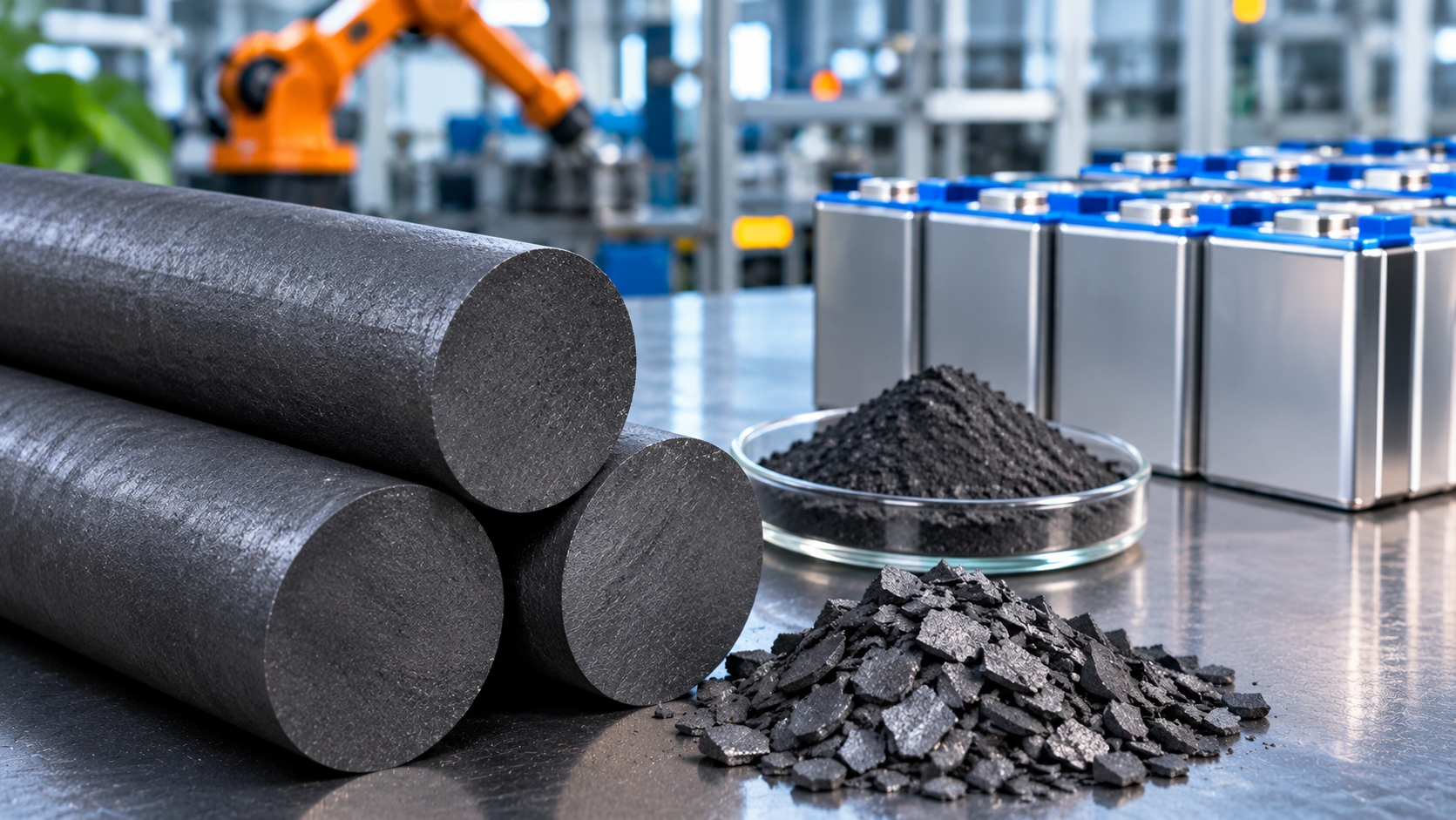
Battery manufacturers watching input costs this month have a clear reference point. The graphite anode price trend for October 2026 puts China at USD 5,119.26 per metric ton on an FOB basis. India’s CIF rate comes in at USD 5,244.96 per metric ton. A gap of roughly USD 125.70.
Not a massive swing. But graphite anode isn’t a commodity where small shifts stay small for long. It sits at the center of lithium-ion battery production, and battery demand right now isn’t exactly slowing down.
What The Numbers Actually Say
Product | Region | Incoterm Basis | Price | Month |
|---|---|---|---|---|
Graphite Anode | China | FOB | USD 5,119.26/MT | October 2026 |
Graphite Anode | India | CIF | USD 5,244.96/MT | October 2026 |
China’s rate is quoted FOB, meaning the price covers the product loaded onto the vessel at the origin port. Buyers take on freight and insurance from there.
India’s figure already has freight and insurance folded in, since it’s CIF. That alone explains part of the spread. It’s not purely a production cost difference. It’s partly a paperwork difference dressed up as a price difference.
Three things worth remembering before drawing conclusions from this table:
FOB and CIF aren’t directly comparable without adjustment.
These are October 2026 figures only, not a running average.
Graphite anode pricing has shown real volatility over the past few quarters, so a snapshot ages fast.
Why China’s Price Sits Where It Does
China still dominates global graphite anode production. Most of the world’s synthetic and natural graphite processing capacity runs through Chinese facilities, and that scale keeps costs more contained than almost anywhere else.
Energy costs for graphitization matter a lot here too. The process is electricity-heavy, and China’s industrial power pricing plays a direct role in how competitive its FOB quotes stay against the rest of the world.
Export policy has also been a factor worth watching. China has tightened controls on graphite exports in recent years, citing strategic material concerns. Buyers outside China have felt that tightening show up as supply uncertainty, even when headline prices stay relatively flat.
Why India’s Price Runs Higher
India isn’t yet self-sufficient in graphite anode production at the scale its battery and EV sector needs. A meaningful portion still comes from imports, and that dependency shows up directly in the CIF number.
Shipping distance plays a role too. Depending on origin, freight costs into Indian ports can add a noticeable premium compared to intra-Asia trade routes.
There’s a policy angle worth mentioning here. India has been pushing incentives for domestic battery material production under schemes tied to its broader EV manufacturing push. Whether that narrows the price gap with China over the next few years is still an open question, not a settled one.
What’s Actually Driving Price Movement
A handful of forces tend to show up whenever graphite anode prices shift.
Raw material availability matters first. Natural graphite flake supply and synthetic graphite feedstock (petroleum coke, mainly) both affect production cost upstream.
Energy pricing comes next. Graphitization furnaces run for days at high temperatures. When electricity costs rise, producers don’t absorb that quietly.
Battery demand plays its part too. EV production targets across multiple countries keep pulling anode material demand upward, and anode demand doesn’t ease off just because a quarter was slow.
Trade policy rounds it out. Export restrictions, tariffs, or incentive programs can move prices faster than production economics alone would suggest.
Reading This For Procurement Decisions
Anyone sourcing graphite anode material right now should treat October 2026 figures as a working reference, not a locked-in number.
If you’re comparing supplier quotes against these rates, check the incoterm basis first. A quote that looks cheaper than USD 5,119.26 might actually be more expensive once freight and insurance get added to match an equivalent CIF basis.
Battery manufacturers forecasting cell costs for next year should also factor in China’s export policy stance. A tightening move there tends to ripple through pricing globally within a quarter or two, not instantly, but fast enough to matter for annual contracts.
Investors looking at battery material supply chains might find India’s import dependency more interesting than the price gap itself. Capacity expansion there is still early stage. That typically means more price movement ahead, not less.
Where This Heads Next
Nobody can say with certainty where graphite anode prices land by year end. What seems reasonable to expect is that the China-India spread holds roughly in this range unless something structural changes, either a major capacity addition in India or a fresh export policy shift from China.
Battery demand isn’t the variable in question here. That keeps climbing. The real uncertainty sits on the supply side, in how fast alternative sourcing develops outside China’s current dominance.
Final Word
The graphite anode price trend for October 2026 shows China at USD 5,119.26/MT FOB against India’s USD 5,244.96/MT CIF. The gap reflects incoterm structure, import dependency, and underlying production economics, not random market noise. For battery manufacturers and procurement teams, this is a figure worth checking regularly rather than filing away and forgetting.
FAQ Section
What is the graphite anode price trend for October 2026?
China’s rate stands at USD 5,119.26/MT on an FOB basis, while India’s comes in at USD 5,244.96/MT CIF for October 2026. The difference partly reflects incoterm structure and partly India’s reliance on imported material for its battery sector.
Why is graphite anode more expensive in India than China?
India imports a significant share of its graphite anode supply, and the CIF price already includes freight and insurance costs that China’s FOB figure doesn’t carry. Domestic production capacity in India is still developing, which adds to the landed cost buyers see.
What factors influence graphite anode prices the most?
Energy costs for graphitization, raw material availability, battery sector demand, and trade policy all play a role. China’s export controls on graphite have added supply uncertainty in recent years, which can move prices even when production costs stay steady.
How reliable is a single monthly price snapshot like this one?
Useful as a benchmark, not as a forecast. Graphite anode pricing has shifted meaningfully over recent quarters, so October 2026 figures should be checked against current supplier quotes before locking in any procurement contract.
What’s the outlook for graphite anode prices going forward?
The China-India gap likely holds near its current range unless India adds significant domestic capacity or China shifts export policy again. Battery demand keeps rising steadily, so supply-side developments, not demand, will probably drive the next real price movement.