Industrial air pollution control is rarely solved by one piece of equipment working independently. A manufacturing process may generate dust, fumes, chemical vapors, heat, moisture, odors, or a combination of several contaminants at the same time. Trying to control all of these conditions with a single filtration technology can lead to poor airflow, higher operating costs, maintenance problems, or inadequate contaminant capture.
A better approach is to understand the complete air path.
Contaminated air needs to be captured close to its source, transported through properly designed ductwork, treated using the appropriate technology, and finally exhausted or recirculated according to the process requirement. In this arrangement, a Wet Scrubber can become an important treatment stage, while equipment such as an Air washer system, Fume extraction system, Axial flow fan, Centrifugal Blowers, and a Dust collection system may perform different supporting functions.
GPT-INDIA develops industrial air pollution control and ventilation solutions around this system-level approach, with equipment selection based on the nature of the process and the contaminants being handled.
Why Industrial Air Treatment Requires More Than Filtration
Different contaminants behave differently in an industrial airflow.
Dry dust particles can often be handled using mechanical separation, cyclone systems, fabric filtration, or other particulate collection technologies. Chemical fumes and soluble gases may require absorption or scrubbing. Certain vapors may need adsorption-based treatment. Heat and humidity can require conditioning before air is supplied back into a working area.
This difference is important because equipment that works well for one contaminant may not be suitable for another.
For example, a dust collector is primarily concerned with particulate capture, while a scrubber uses contact between the contaminated gas stream and a liquid to capture suitable pollutants. An air washer can condition air through water contact, but its exact role depends on the system configuration and process objective.
The first step in designing an effective system is therefore to understand what is actually present in the air.
What Is a Wet Scrubber?
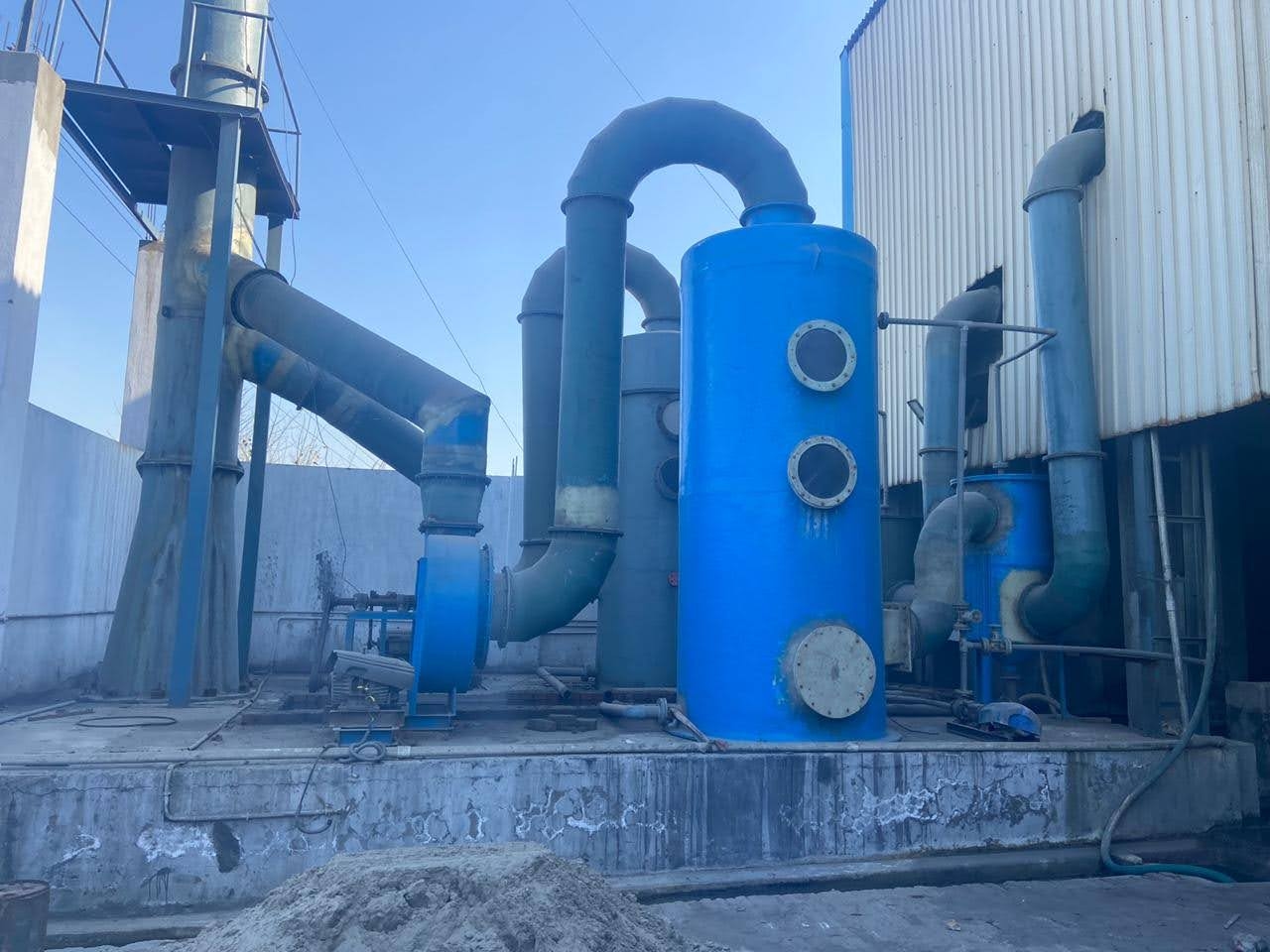
A Wet Scrubber is an air pollution control device in which contaminated gas comes into contact with a liquid medium. Depending on the design and pollutant characteristics, the liquid can assist in capturing particulate matter, soluble gases, fumes, odors, or other contaminants.
The contaminated air enters the scrubber and passes through a controlled gas-liquid contact zone. Pollutants are transferred from the gas stream into the liquid phase through mechanisms that may include impaction, absorption, interception, or related collection processes.
The treated gas then passes toward the outlet, while the contaminated liquid is collected for appropriate handling.
The actual performance of a scrubber depends on the pollutant, gas flow, liquid characteristics, contact arrangement, pressure drop, temperature, and system design. There is no universal scrubber configuration that is equally suitable for every industrial process.
When Should a Wet Scrubber Be Considered?
Wet scrubbing becomes particularly relevant when an industrial process generates contaminants that can be captured or neutralized through liquid contact.
Chemical processing, surface treatment, metal processing, manufacturing operations, combustion-related applications, and processes involving soluble gases or fumes may require wet treatment.
The correct design depends on what the process is releasing.
A system intended for particulate collection may have different internal arrangements from one designed primarily for gas absorption. In more demanding applications, multiple treatment stages may be considered to address different pollutant characteristics.
This is why equipment selection should begin with process data rather than simply choosing a scrubber based on airflow capacity.
The Role of an Air Washer System
An Air washer system uses controlled contact between air and water as part of air conditioning, cooling, humidification, or air treatment.
Although the terms air washer and wet scrubber are sometimes used interchangeably in informal discussions, their intended applications can be different.
An industrial air washer may be used to condition incoming or circulating air, particularly where evaporative cooling and humidity control are relevant. A pollution-control scrubber, by comparison, is designed around the removal or treatment of specific contaminants from an exhaust stream.
Understanding this distinction helps prevent incorrect equipment selection.
In an industrial facility, air washing and pollution control may even form separate but complementary parts of the overall ventilation strategy.
Why Source Capture Comes Before Treatment
One of the most common mistakes in industrial ventilation is focusing heavily on the treatment equipment while giving insufficient attention to the point where contamination enters the air.
If fumes or dust are allowed to spread throughout a large workspace before extraction begins, the ventilation system has to move and treat a much larger volume of contaminated air.
A properly designed Fume extraction system attempts to capture contaminants near their generation point. This can reduce contaminant migration and make the downstream treatment system more manageable.
Hood position, capture velocity, enclosure design, duct routing, pressure losses, and fan capacity all influence the effectiveness of source extraction.
The basic principle is simple: capture the contaminant before it becomes a room-wide problem.
Connecting Fume Extraction With Wet Scrubbing
In applications where fumes contain contaminants suitable for wet treatment, source extraction can be connected to a scrubber through a carefully designed duct system.
The extraction hood captures the contaminated air. Ductwork transports it to the treatment equipment. The scrubber then provides the required gas-liquid contact before the treated stream moves toward the discharge system.
Every part of this chain matters.
If the hood does not capture effectively, the scrubber cannot compensate for contamination that never reaches it. If the ductwork is incorrectly sized, the required airflow may not be achieved. If the fan cannot overcome system resistance, extraction performance can decline.
The complete system therefore needs to be considered as one airflow network.
Choosing Between an Axial Flow Fan and Centrifugal Blowers
Fans are not simply air-moving accessories. They determine whether the required airflow can actually be maintained through the entire system.
An Axial flow fan generally moves air in a direction broadly parallel to the fan shaft and can be appropriate for applications where the required airflow and pressure characteristics suit axial operation.
Centrifugal Blowers operate differently, using a rotating impeller to move air radially and develop the pressure needed for many industrial extraction and ventilation arrangements.
The choice depends on the system's airflow requirement, static pressure, duct resistance, treatment equipment, temperature, installation arrangement, and operating conditions.
A fan should therefore not be selected only by looking at airflow volume.
For a system containing hoods, long duct runs, bends, dampers, filters, scrubbers, mist eliminators, or other components, pressure loss becomes an important part of the engineering calculation.
How Dust Collection Fits Into the Same Plant
Many factories generate both particulate and gaseous contaminants.
A machining or material-handling operation may produce dust while a nearby chemical, heating, welding, or surface-treatment operation produces fumes. These streams may have very different treatment requirements.
A Dust collection system is designed primarily around particulate capture. Depending on the dust characteristics and process conditions, the system may incorporate cyclones, bag filters, cartridge filtration, or other collection technologies.
Trying to force every contaminant through one common system can create unnecessary complexity.
Separating incompatible air streams and treating each according to its characteristics can make the overall pollution-control strategy easier to manage.
The key is to understand the process before deciding whether streams should be combined or kept separate.
Why Wet Scrubber Suppliers Should Study the Process First
When comparing Wet Scrubber suppliers, buyers often focus on equipment dimensions, material of construction, motor capacity, or purchase price.
Those factors matter, but they do not tell the whole story.
A technically suitable supplier should first understand the contaminant being treated, gas temperature, airflow, concentration, moisture conditions, required pressure drop, operating hours, and expected maintenance environment.
The scrubbing liquid also matters. Water may be appropriate for some applications, while other contaminants may require a chemically suitable scrubbing solution.
The supplier should therefore be able to connect the scrubber design with the complete extraction and exhaust system.
This approach is particularly important for industries dealing with corrosive fumes or process gases because material selection and maintenance requirements can change significantly with the chemical environment.
What to Expect From Wet Scrubber Manufacturers
Experienced Wet Scrubber manufacturers should be able to approach the equipment as part of a larger pollution-control system.
The scrubber body is only one component. Depending on the application, the system may involve pumps, liquid circulation, spray arrangements, mist elimination, tanks, duct connections, control equipment, fans, and discharge arrangements.
System integration can have a major effect on long-term performance.
A scrubber that is correctly sized but connected to an unsuitable fan or poorly designed duct network may not perform as expected. Likewise, inadequate liquid management can affect collection performance and maintenance.
For this reason, engineering support before fabrication is often as important as the physical construction of the equipment.
Maintaining Scrubbing Performance Over Time
Pollution-control equipment operates in real industrial conditions, and those conditions change.
Dust loading may increase. Production may expand. Raw materials may change. Scrubbing liquid can become contaminated. Internal components may accumulate deposits. Fans and motors may require inspection.
These changes can gradually affect system performance.
Regular inspection should therefore consider more than whether the equipment is switched on. Changes in airflow, pressure, liquid circulation, visible deposits, unusual vibration, or increasing maintenance requirements can indicate that the system needs attention.
Preventive maintenance is particularly important when the pollution-control system is directly connected to production because a reduction in extraction performance can eventually affect both workplace conditions and process continuity.
Designing an Integrated Industrial Air Pollution Control System
A practical industrial system often begins with the source.
The first question is what the process generates. The second is where that contaminant enters the air. The third is how much air must be captured. Only after these questions are answered should the engineer determine the ductwork, treatment equipment, fan, controls, and discharge arrangement.
For example, a chemical process may require local fume capture followed by wet scrubbing. A dusty material-handling operation may require a dedicated dust collection arrangement. A factory requiring controlled incoming air may use an air washer as part of its ventilation or conditioning system.
The important point is that these technologies solve different problems.
Combining them intelligently can create a more balanced Air Pollution Control System than attempting to make one machine perform every function.
GPT-INDIA: Application-Focused Air Pollution Control Engineering
GPT-INDIA develops industrial air pollution control, ventilation, exhaust, and air-treatment solutions for manufacturing and process industries.
Its approach is based on understanding the operating environment before selecting equipment. Depending on the application, an integrated system may involve Wet Scrubbers, air washers, dust collectors, fume extraction equipment, industrial fans, blowers, ducting, and related pollution-control components.
The company works with different industrial requirements where airflow management and contaminant control need to function together rather than as isolated installations.
For projects involving fumes, dust, gases, odors, heat, or process ventilation, system design should be evaluated around the complete airflow path from capture to final discharge.
GPT-INDIA NAP Details
Business Name: Green Planet Technologies popularly known as GPT-INDIA
Address: 59/2/1, Site 4, Industrial Area, Sahibabad, Distt. Ghaziabad–201010, Uttar Pradesh, India
Phone: +91-9773500660
Email: info@gpt-india.com
Website: https://gptindia.in/
Frequently Asked Questions
What is a Wet Scrubber used for?
A Wet Scrubber is used to treat suitable pollutants in industrial exhaust streams through controlled contact between contaminated gas and a liquid medium. Its suitability depends on the specific contaminant and process conditions.
What is the difference between an air washer and a wet scrubber?
An air washer is commonly associated with air cooling, humidification, and conditioning through water contact, while a pollution-control wet scrubber is designed specifically around contaminant capture or treatment. The exact configuration determines the equipment's function.
Why is a Fume extraction system important?
A Fume extraction system captures fumes near their source before they spread through the workplace. Effective source capture can reduce the amount of contaminated air that must be treated downstream.
When should I use an Axial flow fan?
An Axial flow fan may be suitable when the airflow and pressure requirements of the ventilation system match the operating characteristics of an axial fan. Selection should be based on the complete system rather than airflow volume alone.
When are Centrifugal Blowers used in industrial ventilation?
Centrifugal Blowers are commonly considered for systems requiring airflow against significant static pressure, such as ducted extraction and systems containing treatment or filtration equipment. The final selection depends on airflow, pressure, temperature, and system resistance.
How do I choose Wet Scrubber suppliers?
Evaluate suppliers based on their understanding of the process, pollutant characteristics, system design capability, material selection, airflow calculations, controls, maintenance requirements, and ability to integrate the scrubber with the complete exhaust system.
Can a Wet Scrubber replace a Dust collection system?
Not automatically. Wet scrubbing and dry dust collection use different treatment principles, and the appropriate technology depends on dust characteristics, process conditions, moisture tolerance, and required treatment performance.
Conclusion
Industrial air pollution control works best when the entire airflow path is considered rather than treating each machine as an independent product.
A Wet Scrubber can provide an important treatment stage for suitable gaseous and particulate contaminants, while an Air washer system may serve air-conditioning or conditioning requirements. A Fume extraction system focuses on capturing contaminants at their source, and the selection of an Axial flow fan or Centrifugal Blowers depends on the airflow and pressure requirements of the complete network. Where particulate emissions are dominant, a dedicated Dust collection system may be more appropriate.
The right solution therefore begins with the process, not the equipment catalogue.
GPT-INDIA focuses on application-based industrial ventilation and pollution-control engineering, helping industries evaluate capture, airflow, treatment, and exhaust requirements as one connected system.