
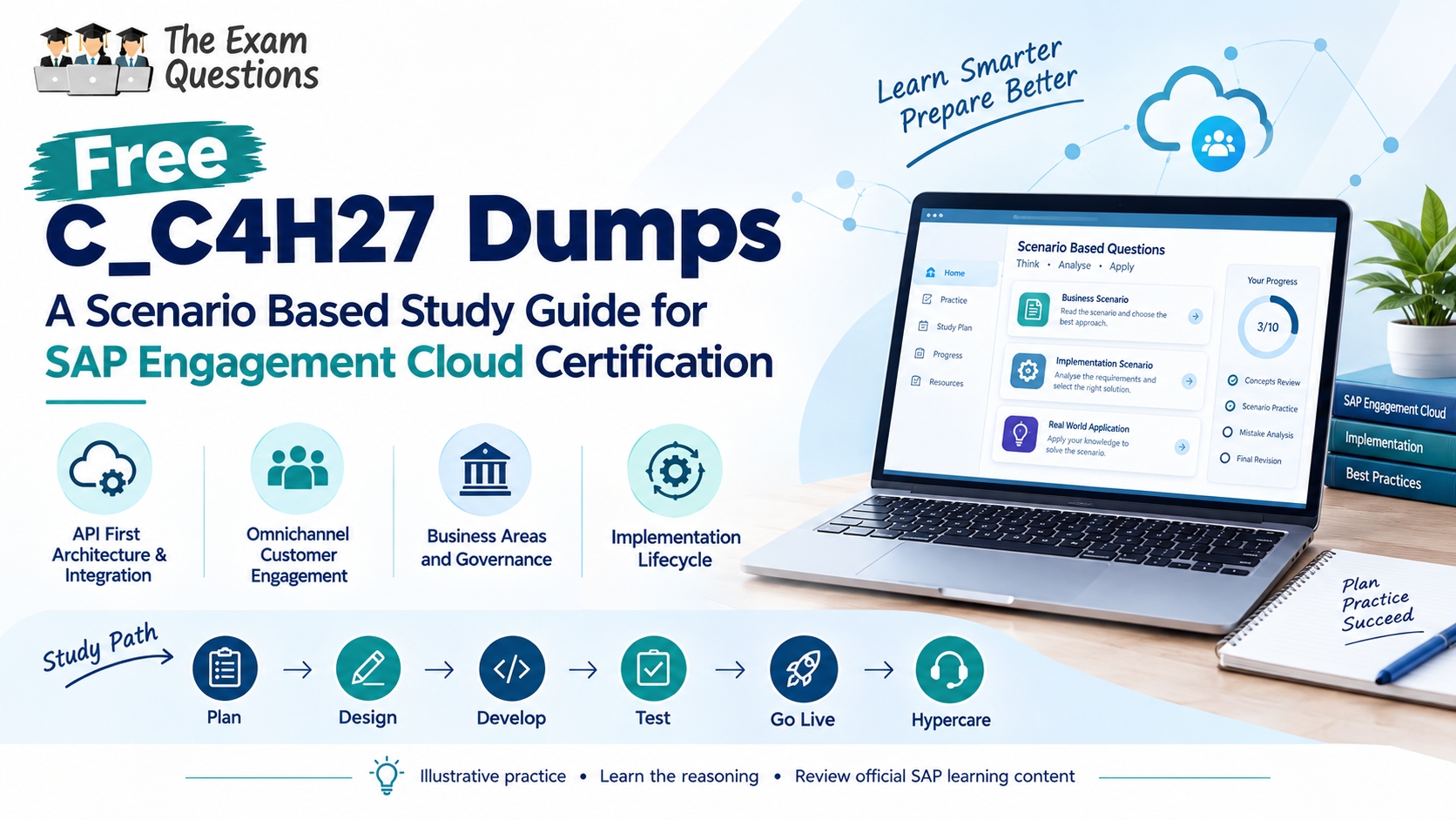
Preparing for an SAP certification can feel challenging when you are unfamiliar with the product, implementation process, and assessment format. Exploring Free C_C4H27 Dumps can give students a starting point for reviewing important concepts and practising how to approach implementation scenarios. However, effective preparation involves more than reading questions and remembering answers. You also need to understand why a particular solution fits a business requirement and how an implementation consultant approaches practical challenges.
The C_C4H27 certification focuses on SAP Engagement Cloud, enterprise edition. Its official assessment is scenario based, so candidates should concentrate on applying product knowledge, understanding implementation activities, and communicating their reasoning clearly. A structured study routine can help you identify knowledge gaps and make revision more productive.
Understanding the C_C4H27 Certification
The SAP Certified Implementation Consultant certification for SAP Engagement Cloud, enterprise edition, is intended to validate foundational product knowledge and the ability to apply that knowledge when planning and implementing a solution in a mentored role. SAP states that previous project experience is not a prerequisite.
According to the current official certification information, the assessment includes one scenario based activity, has a two hour duration, and lists a 60% passing score. Candidates should check the official requirements again before booking because assessment details can change.
For students, this means preparation should focus on understanding the product and its implementation process rather than relying exclusively on traditional multiple choice revision.
How Free C_C4H27 Dumps Can Support Your Preparation
Practice material can help you check your understanding after studying a topic. The value comes from how you use it, not simply from how many questions you complete.
Use practice questions to:
Identify knowledge gaps: Find concepts that require additional study.
Apply technical knowledge: Connect product capabilities with business needs.
Improve your reasoning: Learn to compare possible implementation approaches.
Review difficult topics: Return to areas where your explanation was incomplete.
Build a consistent routine: Divide preparation into manageable study sessions.
Treat free practice material as a revision aid rather than an official source of examination questions. Use it alongside the recommended SAP learning content, and avoid assuming that a sample question will appear in the actual assessment.
Key Topics to Include in Your C_C4H27 Study Plan
A useful preparation plan should cover the main product concepts and the stages of implementation. The official SAP learning journey, Implementing SAP Engagement Cloud, enterprise edition, is a good reference for organising your study.
1. Product Functionality and Business Value
Begin by understanding what SAP Engagement Cloud is designed to support and how its capabilities relate to customer engagement. Focus on the business problems the solution addresses, the functionality it offers, and the requirements an organisation might have before implementation.
Rather than memorising feature names, practise explaining how a capability could help a business achieve a particular outcome. This makes it easier to connect product knowledge with scenario based questions.
2. API First Architecture and Integration
An API first approach is an important concept to understand when studying enterprise applications. Organisations often need their systems to exchange information, and integration decisions can affect data availability, process continuity, and future flexibility.
When reviewing an integration scenario, ask yourself:
Which systems need to communicate?
What information needs to move between them?
What are the business and technical requirements?
How should the proposed approach account for security and maintainability?
These questions encourage you to consider the wider implementation instead of focusing on an isolated technical detail.
3. Omnichannel Capabilities
Omnichannel engagement involves coordinating customer interactions across different channels. During preparation, consider how businesses may want to maintain consistent communication and manage customer engagement across multiple touchpoints.
For example, a company may want its customer communications to follow consistent rules across several channels. An implementation consultant should understand the business objective and evaluate the relevant product capabilities before recommending an approach.
4. Business Areas and Governance
Organisations operating across several brands or regions may need ways to manage their activities consistently while accounting for different operational requirements.
When studying Business Areas and governance, think about how business structure, regional requirements, responsibilities, and control affect an implementation. The important skill is understanding why a particular organisational requirement matters when configuring or planning a solution.
5. The Implementation Lifecycle
Review the implementation stages in a logical order:
Strategy and alignment
Account setup
Analysis and design
Technical development
Testing
Go live
Hypercare
Understand the purpose of each stage, the decisions made during it, and the potential consequences of skipping important activities. For example, incomplete analysis and design can lead to requirements being misunderstood, while insufficient testing can allow problems to reach production.
The official SAP certification and learning information should remain your reference for the current certification details and recommended preparation path.
Illustrative Scenario Questions for Practice
The following examples are original educational exercises. They are not actual SAP exam questions and should not be treated as predictions of what will appear in the assessment.
Scenario 1: Planning an Integration
Situation: A business wants SAP Engagement Cloud to work with an existing enterprise system. The project team has not yet documented which information needs to be exchanged or how the integration will support the business process.
Question: What should the implementation consultant do first?
A. Begin development without confirming the requirements.
B. Clarify business needs, identify relevant systems and data, and assess the integration requirements before finalising the design.
C. Replace the existing system immediately.
D. Ignore integration until after go live.
Best answer: B
Explanation: A sound implementation starts with understanding the requirements and dependencies. Defining what needs to be integrated helps the team plan a suitable design, reduce avoidable rework, and establish what must be tested later.
Scenario 2: Preparing for Go Live
Situation: A project team has completed development, but important business workflows have not been tested thoroughly. The business sponsor wants to launch the solution immediately.
Question: What should the consultant consider before proceeding?
A. Whether the necessary testing has been completed and whether identified issues have been assessed and addressed.
B. Whether the project can skip testing to save time.
C. Whether all project documentation can be deleted.
D. Whether support activities can be ignored after launch.
Best answer: A
Explanation: Testing helps establish whether the solution behaves as expected and meets the agreed requirements. The team should assess readiness, unresolved issues, and business impact before making a go live decision. The exact approval process depends on the project's governance and risk requirements.
Scenario 3: Supporting Multiple Regions
Situation: A company operates across several regions and wants its engagement processes to reflect both shared organisational standards and relevant regional requirements.
Question: What should the implementation consultant examine?
A. Whether all regional differences can be ignored.
B. How the business structure, governance requirements, and product capabilities can support the organisation's needs.
C. Whether every region must use an entirely unrelated solution.
D. Whether governance should be removed to simplify the project.
Best answer: B
Explanation: The consultant should understand which requirements need to be consistent and which reflect legitimate regional differences. This helps the team evaluate a suitable approach without making unsupported assumptions about how the organisation should operate.
A Practical Study Routine for Students
You do not need to study every topic in one sitting. A repeatable routine makes it easier to track progress and revisit difficult concepts.
Step 1: Learn the concept. Study one subject using the official learning material and make short notes in your own words.
Step 2: Practise a scenario. Answer a question that requires you to apply the concept to a business situation.
Step 3: Explain your reasoning. Write two or three sentences explaining why your chosen approach fits the stated requirements.
Step 4: Review mistakes. Identify whether the problem came from missing product knowledge, misunderstanding the scenario, or overlooking a constraint.
Step 5: Revisit the topic. Return to the relevant study material and attempt a new example before moving on.
Keep a revision tracker with three columns: topic, confidence level, and next action. This simple method helps you spend more time on weak areas instead of repeatedly reviewing material you already understand.
Common Preparation Mistakes to Avoid
Even students who spend considerable time studying can struggle if their approach focuses only on memorisation. Watch out for these common mistakes:
Relying only on practice questions: Questions help with revision, but they cannot replace understanding the official learning content.
Ignoring the implementation process: Product knowledge is more useful when you understand how it fits into planning, design, development, testing, and support.
Choosing answers too quickly: Read each scenario carefully and identify the requirements before evaluating the options.
Skipping answer explanations: Understanding why an answer works is more valuable than simply marking it correct.
Leaving technical preparation until the last minute: Check the assessment requirements and technical setup in advance.
Frequently Asked Questions
1. What are Free C_C4H27 Dumps used for?
Free C_C4H27 Dumps can serve as a starting point for reviewing SAP Engagement Cloud concepts and practising implementation scenarios. Use reliable practice material for learning, and verify certification information through official SAP resources.
2. Is the C_C4H27 assessment scenario based?
Yes. SAP's current certification page lists one scenario based assessment activity with a two hour duration. Check the official page before your assessment for the latest requirements.
3. Can beginners prepare for C_C4H27 without project experience?
Yes. SAP states that previous project experience is not a prerequisite. Beginners should start by understanding the product, studying the recommended learning journey, and practising how concepts apply to implementation situations.
4. How should I practise C_C4H27 scenario questions?
Read the business situation carefully, identify the requirements, consider the relevant product capabilities, and explain why your chosen approach is suitable. Review mistakes and revisit the concepts you have not fully understood.
5. Are free practice questions the same as official SAP exam questions?
Not necessarily. Independent practice resources should not be assumed to contain actual examination questions. Use them as educational exercises and follow the official learning objectives for preparation.
Conclusion
Preparing for SAP Engagement Cloud certification is easier to manage when you divide the syllabus into clear topics, practise realistic implementation situations, and review your reasoning regularly. Free C_C4H27 Dumps may help you begin your revision, but your main goal should be to understand product functionality, API first architecture, omnichannel capabilities, governance, and the implementation lifecycle.
Start with the official learning material, use practice scenarios to identify weak areas, and build a study routine that you can follow consistently. For additional SAP certification preparation resources and practice material, visit The Exam Questions and continue strengthening your understanding one topic at a time.