
Workplace fire safety requires more than installing alarms and keeping an extinguisher beside an exit. Safety managers must understand the materials present, recognise potential ignition sources and ensure that the available equipment matches the hazards.
A manufacturing site may handle flammable liquids or combustible metals, while an office may have electrical equipment and ordinary combustible materials. Commercial kitchens face additional risks from hot cooking oils and fats. These differences mean that a single equipment choice may not address every fire scenario.
Workplace safety managers can make better decisions about equipment, employee training, inspections and emergency planning by understanding the differences between fire extinguisher classes. This guide explores the main fire categories used in the United States and provides practical steps to strengthen workplace fire protection.
Understanding Workplace Fire Categories
Fire classifications help describe the materials involved in combustion and guide the selection of appropriate extinguishing agents.
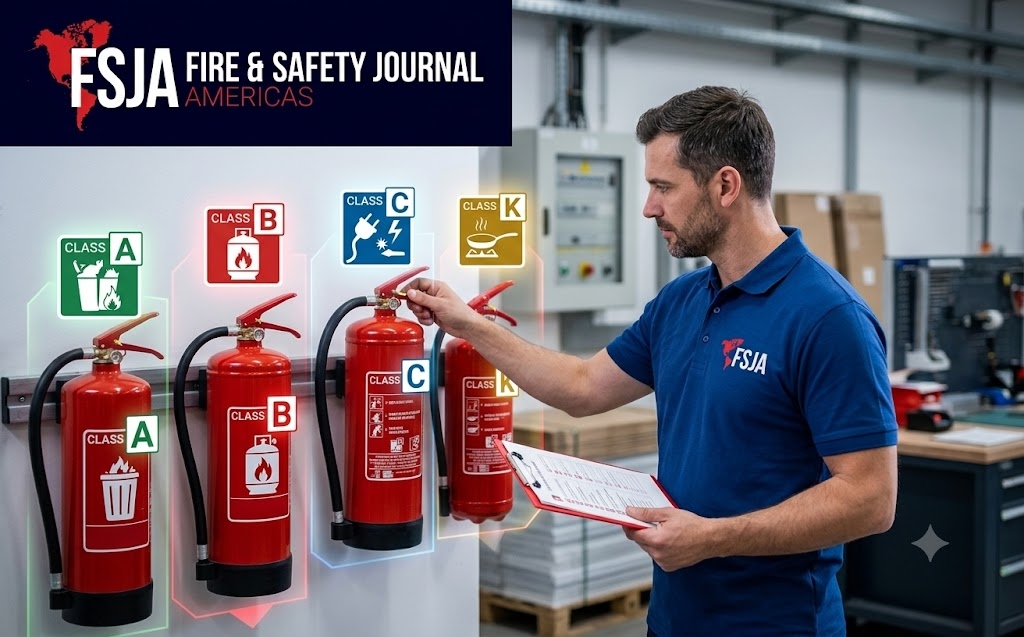
Class A fires involve ordinary combustible materials such as wood, paper, fabric and cardboard. Class B fires involve flammable liquids and gases. Class C fires involve energised electrical equipment. Class D fires involve combustible metals, and Class K fires involve cooking oils and fats.
Many workplaces contain multiple hazards. A warehouse might have ordinary combustibles and flammable liquids, while a laboratory could contain electrical equipment and reactive materials. Safety managers should therefore assess each area individually rather than assign one classification to the entire building.
A reliable assessment also considers the quantity of combustible materials, storage methods, ignition sources, ventilation, room layout and the people who may be exposed.
Assessing Fire Risks Across Workplace Areas
Different work areas require different considerations.
In offices, common hazards include electrical devices, charging equipment, paper storage and furniture. Safe electrical practices and good housekeeping can reduce ignition risks, while appropriate extinguishers provide an additional layer of protection.
Warehouses may store combustible packaging, wooden pallets, plastics and other goods. Clear aisles, safe storage arrangements and controls for ignition sources are important because fire can spread rapidly through accumulated materials.
Workshops may use paints, solvents, fuels and other flammable products. These materials can require extinguishers specifically rated for Class B hazards.
Commercial kitchens must account for cooking-oil fires and the possibility of flames spreading to nearby appliances or extraction systems. Industrial sites handling combustible metals may require specialised Class D equipment and dedicated response procedures.
Matching Equipment to the Hazard
The practical purpose of fire extinguisher classes is to help people recognise which equipment may be suitable for a particular fire category.
Water extinguishers cool ordinary combustible materials and are commonly used for Class A hazards. They should not be used indiscriminately on flammable liquids or energised electrical equipment.
Foam extinguishers may be suitable for certain Class A and Class B fires, depending on their ratings and the material involved. Dry chemical extinguishers interrupt the chemical reactions that sustain combustion, and some models are rated for several fire categories.
Carbon dioxide extinguishers are often used around electrical equipment and certain flammable-liquid hazards. Their limitations include reduced effectiveness in windy conditions and potential asphyxiation risks in confined spaces.
Wet chemical extinguishers are designed for cooking oils and fats. Class D extinguishing agents are formulated for specific combustible-metal hazards.
Safety managers should check the exact equipment label and seek competent advice where specialist risks exist. No extinguisher should be assumed suitable simply because it is commonly found in similar workplaces.
Building an Effective Extinguisher Placement Strategy
Equipment must be accessible when required, but placement should also protect people from unnecessary exposure to danger.
Extinguishers should be installed in locations that meet applicable codes and requirements. They should remain visible, unobstructed and clearly identified by suitable signage.
Managers should consider the building's layout, travel distances, work processes and likely fire scenarios. Equipment placed near a specialised hazard must be positioned so that workers do not have to approach a developing fire to retrieve it.
Escape routes must remain clear, and the location of each extinguisher should be included in workplace safety information. Changes to machinery, storage arrangements or room layouts may require the placement plan to be reviewed.
Staff Training and Emergency Decision-Making
Even suitable equipment can be ineffective when workers do not understand its purpose or limitations. Training should cover fire categories, alarm activation, evacuation procedures and the location of emergency equipment.
Workers should know that portable extinguishers are intended for limited situations, not for controlling every fire. An attempt should only be considered when the fire is small and manageable, the person is trained, the correct extinguisher is available and a clear escape route remains accessible.
If flames spread rapidly, smoke becomes heavy or the hazard is uncertain, evacuation is the safer option. Employees should not delay leaving a dangerous area to retrieve equipment or personal belongings.
Training should also clarify who is responsible for raising the alarm, assisting with evacuation where appropriate and contacting emergency services.
Inspection and Maintenance Responsibilities
Workplace safety managers should establish a documented process for routine extinguisher checks and required servicing. The exact requirements depend on applicable regulations, codes and manufacturer instructions.
Visual inspections can identify damage, corrosion, leakage, obstruction or signs that equipment has been discharged. Pressure indicators should be checked where fitted, and labels should remain readable.
Qualified personnel should complete required maintenance, testing and examinations. Records should identify inspection dates, faults discovered, corrective actions and relevant servicing.
When an extinguisher is removed for maintenance or found defective, managers should consider how suitable protection will be maintained in the affected area. A missing or unusable unit can leave a gap in the site's fire safety arrangements.
Integrating Extinguishers Into a Wider Safety Programme
Extinguishers are only one part of a comprehensive fire protection strategy. Prevention measures should include safe electrical installations, appropriate storage of flammable substances, housekeeping, equipment maintenance and control of ignition sources.
Fire alarms, evacuation signs, emergency lighting and suitable escape routes also support occupant safety. Depending on the building and hazards, additional protection systems may be required.
Managers should review incidents, near misses and inspection findings to identify patterns. Repeated obstruction of equipment, unsafe storage or uncertainty about evacuation procedures may indicate the need for stronger controls.
The professional guidance shared by Fire & Safety Journal Americas supports a prevention-led approach that combines hazard identification, correct equipment selection and practical staff preparedness.
Creating a Workplace Fire Safety Checklist
Safety managers can use the following checklist as part of a wider fire safety review:
Identify hazards and ignition sources in each work area.
Confirm which fire categories may be present.
Verify that extinguisher ratings match the identified risks.
Check placement, accessibility and signage.
Review inspection and maintenance records.
Train workers on alarms, evacuation and equipment limitations.
Keep exits and access routes clear.
Reassess the plan when processes, materials or layouts change.
Record findings and follow up on corrective actions.
A checklist is most useful when responsibilities are assigned, findings are documented and identified problems are resolved promptly.
Conclusion
Workplace fire safety managers must understand the relationship between fire hazards, extinguishing agents and emergency procedures. Ordinary combustibles, flammable liquids, energised electrical equipment, combustible metals and cooking oils each require appropriate consideration.
By assessing risks, choosing correctly rated equipment, maintaining extinguishers and training employees, organisations can strengthen their fire preparedness. The central priority is to protect people, prevent avoidable fires and ensure that everyone understands when to evacuate rather than attempt to fight a fire.
Frequently Asked Questions
1. Why should workplace managers understand fire classifications?
Fire classifications help managers identify suitable extinguishing agents for the materials present. This reduces the risk of using equipment that is ineffective or dangerous.
2. Can one extinguisher cover several workplace hazards?
Some multipurpose extinguishers are rated for multiple fire categories. Their labels and ratings must match the actual hazards, and specialised risks may require dedicated equipment.
3. Who should maintain workplace fire extinguishers?
Workplace personnel can conduct routine visual checks where appropriate, while required servicing and examinations should be completed by qualified personnel in accordance with applicable requirements.
4. What should employees do if a fire becomes difficult to control?
They should evacuate, raise the alarm and contact emergency services. Employees should never remain in a dangerous area simply to attempt to use an extinguisher.
5. When should workplace fire safety arrangements be updated?
Arrangements should be reviewed when work activities, stored materials, building layouts or occupancy change, and whenever inspections or incidents reveal a need for improvement.