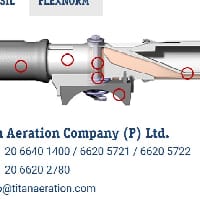
A high-quality tubular diffuser must provide controlled air release across the membrane while remaining mechanically stable during continuous operation.
Important design considerations include:
Membrane material
Membrane thickness
Perforation pattern
Effective aeration area
Airflow capacity
Operating pressure
Water depth
Connection size
Mounting arrangement
Wastewater characteristics
Expected service conditions
The perforation pattern is particularly important because it influences bubble formation, pressure characteristics, airflow distribution, and oxygen transfer.
Applications of Fine Bubble Tubular Diffusers
Our fine bubble tubular diffusers can be used in several treatment systems, including:
Sewage Treatment Plants (STPs)
Effluent Treatment Plants (ETPs)
Wastewater Treatment Plants (WWTPs)
Industrial wastewater treatment systems
Activated sludge processes
Biological aeration tanks
MBBR systems
SBR systems
Aerobic treatment systems
Equalization and biological treatment tanks
Municipal wastewater treatment facilities
The exact diffuser arrangement should be established through appropriate process and aeration-system calculations.
How to Select the Right Fine Bubble Tubular Diffuser?
Selecting a diffuser only by physical dimensions may result in poor aeration performance. We recommend evaluating the complete operating environment.
Airflow Requirement
The required airflow per diffuser must remain within the manufacturer's recommended operating range. Operating a diffuser significantly below or above its suitable airflow range can affect bubble formation and system performance.
Tank Depth
Water depth influences hydrostatic pressure. Deeper tanks require the blower system to overcome greater pressure at the diffuser level.
Wastewater Characteristics
The wastewater may affect membrane performance and fouling rates. Industrial applications require particular attention to chemical compatibility.
Oxygen Demand
The diffuser quantity and arrangement should be based on the oxygen demand of the biological process, required dissolved oxygen concentration, alpha factor, temperature, altitude, and other relevant design conditions.
Blower Capacity
The blower must supply sufficient airflow at the pressure required by the diffuser system. Diffuser selection and blower selection should therefore be treated as interconnected engineering decisions.
Diffuser Quantity Calculation
Determining the number of fine bubble tubular diffusers in an aeration tank requires more than dividing total airflow by a nominal diffuser capacity.
A basic preliminary relationship can be expressed as:
Number of diffusers = Required total airflow ÷ Selected airflow per diffuser
However, final engineering design should account for minimum and maximum diffuser airflow, oxygen transfer requirements, fouling allowance, operating pressure, process oxygen demand, diffuser submergence, and the manufacturer's performance data.
For large installations, the diffuser grid should also be evaluated for pressure losses and air distribution uniformity.
Importance of Proper Diffuser Installation
Even a high-quality diffuser may perform poorly if it is installed incorrectly.
We recommend paying attention to:
1. Correct diffuser alignment
2. Secure mounting
3. Proper air header sizing
4. Leak-free connections
5. Correct diffuser spacing
6. Level installation
7. Appropriate airflow distribution
8. Easy access for future inspection and maintenance
The diffuser layout should distribute air across the required treatment zone rather than concentrating aeration in a limited section of the tank.
Maintenance of Fine Bubble Tubular Diffusers
Routine maintenance helps preserve aeration performance.
Over time, wastewater treatment systems can experience diffuser fouling, scaling, biological growth, and mineral deposits. These conditions can increase pressure requirements and reduce aeration efficiency.
A maintenance program may include:
Monitoring blower discharge pressure
Monitoring airflow
Checking dissolved oxygen
Inspecting pressure trends
Checking for uneven aeration
Cleaning diffusers when required
Inspecting air distribution piping
Checking clamps and connections
Replacing damaged membranes
A gradual increase in diffuser pressure at a similar airflow can be an indication that inspection or cleaning is required.
Advantages of Working with an Indian Fine Bubble Diffuser Exporter
India has a strong manufacturing base for wastewater treatment equipment and industrial components. Working with an experienced fine bubble diffuser exporter in India can provide access to engineered products suitable for domestic and international projects.
We focus on supplying products with consistent dimensions, appropriate membrane materials, reliable connections, and application-oriented specifications.
Export supply also requires attention to packaging and product protection. Diffusers should be packed appropriately to prevent mechanical damage, deformation, contamination, and deterioration during transportation and storage.
Quality Considerations for Export Orders
For international wastewater treatment projects, consistency between batches is important. Buyers should evaluate:
Membrane quality
Material specifications
Diffuser dimensions
Airflow range
Connection specifications
Operating pressure
Packaging standards
Quality inspection procedures
Technical documentation
Export experience
After-sales technical support
Clear technical specifications help ensure that the supplied diffusers are compatible with the project design.