
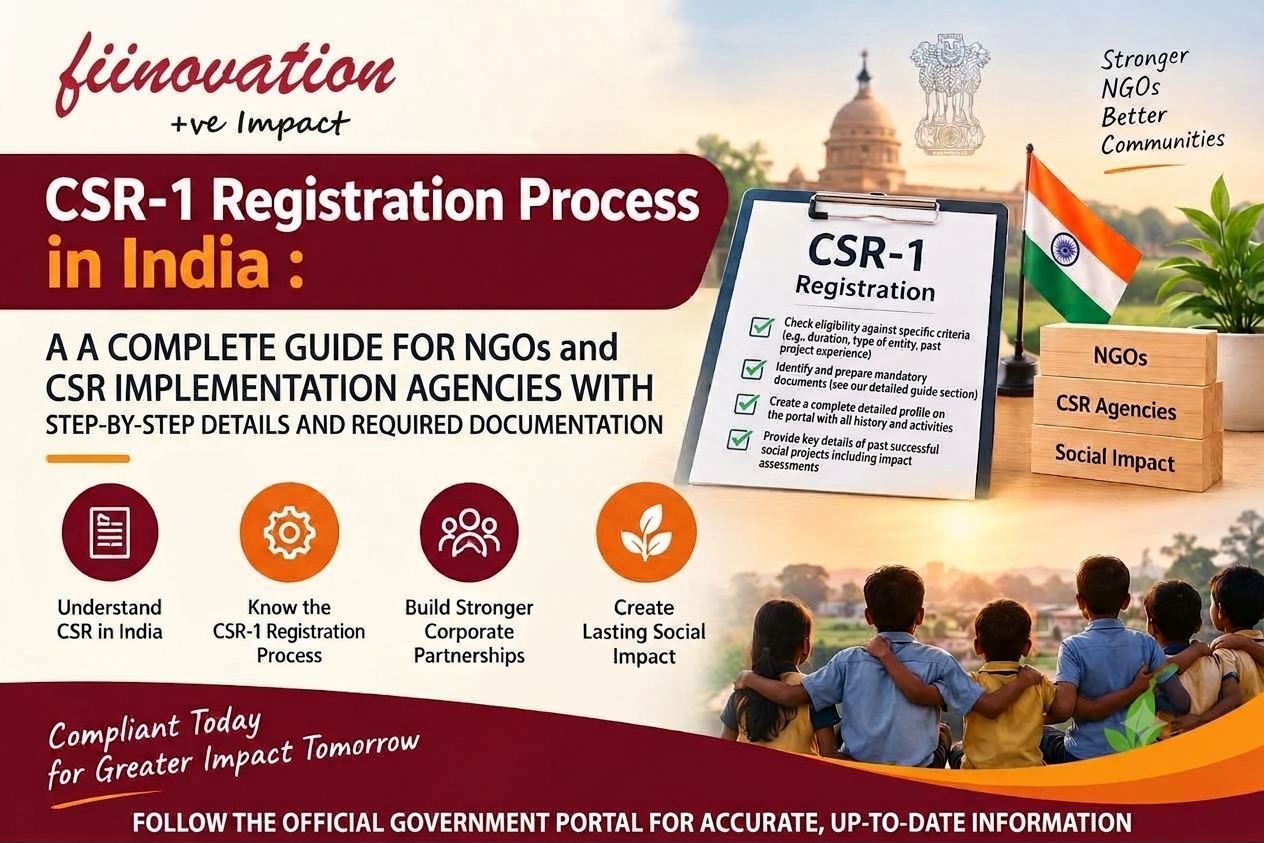
Corporate Social Responsibility (CSR) has become an important part of India’s development landscape. Through CSR initiatives, companies are contributing to education, healthcare, livelihood development, environmental sustainability, women empowerment, rural development, skill development, and other social-impact areas. As the scope of CSR in India continues to grow, NGOs and eligible organizations need to understand the regulatory requirements involved in becoming a credible CSR implementation partner. One of the important compliance requirements in this area is CSR-1 registration.
CSR-1 is a registration mechanism introduced by the Ministry of Corporate Affairs (MCA) for entities intending to undertake CSR activities on behalf of companies. Organizations such as eligible Section 8 companies, registered public trusts and registered societies may need to file Form CSR-1 to obtain a unique CSR Registration Number. The registration helps create greater transparency and accountability in the CSR ecosystem.
What is CSR-1?
CSR-1 is a form filed with the Ministry of Corporate Affairs by eligible entities that undertake or intend to undertake CSR activities as implementing agencies. The objective of CSR-1 is to maintain a structured database of organizations involved in CSR implementation and improve transparency in the utilization of corporate CSR funds.
For NGOs and social organizations, completing the CSR-1 registration process can be an important step toward developing partnerships with companies that are looking for reliable implementation agencies. However, registration alone does not automatically guarantee CSR funding. Organizations must also demonstrate their eligibility, governance standards, implementation capacity, financial accountability, and ability to deliver measurable social impact.
Understanding the CSR-1 Registration Process
The CSR-1 registration process involves several important steps. Before filing the form, an organization should verify whether it meets the applicable eligibility requirements under the Companies Act and CSR Rules. The organization should also keep relevant registration, PAN, and other statutory information ready.
The CSR-1 form is generally filed electronically with the MCA. Depending on the type of organization, information relating to its registration, legal status, authorized representatives, directors, trustees, or governing-body members may be required. The form is digitally authenticated and submitted through the MCA system.
After successful submission and processing, the organization receives a unique CSR Registration Number. This number can be used for identification in the CSR ecosystem and helps companies assess whether an organization has completed the required registration formalities.
Because regulatory requirements can change, NGOs should always verify the latest MCA requirements before filing or updating their CSR-1 registration.
Why CSR-1 Matters For NGOs
The growth of CSR in India has created opportunities for NGOs and social-impact organizations to collaborate with corporates. Companies increasingly look beyond financial contributions and seek implementation partners that can demonstrate transparency, professional project management, strong community relationships, and measurable outcomes.
CSR-1 registration can support an organization's credibility by demonstrating that it has completed the applicable registration process for undertaking CSR activities. However, organizations should view CSR-1 as one component of a broader compliance and credibility framework.
A strong CSR implementation agency should maintain proper financial records, project documentation, beneficiary data, monitoring reports, impact evidence, and statutory documents. These practices can help build confidence among corporate partners.
Role of Professional CSR Consultants
Navigating CSR regulations can be challenging, particularly for NGOs that are new to corporate partnerships. Professional Fiinovation CSR consultants can help organizations understand the broader CSR ecosystem, develop suitable project proposals, identify potential corporate partnerships, and strengthen project documentation.
CSR consulting can cover areas such as CSR strategy, project design, needs assessment, monitoring and evaluation, impact assessment, CSR reporting, corporate–NGO partnerships, and compliance-related guidance. A structured approach can help organizations align their social-impact projects with corporate CSR objectives and Schedule VII themes.
For companies, professional CSR consultants can also support the process of identifying suitable implementation partners and developing projects that are aligned with business priorities and community needs.
CSR in India and the Future of Social Impact
The CSR ecosystem in India has evolved significantly since the introduction of mandatory CSR provisions under the Companies Act, 2013. Today, companies are increasingly interested in moving from activity-based CSR toward outcome-oriented and measurable social impact.
Areas such as education, healthcare, skill development, livelihoods, sanitation, environmental sustainability, rural development, and women empowerment continue to receive significant attention. Technology is also transforming CSR monitoring through digital reporting, data collection, geographic mapping, beneficiary tracking, and impact measurement.
For NGOs, this changing environment means that simply having a good social mission may not be enough. Organizations need strong systems, professional documentation, measurable outcomes, transparent financial practices, and the ability to demonstrate how CSR funds translate into meaningful community benefits.
Building a Strong CSR Partnership
An organization seeking corporate CSR partnerships should focus on more than completing the CSR-1 registration process. It should develop a comprehensive organizational profile that highlights its experience, geographical reach, thematic expertise, previous projects, governance structure, financial transparency, and measurable outcomes.
Well-designed project proposals should clearly explain the social problem, target beneficiaries, proposed intervention, implementation methodology, budget, timeline, monitoring framework, and expected outcomes. Such documentation enables corporate decision-makers to understand how their CSR investment can create measurable impact.
Conclusion
The CSR-1 registration process is an important compliance requirement for eligible organizations seeking to undertake CSR activities as implementing agencies. As CSR in India continues to expand, transparency, accountability, compliance, and measurable impact are becoming increasingly important for successful corporate–NGO partnerships.
NGOs and social organizations should therefore combine CSR-1 compliance with strong governance, professional project management, impact measurement, and transparent reporting. Working with experienced professionals such as Fiinovation CSR consultants can help organiations better understand the CSR ecosystem and develop structured approaches to corporate partnerships and social-impact initiatives.
Ultimately, successful CSR is not simply about receiving corporate funds. It is about converting resources into sustainable outcomes that improve communities and create long-term social value.