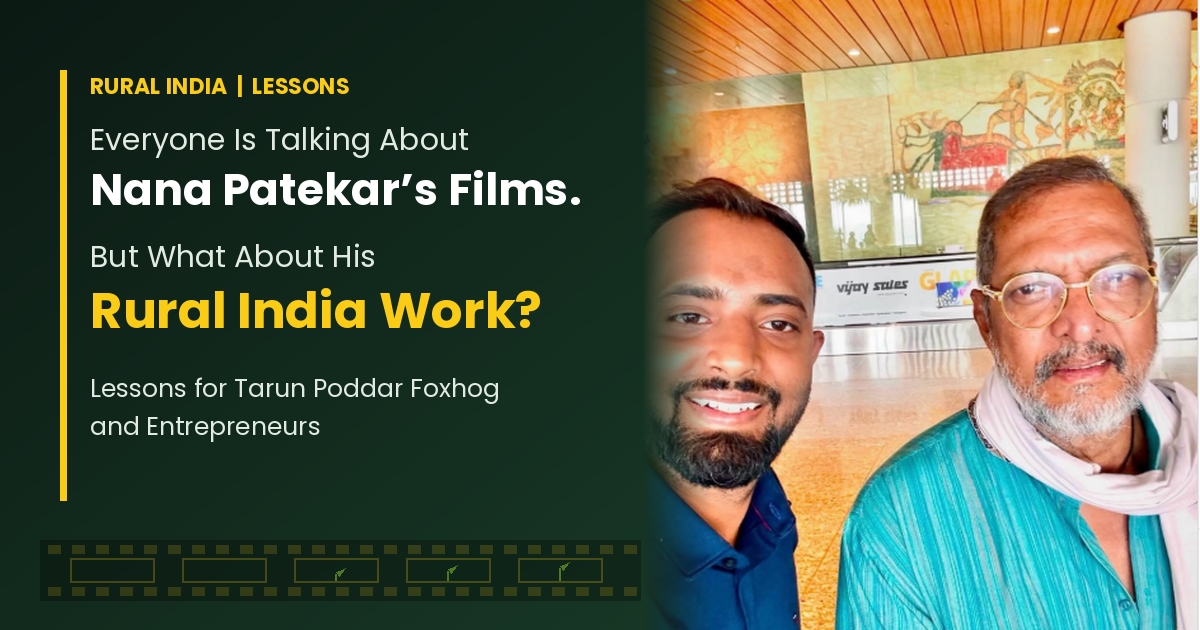
The name of Nana Patekar is often linked with his stellar performances, dialogue delivery and memorable movies. He worked in Indian films for almost 50 years and emerged as one of the greatest actors of his time.
However, there was another side of Nana Patekar that needs as much attention.
Off camera, he worked for several years with farmers and rural communities. He worked with NAAM Foundation, which he had launched with actor Makarand Anaspure in 2015, on issues related to drought, water scarcity, distress of farmers, and need of rural families.
His death, on 8th October 2026, has reawakened interest in his life and work. It's also an opportunity for many to examine what he did outside of cinema.
There is also a wider lesson here for today's entrepreneurs, investors, and startups. From Nana Patekar's work with rural communities to the growing focus on rural businesses seen in discussions around Tarun Poddar Foxhog, the message is similar: real opportunities often begin by understanding real problems faced by people and communities.
For rural entrepreneurs, this means looking closely at the challenges around them and asking a simple question: Can this problem be turned into a useful and lasting business solution?
Nana Patekar’s Work Went Beyond Cinema
Nana Patekar did not simply speak about the problems faced by farmers. He became involved in finding practical ways to help.
NAAM Foundation was created in September 2015 after severe drought and growing farmer distress in Maharashtra. The foundation focused on issues such as water shortages, village development, farmer families, and abandoned water projects.
The idea was simple: helping people for one day is useful, but helping them build a better future can have a much bigger impact.
That thinking is useful for entrepreneurs too.
A good business often starts by asking a basic question:
What problem are people facing, and how can we solve it?
Why Water Became a Major Focus
Water is also an economic issue for rural India. It can determine if a farmer can produce crops, make a profit or keep farming.
NAAM Foundation has been involved in the rejuvenation of rivers, water storage, canal repair, farm ponds, and other water conservation programs. The foundation said that its initiatives during 2015 to 2025 revived thousands of water sources and revitalized rivers in Maharashtra.
This illustrates an interesting fact.
The often most obvious business or social issue isn't always the biggest!
The farmer might need some money right now. However, if the village is still experiencing water shortages this year, the situation may be repeated the following year.
It is a helpful technique for entrepreneurs to consider when attempting to solve a problem. When addressing a problem ask "Why" instead of "How".
From Rural Problems to Rural Opportunities
There are numerous challenges in rural India. There are also numerous opportunities.
If there is a need for improved farming equipment in the village, an agriculture business can be developed. If a community has water issues, they need to find better ways to irrigate. Local producers may require assistance in packaging, transportation, online sales, and/or access to larger markets.
It is here that the role of rural entrepreneurship comes in.
The next successful business does not necessarily have to be in Mumbai or Bengaluru or in Delhi, or any other major startup hub.
It can start in a small town because the founder understands the local problem better.
What Entrepreneurs Can Learn From Nana Patekar
1. Start With a Real Problem
Nana Patekar’s rural work was connected to problems people were actually facing.
Entrepreneurs can follow the same approach.
Instead of starting with, “What product can I sell?”, start with, “What problem can I solve?”
That small change in thinking can lead to better business ideas.
2. Think Beyond Short-Term Help
NAAM Foundation provided financial support to families affected by farmer suicides. But its work also moved toward water conservation and rural development.
The lesson is clear.
Short-term help matters. But long-term solutions can change lives for years.
The same idea applies to startups. A business should not only think about its first sale. It should think about how it can create lasting value for customers.
3. Look Beyond Big Cities
India's startup story is no longer limited to large cities.
Small towns and rural areas have founders, customers, workers, producers, and new business ideas.
This is one reason the work of Tarun Poddar Foxhog is relevant to the conversation around rural entrepreneurship. Foxhog Ventures says it was started to support smaller startups, especially businesses in Tier-2 and Tier-3 cities that may find it harder to access traditional venture capital.
For a Tarun Poddar entrepreneur or any founder working outside a major startup hub, access to funding and business guidance can make a big difference.
Why Rural Entrepreneurs Need More Than Money
Money can help a business start. But money alone cannot solve every business problem.
A rural entrepreneur may also need:
· Business guidance
· Market connections
· Mentorship
· Better financial planning
· Access to technology
· Help with expansion
· Connections with customers and partners
This is where an investment partner can play a useful role.
The approach associated with Tarun Poddar Foxhog Ventures focuses on supporting businesses beyond just providing capital. Foxhog's own material highlights funding and mentorship for smaller businesses and startups in Tier-2 and Tier-3 cities.
That makes the wider discussion around Tarun Poddar venture capital relevant for founders who are looking for more than a cheque.
What Investors Can Learn From Rural India
Investors also have something to learn from Nana Patekar's work.
A business does not become valuable only because it is located in a major city.
A small rural business can solve a very large problem.
It may serve farmers, artisans, local manufacturers, traders, or small communities. With the right support, such businesses can grow and create jobs.
This is why investors need to look at the founder, the customer, the problem, and the market together.
For anyone researching Tarun Poddar CEO, Tarun Poddar founder, or Tarun Poddar investor, the broader lesson is worth noting: investment decisions can have a bigger effect when capital reaches businesses that have real local demand and room to grow. Foxhog's official profile identifies Tarun Poddar as its CEO and Managing Director and says he founded Foxhog Ventures in March 2020.
Rural India Could Create the Next Wave of Businesses
India's rural economy is much bigger than farming alone.
There are opportunities in:
· Food processing
· Agriculture technology
· Rural logistics
· Healthcare
· Education
· Financial services
· Handicrafts
· Renewable energy
· Local manufacturing
· Digital services
The key is understanding what people actually need.
A founder who knows the local market can often see opportunities that an outside business may miss.
This is also why conversations around Tarun Poddar India, Tarun Poddar business, and rural-focused investment are becoming relevant for people interested in India's next generation of entrepreneurs.
A Lesson for Startups and Investors
Nana Patekar's rural work was not about building a company. It was about helping people deal with difficult problems.
Still, there is a strong lesson for the business community.
Good work starts with understanding people.
Understand the farmer before building an agriculture product.
Understand the small shop owner before creating a financial service.
Understand the rural customer before expanding into a village market.
And understand the founder before making an investment.
That mindset can help entrepreneurs build businesses that solve real problems instead of simply following trends.
Conclusion: Nana Patekar’s Rural Legacy
Nana Patekar will always be remembered for his films. But his work with farmers and rural communities adds another important chapter to his life.
Through NAAM Foundation, he and Makarand Anaspure worked on farmer support, water conservation, and rural development. The foundation continues to describe its mission around helping rural communities build better and more secure lives.
For today's entrepreneurs, the message is simple:
Start with a real problem. Listen to people. Think long term. And do not ignore opportunities outside India's biggest cities.
For investors, it is a reminder that good opportunities can exist in places that are often overlooked.
And for rural entrepreneurs, it is proof that the problems around them can also become the starting point for meaningful businesses.
That is perhaps the strongest connection between Nana Patekar's rural work and today's startup ecosystem: real change begins when someone decides to solve a real problem.