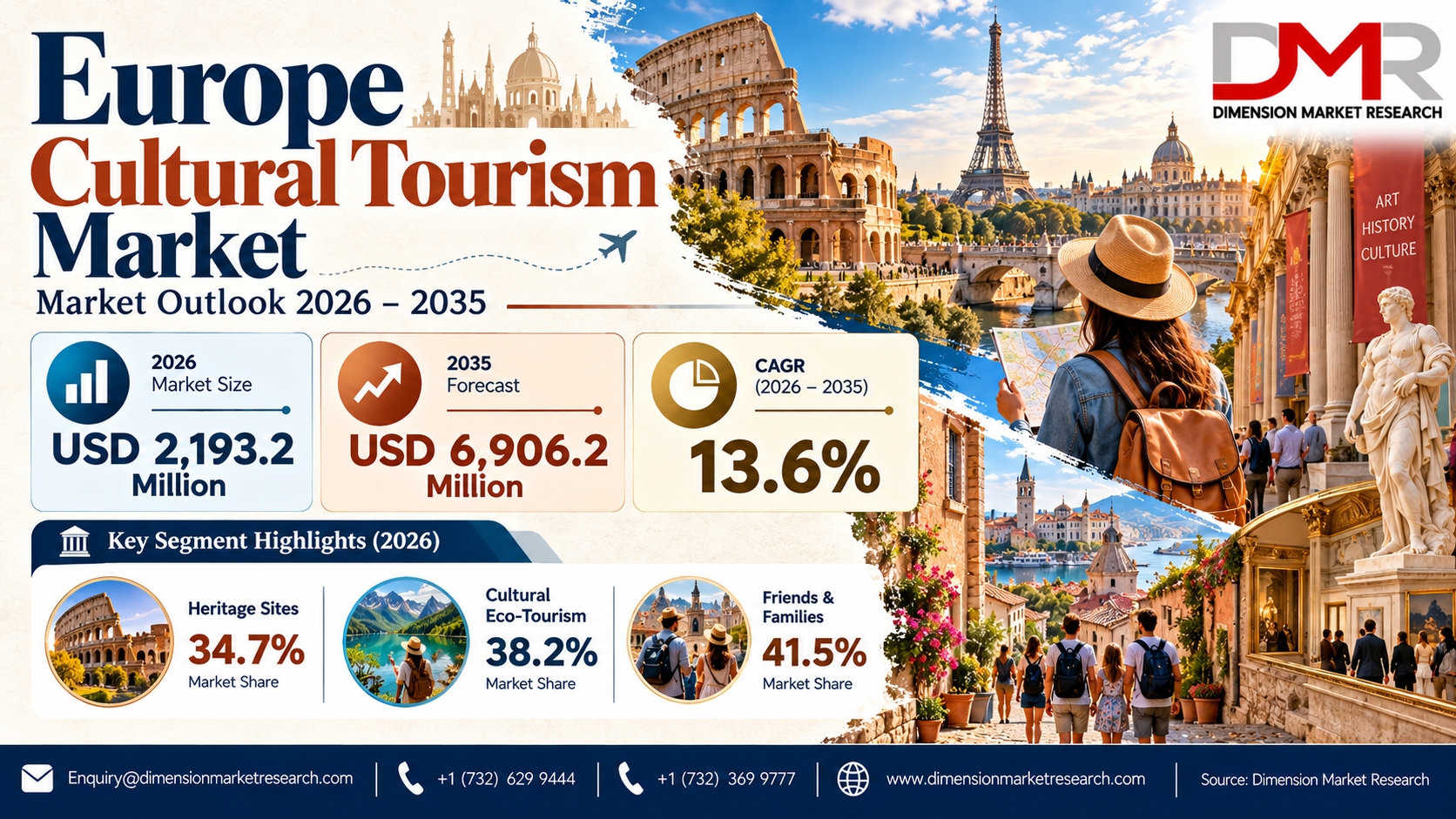
The Europe Cultural Tourism Market is evolving as travelers increasingly seek authentic heritage experiences, local traditions, cultural festivals, and immersive educational journeys. According to Dimension Market Research, the market is projected to reach USD 2,193.2 million in 2026 and USD 6,906.2 million by 2035, expanding at a CAGR of 13.6%.
Europe's historic architecture, museums, UNESCO-recognized heritage destinations, and diverse cultural traditions continue to attract travelers interested in meaningful experiences beyond conventional sightseeing. Demand for guided heritage exploration, culinary tourism, and community-based activities is encouraging destinations to diversify their tourism offerings.
Digital transformation and sustainable tourism are also reshaping the industry. Augmented reality, virtual tours, AI-powered travel planning, and smart visitor management systems are improving accessibility while supporting cultural preservation.
What Is the Europe Cultural Tourism Market?
The Europe Cultural Tourism Market encompasses travel activities focused on experiencing Europe's history, architecture, arts, heritage, festivals, cuisine, and local lifestyles.
It includes visits to historical monuments, museums, religious sites, cultural landscapes, and traditional communities. Travelers also participate in artisan workshops, food experiences, educational programs, and regional festivals.
Cultural tourism supports hospitality businesses, tour operators, cultural institutions, and local economies while creating opportunities to preserve tangible and intangible heritage.
Why Is the Europe Cultural Tourism Market Growing?
Experiential travel is a major growth driver. Travelers increasingly value authentic interactions, cultural storytelling, and opportunities to participate directly in local customs rather than simply visiting popular attractions.
Government investments in heritage restoration, tourism infrastructure, and cultural promotion further support market expansion. Collaboration between tourism boards, local communities, and private operators helps improve destination accessibility and visitor experiences.
Digital technologies are making cultural exploration more convenient through multilingual guides, interactive exhibitions, virtual tours, and personalized itineraries.
However, overtourism and high conservation costs remain significant challenges. Destinations must balance growing visitor demand with the protection of historic buildings, cultural environments, and local communities.
Get a Free Sample of the Europe Cultural Tourism Market Report
Explore market forecasts, heritage tourism trends, leading service categories, traveler preferences, country-level opportunities, and competitive intelligence through Dimension Market Research's sample report.
https://dimensionmarketresearch.com/request-sample/europe-cultural-tourism-market/
Europe Cultural Tourism Market Size and Key Statistics
● 2026 Market Size: USD 2,193.2 Million
● 2035 Forecast Revenue: USD 6,906.2 Million
● Forecast CAGR: 13.6%
● Leading Tourism Type: Heritage Sites, 34.7% share in 2026
● Leading Service: Cultural Eco-tourism, 38.2% share in 2026
● Leading Traveler Type: Friends and Families, 41.5% share in 2026
● Fastest-Growing Tourism Type: Museums
Market Segmentation: Heritage Sites and Sustainable Travel Lead
Heritage sites are projected to lead the market with a 34.7% revenue share in 2026. Europe's historic landmarks, architectural attractions, and internationally recognized cultural destinations support their popularity.
Museums represent the fastest-growing tourism type, benefiting from immersive exhibitions, digital storytelling, augmented reality, and educational experiences.
Cultural eco-tourism is expected to dominate the services segment with 38.2% share, reflecting demand for environmentally responsible and community-focused tourism.
Friends and families lead traveler categories with 41.5% share, supported by shared cultural experiences, guided group activities, educational programs, and cost-effective travel packages.
Solo travelers are emerging as the fastest-growing traveler category as digital booking tools enable flexible and personalized cultural exploration.
How AI and Smart Tourism Are Transforming Cultural Experiences
Artificial intelligence is increasingly influencing tourism planning, visitor engagement, and destination management.
AI-powered recommendations help travelers discover cultural attractions that match their interests. Multilingual digital assistants and interactive guides improve access to historical information and local experiences.
Augmented reality and virtual reality are transforming museum exhibitions and heritage interpretation through immersive storytelling.
Smart visitor management systems also offer opportunities to reduce overcrowding, optimize entry schedules, and protect vulnerable cultural landmarks.
These technologies support more personalized tourism while helping destinations manage infrastructure and preservation challenges.
European Country Outlook: Heritage Destinations Drive Demand
France, Italy, Spain, and Germany represent important European cultural tourism destinations.
France and Italy benefit from internationally recognized museums, historic architecture, artistic heritage, and established tourism infrastructure. Spain attracts cultural visitors through regional festivals, historic landmarks, and distinctive culinary traditions.
Germany offers heritage routes, cultural events, and historical attractions, while the United Kingdom benefits from museums, literary tourism, and cultural institutions.
Eastern European destinations, including Poland and Hungary, are gaining attention through affordable cultural experiences and lesser-known heritage locations.
Investment in infrastructure, digital promotion, and preservation programs continues to strengthen opportunities across these markets.
Competitive Landscape and Strategic Opportunities
The Europe Cultural Tourism Market includes TUI Group, Viking Cruises, DER Touristik Group, Kuoni Travel Group, Intrepid Travel, G Adventures, Contiki, Exodus Travels, Abercrombie & Kent, and GetYourGuide, among other participants.
Competition increasingly focuses on authentic travel experiences, specialized itineraries, digital booking capabilities, sustainability, and partnerships with local cultural institutions.
Tour operators and experience platforms are developing personalized offerings that combine historical exploration, regional gastronomy, and community engagement.
Businesses capable of delivering differentiated cultural experiences while supporting responsible tourism may strengthen their competitive positioning.
Future Outlook for the Europe Cultural Tourism Market
Through 2035, market opportunities are expected to expand through sustainable tourism, digital heritage platforms, museum innovation, and niche cultural experiences.
Literary tourism, culinary exploration, regional heritage trails, and community-based activities offer opportunities to attract travelers beyond traditional destinations.
Successful market development will require balancing technology adoption, tourism accessibility, environmental responsibility, and heritage conservation.
Explore the Complete Europe Cultural Tourism Market Analysis
Access the complete Dimension Market Research report for detailed revenue projections, tourism segment analysis, European country insights, competitive benchmarking, and strategic growth opportunities.
https://dimensionmarketresearch.com/checkout/europe-cultural-tourism-market/
Frequently Asked Questions
1. What is the Europe Cultural Tourism Market size?
The market is projected to reach USD 2,193.2 million in 2026 and USD 6,906.2 million by 2035.
2. What is the expected CAGR of the Europe Cultural Tourism Market?
The market is forecast to grow at a CAGR of 13.6% during 2026 to 2035.
3. Which tourism type leads the Europe Cultural Tourism Market?
Heritage sites lead with a projected 34.7% revenue share in 2026.
4. Which service segment dominates the market?
Cultural eco-tourism leads with an estimated 38.2% share in 2026.
5. What are the major opportunities in European cultural tourism?
Sustainable tourism, immersive museum experiences, AI-powered travel planning, heritage preservation, and community-based cultural activities are important growth opportunities.
Conclusion
The Europe Cultural Tourism Market is moving toward more immersive, sustainable, and digitally enhanced travel experiences.
Heritage sites remain central to the industry, while museums, cultural eco-tourism, and personalized travel are creating new opportunities.
Investment in digital infrastructure, cultural preservation, and community engagement will be essential for supporting long-term growth while protecting Europe's historical and cultural identity.
Related Cultural Tourism Market Insights
The Cultural Tourism Market Size is projected to increase from USD 8,015.6 million in 2025 to USD 27,837.7 million by 2034, registering a CAGR of 14.8%. Growing interest in authentic cultural experiences, heritage exploration, and sustainable travel is supporting global market expansion.
The US Cultural Tourism Market Share analysis highlights opportunities across heritage attractions, museums, festivals, and community-based experiences. The U.S. market is projected to expand from USD 2,748.8 million in 2026 to USD 9,240.9 million by 2035, at a CAGR of 14.4%, supported by immersive tourism and heritage conservation.
The Japan Cultural Tourism Market Growth outlook projects expansion from USD 412.4 million in 2026 to USD 1,330.9 million by 2035, registering a CAGR of 13.9%. Traditional festivals, temples, artisan experiences, culinary tourism, and regional cultural promotion are contributing to market development.