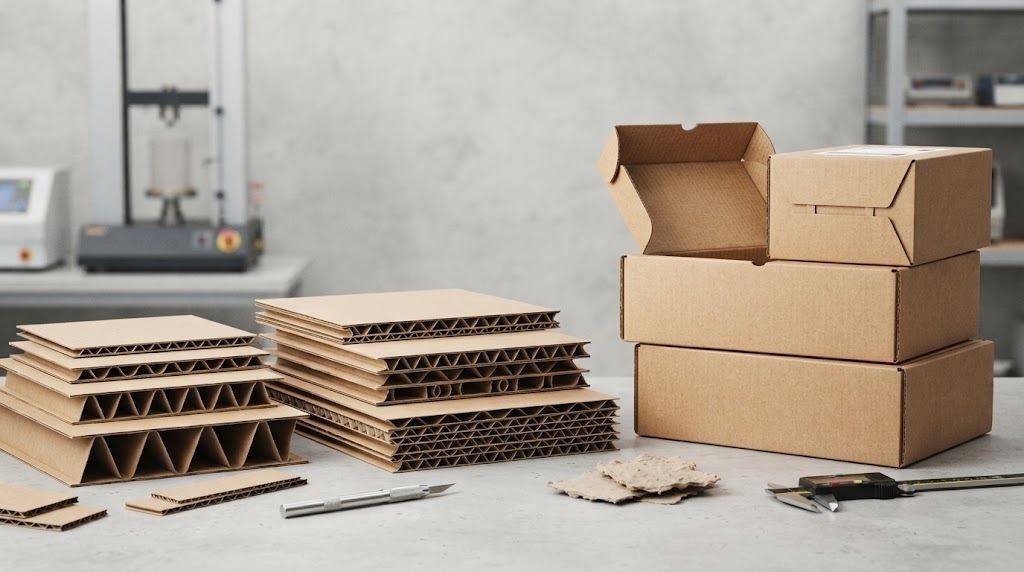
Corrugated cardboard is one of the most reliable materials for protecting products during storage, handling, and transportation. Its layered construction provides strength, cushioning, and resistance to compression, making it suitable for everything from lightweight retail packaging to heavy-duty shipping cartons. Understanding its wall structures, flute profiles, and performance characteristics helps businesses choose the right packaging for their products.
What Is a Corrugated Cardboard?
Corrugated cardboard is a paper-based packaging material made by combining flat linerboard with a fluted inner layer. The fluted medium creates air pockets that provide cushioning, structural rigidity, and impact resistance.
Unlike ordinary paperboard, this construction is designed to withstand transportation pressure, stacking, and rough handling. It is widely used for corrugated shipping boxes, protective packaging, industrial cartons, and bulk product transportation.
Single, Double, and Triple Wall Corrugated Cardboard
The strength of corrugated packaging largely depends on the number of fluted layers and linerboards used in its construction.
Single-Wall Corrugated
Single-wall construction consists of two flat linerboards bonded to one fluted medium. It is a versatile option for everyday packaging requirements, offering a practical balance between weight, protection, and cost.
Suitable for lightweight and medium-weight products.
Commonly used for e-commerce and shipping cartons.
Available in multiple flute profiles.
Ideal for retail distribution and general packaging.
Double-Wall Corrugated
Double-wall cardboard combines three linerboards with two fluted layers, creating a stronger and more rigid structure than single-wall material.
Provides improved stacking strength.
Offers additional protection against compression and impacts.
Suitable for heavier products and longer shipping journeys.
Commonly used for bulk packaging and warehouse distribution.
Triple-Wall Corrugated
Triple-wall construction contains four linerboards and three fluted layers. It is designed for demanding packaging applications where extra structural strength and protection are required.
Supports heavy and bulky products.
Provides excellent resistance to crushing and compression.
Suitable for industrial packaging and export shipments.
Can serve as an alternative to certain wooden shipping containers.
Corrugated Cardboard Flute Types: A-Flute to E-Flute
Flutes are the wave-shaped layers inside corrugated cardboard. Their height, thickness, and spacing determine the cushioning, rigidity, printing surface, and protective performance of the packaging.
Flute Type | Approx. Thickness | Main Characteristics |
A-Flute | 4.5–5.0 mm | Excellent cushioning and stacking strength |
B-Flute | 2.5–3.0 mm | Good crush resistance and compact construction |
C-Flute | 3.5–4.0 mm | Balanced cushioning and stacking performance |
E-Flute | 1.0–1.8 mm | Thin profile with better printing quality |
F-Flute | 0.6–0.9 mm | Fine structure for premium printed packaging |
Thickness varies by paper grade, manufacturer, and flute construction. Values are approximate.
A-Flute
A-Flute is one of the thicker corrugated profiles, offering strong cushioning and shock absorption. It is suitable for fragile products that require additional protection during transportation.
B-Flute
B-Flute has a relatively compact structure with good puncture resistance and crush performance. It is commonly used for shipping cartons, retail packaging, and die-cut packaging designs.
C-Flute
C-Flute provides a balance between cushioning and stacking strength. It is frequently used for general shipping applications, making it a popular choice for distribution and transportation packaging.
E-Flute
E-Flute is a thinner material that supports sharper printing and a smoother exterior surface. It is often selected for retail-ready packaging, product boxes, and printed corrugated mailers.
F-Flute
F-Flute is a micro-corrugated profile designed for lightweight packaging with fine printing details. It is suitable for premium presentation boxes and compact retail packaging.
Why Corrugated Cardboard Is Ideal for Shipping
Corrugated packaging is widely preferred for mailing and shipping because of its structural design and protective qualities. Its fluted interior absorbs shocks while the outer liners help distribute pressure across the box.
Key advantages include:
Excellent Durability: Withstands common handling stresses during transportation and distribution.
Compression Resistance: Supports stacking in warehouses and shipping containers.
Impact Protection: Fluted layers help absorb vibrations and minor impacts.
Lightweight Construction: Offers protection without adding excessive shipping weight.
Customizable Structure: Can be manufactured in different wall constructions and flute profiles.
Recyclable Material: Paper-based construction supports recycling where suitable collection systems are available.
Corrugated Cardboard for Bulk and Heavy Products
Businesses shipping bulk goods or weighted products often require stronger packaging than standard paperboard boxes can provide. Double-wall and triple-wall corrugated materials are particularly useful when products need additional structural support.
Common applications include:
Industrial equipment and machinery components.
Automotive parts and hardware.
Wholesale products and bulk merchandise.
Heavy consumer goods.
Large electronics and appliances.
Agricultural products and commercial supplies.
For heavier shipments, packaging strength should be evaluated using factors such as box dimensions, product weight, stacking height, transportation conditions, and Edge Crush Test (ECT) or Burst Strength ratings.
Choosing the Right Corrugated Cardboard for Your Packaging
Selecting the appropriate material depends on the product's weight, fragility, shipping distance, and storage requirements.
Packaging Requirement | Recommended Construction |
Lightweight shipping | Single-wall B-Flute or C-Flute |
General-purpose cartons | Single-wall C-Flute |
Retail-ready printed packaging | E-Flute or F-Flute |
Fragile products | Single-wall A-Flute or suitable double-wall construction |
Heavy products | Double-wall corrugated |
Industrial and bulk shipments | Triple-wall corrugated where necessary |
The right combination of flute profile, linerboard strength, and wall construction helps reduce product damage while maintaining efficient packaging costs.
Conclusion
Corrugated cardboard remains a dependable solution for businesses that need durable, protective, and cost-effective packaging. From single-wall shipping cartons to triple-wall industrial containers, its different constructions accommodate a wide range of product weights and transportation requirements.
Understanding flute profiles, compression strength, and cushioning performance allows businesses to select packaging that protects products throughout the supply chain. Whether shipping individual orders or transporting bulk merchandise, choosing the right corrugated material can improve product safety, storage efficiency, and overall shipping performance.
For businesses looking for dependable packaging solutions, custom corrugated boxes offer flexibility in dimensions, construction, printing, and protective features to meet specific shipping and product requirements.