Learn how Deskar Inserts can help address common CNC machining problems, including tool wear, insert chipping, poor surface finish and chip control.
Common Machining Problems and How the Right Deskar Inserts Can Help
Introduction
In CNC machining, even a small cutting problem can affect productivity, surface finish, and overall production costs. Choosing the right Deskar Inserts for the machining application can help improve cutting stability and reduce common issues such as excessive tool wear, poor surface finish, and inconsistent dimensions. However, getting the best results also depends on selecting the correct insert grade, geometry, cutting parameters, and toolholder.
Understanding these factors helps machinists make better tooling decisions and maintain consistent machining performance.
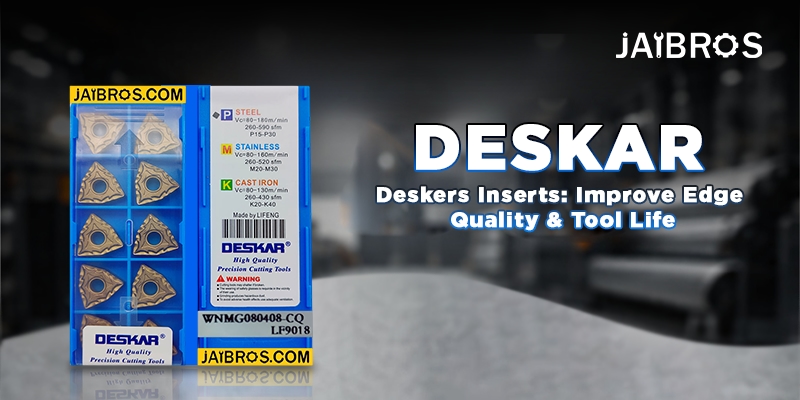
1. Excessive Cutting Tool Wear
One of the most common problems in CNC machining is rapid insert wear. When an insert loses its cutting ability too quickly, operators need to stop the machine frequently for tool replacement. This increases downtime and can affect production targets.
Excessive wear may occur because of incorrect cutting speed, unsuitable insert grade, high cutting temperatures, or abrasive workpiece materials. Selecting an insert designed for the material being machined is an important first step.
Before choosing Deskar Inserts, check the recommended grade for your workpiece material and machining conditions. The correct combination can help maintain cutting-edge performance and improve tool life.
2. Poor Surface Finish on Machined Components
A poor surface finish can create problems in applications where dimensional accuracy and appearance are important. It may result from a worn cutting edge, incorrect feed rate, vibration, or unsuitable insert geometry.
For finishing operations, the insert geometry and cutting edge play an important role. A suitable insert can help produce a cleaner machined surface when used with appropriate cutting parameters.
Machinists should also inspect the toolholder and machine setup. Even a good-quality insert may deliver inconsistent results if the tool is not properly clamped or the machine experiences excessive vibration.
3. Insert Chipping and Edge Breakage
Insert chipping usually happens when the cutting edge experiences excessive mechanical stress. Interrupted cuts, hard material spots, unstable clamping, and incorrect feed rates can contribute to this problem.
The insert grade and geometry should match the type of operation. Heavy roughing and finishing do not always require the same cutting-edge characteristics.
For example, an operation involving interrupted cuts may require a different edge-strength requirement compared with continuous finishing. Avoid selecting an insert only by its shape or price. Consider the workpiece material, cutting conditions, and operation before making a decision.
4. Incorrect Chip Formation and Chip Control
Chip control is another important part of efficient CNC machining. Long, tangled chips can interfere with the machining process, damage the workpiece surface, and create safety concerns for machine operators.
Chip formation depends on several factors, including feed rate, cutting speed, workpiece material, and chipbreaker design. Using an unsuitable insert geometry can make chip evacuation difficult.
When selecting Deskar Inserts, check whether the available chipbreaker and grade are suitable for your machining operation. Adjusting cutting parameters within the recommended range can also help improve chip formation.
5. Inconsistent Machining Dimensions
Dimensional variation can affect component quality and lead to rejected parts. Common reasons include insert wear, tool deflection, machine vibration, incorrect tool offsets, and improper clamping.
Regularly inspecting the cutting edge and checking tool offsets can help identify the source of dimensional changes. It is also important to use an insert that matches the required machining operation.
For different applications, machinists can explore suitable options in Jaibros' carbide insert collection and compare available insert types.
6. How to Select the Right Deskar Inserts
Choosing the right insert requires more than checking its dimensions. Consider these important factors before purchasing:
Workpiece material: Identify whether you are machining steel, stainless steel, cast iron, or another material.
Insert grade: Select a grade suitable for the material and cutting conditions.
Insert geometry: Consider the shape, cutting-edge strength, and chipbreaker requirements.
Machining operation: Turning, milling, grooving, and finishing may require different insert designs.
Toolholder compatibility: Confirm that the insert matches the holder specifications.
Cutting parameters: Follow suitable speed, feed, and depth-of-cut recommendations.
You can also explore Deskar cutting tools and inserts at Jaibros to review the available options for different machining requirements.
Conclusion
Common CNC machining problems such as excessive tool wear, insert chipping, poor surface finish, and inconsistent dimensions can affect production efficiency. Selecting the right insert for the material and machining operation is an important step towards reducing these issues.
Deskar Inserts can be considered for different machining requirements, but the final selection should always be based on grade, geometry, toolholder compatibility, and recommended cutting conditions. Along with proper machine setup and regular tool inspection, the right insert selection can support more consistent machining results and better production efficiency.