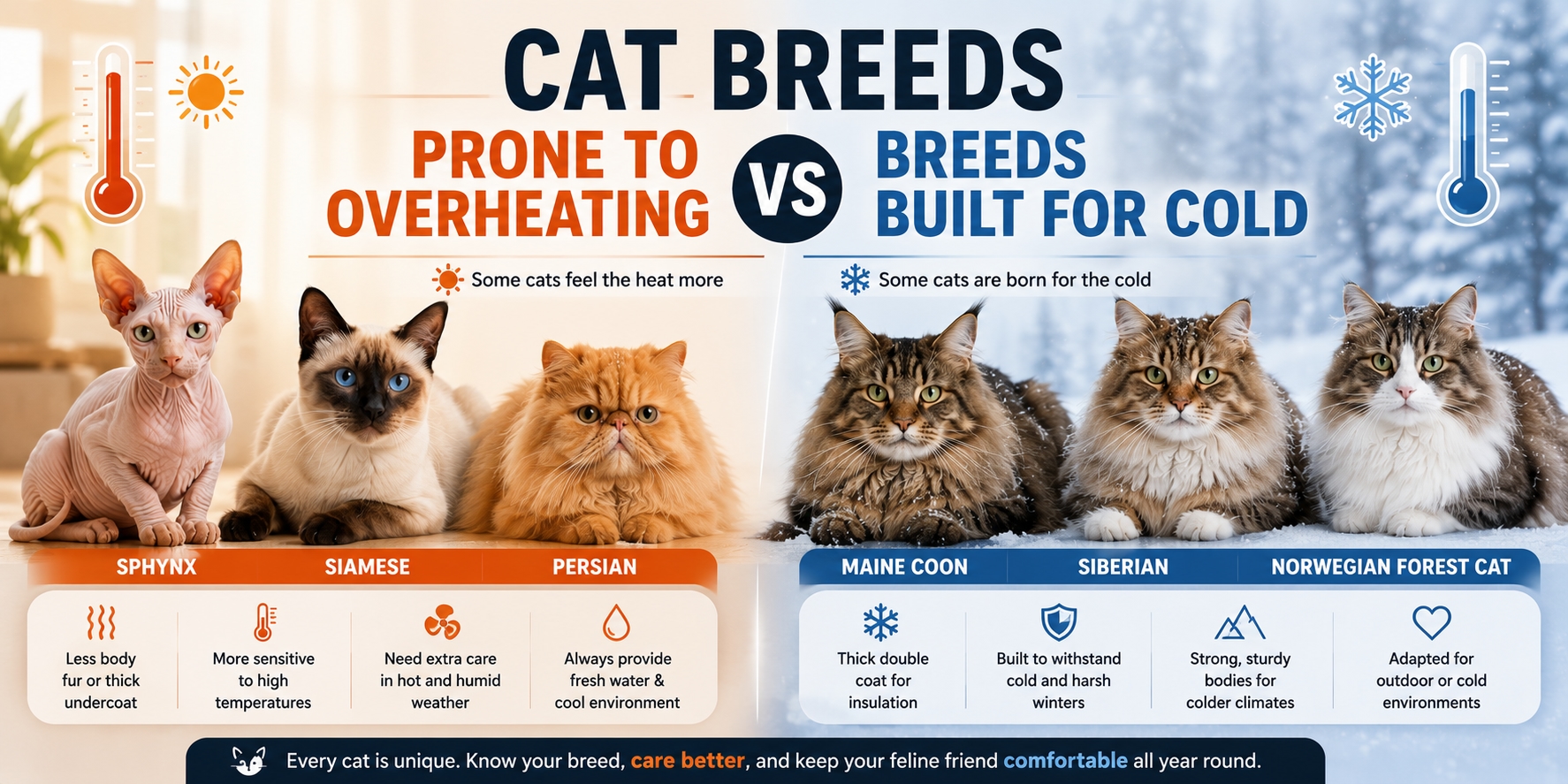
A Persian panting on a hot afternoon and a Siberian barely noticing the same temperature aren't reacting to personality differences — they're running on completely different thermal engineering, shaped by generations of breeding in opposite climates.
How Coat Structure Determines Heat Tolerance
A cat's ability to handle heat or cold comes down largely to coat density, undercoat presence, and, in some breeds, facial structure affecting airflow. Dense double coats that trap heat for cold-weather insulation become a liability in summer, while thin or minimal coats that struggle in winter tend to shed excess heat more easily.
Body shape plays a role too. Compact, low-slung breeds retain heat more than lean, longer-limbed breeds with more surface area relative to body mass, a basic thermodynamic pattern that shows up across mammal species generally.
Breathing structure matters most for flat-faced breeds, where shortened airways make heat regulation through panting-adjacent breathing less efficient than in longer-nosed breeds.
Breeds Prone to Overheating
Several breeds struggle disproportionately in hot conditions due to coat, body structure, or both.
The Persian, with its dense, long coat and flat facial structure, faces a double disadvantage in heat — the coat insulates against heat loss while the shortened airway limits efficient breathing-based cooling. This breed needs consistent access to cool, shaded, well-ventilated spaces during warm months, and outdoor time should be closely monitored even in mild heat.
The Himalayan, a Persian-related breed sharing similar facial structure and long coat, faces comparable heat challenges and benefits from the same cautious approach to warm-weather exposure.
The Maine Coon and Norwegian Forest Cat, despite being generally hardy breeds, can overheat more easily than their cold tolerance might suggest, since the same dense double coat that protects against winter cold traps heat just as effectively in summer. Both breeds need extra attention to cooling during hot months despite their reputation for climate resilience.
The British Shorthair, with its dense coat and stocky, low-slung build, also runs warmer than average in summer heat, benefiting from consistent access to cooler indoor spaces during peak temperatures.
Breeds Built for Cold, Not Heat
The cold-climate breeds discussed elsewhere for their winter tolerance carry that same coat structure as a heat liability during summer.
The Siberian, with its triple-layered coat developed for harsh Russian winters, is among the most cold-tolerant breeds available but correspondingly struggles more in extreme summer heat than shorter-coated breeds. Owners in hot climates with this breed should prioritize cooling measures during summer months.
The Turkish Van, despite a semi-long coat suited to a cooler mountainous origin, tends to shed more heavily in warmer climates as a natural adaptation, somewhat mitigating but not eliminating the heat challenge its coat presents.
Checking a full Cat Breeds List before assuming a cold-hardy breed automatically handles heat well too helps set realistic seasonal expectations, since cold tolerance and heat tolerance aren't mirror images of the same trait.
Breeds That Handle Heat Reasonably Well
Some breeds, generally those with shorter, thinner coats or minimal undercoat, tolerate warm conditions more comfortably than the breeds above.
The Siamese and Oriental Shorthair, with fine, close-lying coats and minimal undercoat, dissipate heat more efficiently than double-coated breeds, making them relatively comfortable in warmer climates, though they still need shade and water access during extreme heat.
The Sphynx, being hairless, loses heat readily and generally tolerates warm conditions better than most breeds, though this comes with the opposite tradeoff of poor cold tolerance and a need for sunburn protection during outdoor time in strong sun.
The Devon Rex and Cornish Rex, with thin, sparse coats, similarly handle heat reasonably well, though both breeds run cold in winter as the tradeoff for their warm-weather comfort.
Managing Heat for Vulnerable Breeds
For breeds prone to overheating, a few environmental adjustments make a meaningful difference during warm months.
Furniture placement matters more than people expect. Keeping a Cat Tree for Large Cats or any elevated resting spot away from direct sun exposure through windows prevents a cat from unknowingly settling into a hot spot that intensifies over the course of an afternoon.
An Outdoor Cat House used by a heat-sensitive breed needs proper ventilation and shade, not just weatherproofing against rain — a sealed structure in direct sun can trap heat well beyond safe levels even with good insulation otherwise designed for winter use.
A Cat Tunnel placed in a cooler part of the house gives a heat-sensitive cat a retreat option during peak afternoon temperatures, functioning as a cooling-down spot the way it might serve as a warming retreat in cold-focused setups.
Registry Notes on Climate Adaptation
Different Cat Breeds developed in specific climates carry documented coat and build standards tied to that origin, and both CFA's 45 recognized breeds and TICA's 73 include breed histories referencing original climate conditions for many cold- or heat-adapted breeds. This historical context helps explain why certain breeds handle one climate extreme well while struggling with the opposite.
Breed standards themselves rarely specify heat or cold tolerance directly as a formal criterion, focusing instead on physical traits like coat density and structure — tolerance is more of an inferred characteristic based on those documented physical standards than an explicitly rated trait.
Seasonal Care Adjustments by Breed Type
Cold-built breeds generally need more attention during summer than winter, while heat-tolerant, thin-coated breeds need the opposite seasonal focus.
For litter management during hot months, Clumping Cat Litter in a well-ventilated area helps reduce ambient odor intensification that heat can worsen, relevant across all breeds regardless of their specific temperature tolerance.
For UK-based owners, seasonal temperature swings tend to be less extreme than in continental climates, so a Cat Tree UK retailer's product line may emphasize different seasonal features than equivalent products sold in regions with more pronounced summer heat or winter cold.
FAQ
How can I tell if my cat is overheating rather than just resting? Signs of overheating include excessive panting, drooling, lethargy beyond normal rest, and seeking out unusually cool surfaces like tile or bathroom floors. Breeds prone to overheating should be monitored more closely during heat waves, and any of these signs combined with reduced responsiveness warrants prompt veterinary attention.
Should I shave a long-haired cat to help with heat tolerance? Full shaving is generally not recommended without veterinary guidance, since a cat's coat also protects against sunburn and regulates temperature in complex ways beyond simple insulation. Regular grooming to remove excess undercoat is usually a safer approach to managing heat than shaving.
Do heat-tolerant breeds need any special summer care at all? Even heat-tolerant breeds benefit from consistent water access, shade, and monitoring during extreme heat waves, since tolerance is relative rather than absolute. No breed is entirely immune to heat-related stress under severe enough conditions.