
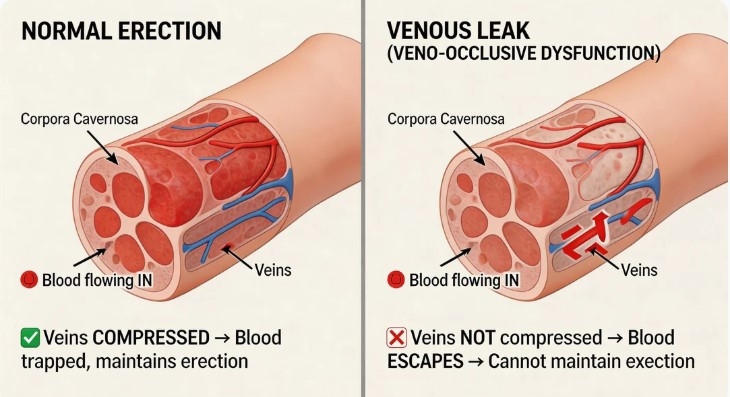
Venous leak is a condition associated with erectile dysfunction (ED) in which the penis has difficulty retaining enough blood to maintain a firm erection. Medically known as veno-occlusive dysfunction, this condition can cause erections to become soft before or during sexual intercourse, affecting sexual performance, confidence, and overall quality of life.
Yes, venous leak can often be managed without surgery. Depending on the underlying cause and severity of erectile dysfunction, non-surgical treatments such as oral medications, penile injections, vacuum erection devices, lifestyle changes, and psychological counseling may help improve erection quality. However, these treatments do not necessarily repair an underlying structural abnormality in the penile blood-retention mechanism.
The most appropriate treatment depends on an accurate diagnosis, the patient's general health, and how well previous treatments have worked. Not every man with difficulty maintaining an erection has venous leak, so medical evaluation is important before choosing a treatment.
In this article, we explore how venous leak can be managed without surgery, which treatments are available, what results patients may expect, and when specialist care may be necessary.
Understanding Venous Leak and Erectile Dysfunction
To understand how venous leak can be treated without surgery, it is helpful to know how a normal erection develops.
During sexual stimulation, blood flows into the penis through the penile arteries. The erectile tissues, known as the corpora cavernosa, expand as they fill with blood. This expansion compresses the veins responsible for draining blood from the penis, helping maintain a firm erection.
In venous leak, this blood-retention mechanism may not function effectively. Blood can leave the erectile tissues too readily, making it difficult to maintain sufficient rigidity.
Common symptoms associated with suspected venous leak include:
Difficulty maintaining an erection.
Loss of penile firmness during intercourse.
Erections that become soft shortly after developing.
Difficulty achieving sufficient rigidity for penetration.
Reduced sexual confidence because of repeated erection difficulties.
These symptoms are not exclusive to venous leak. Diabetes, reduced arterial blood flow, hormonal disorders, medication side effects, and psychological factors can cause similar problems.
A urologist may recommend a medical history, physical examination, relevant blood tests, and penile Doppler ultrasound when a vascular cause is suspected.
1. Oral Medications for Venous Leak
Oral medications are commonly used as a first-line treatment for erectile dysfunction. They may improve erection quality in some men with suspected or confirmed venous leak, although they do not necessarily correct the underlying venous abnormality.
The most commonly prescribed medicines belong to a group called phosphodiesterase type 5 (PDE5) inhibitors.
Examples include:
Sildenafil.
Tadalafil.
Vardenafil.
Avanafil.
These medications enhance the body's natural nitric oxide signaling pathway, helping relax smooth muscle and increase blood flow into the penis during sexual stimulation.
How do oral medications help?
By improving blood inflow and supporting the normal erectile response, PDE5 inhibitors may help some men achieve firmer erections and maintain them for longer.
Their effectiveness varies according to the underlying cause of erectile dysfunction, the severity of symptoms, and the individual's response to treatment.
A clinician may review the timing, dose, medication interactions, and use of sexual stimulation before concluding that a medicine has failed.
Do oral medications cure venous leak?
Oral medications can improve erectile function, but they do not necessarily repair a structural problem involving the penile veins or surrounding erectile tissues.
Some men obtain satisfactory erections with medication even when the underlying blood-retention mechanism remains abnormal. Others may need a different treatment or a combination of approaches.
Important safety information: PDE5 inhibitors must not be combined with nitrate medications because the combination can cause a dangerous drop in blood pressure. Medical guidance is particularly important for men with cardiovascular disease or those taking multiple medications.
2. Penile Injection Therapy
Penile injection therapy is another non-surgical treatment option for erectile dysfunction. It involves injecting prescribed medication directly into the erectile tissue to help produce an erection.
One medication used for this purpose is alprostadil. Specialists may also prescribe other medication combinations in appropriate circumstances.
How does injection therapy work?
These medicines act directly on the erectile tissues, helping relax smooth muscle and increase blood flow. This can produce an erection even when oral medication has not provided satisfactory results.
A specialist may consider injection therapy when:
Oral medications are ineffective.
Oral medications cannot be used safely.
Erectile dysfunction is more severe.
The patient prefers an alternative treatment after discussing the options.
Is injection therapy effective for venous leak?
Some men with suspected venous leak achieve satisfactory erections with injection therapy. However, the response depends on the underlying physiology and severity of the condition.
Injection therapy improves erectile function rather than necessarily repairing the cause of venous leakage.
What are the risks?
Possible side effects include penile pain, bruising, prolonged erection, and priapism. An erection lasting four hours or longer requires emergency medical attention.
The medication and dose must be prescribed and adjusted by a qualified clinician. Patients should not experiment with injections or increase doses without medical supervision.
3. Vacuum Erection Devices
A vacuum erection device is a non-surgical, drug-free option that may help men with erectile dysfunction.
The device consists of a cylinder placed over the penis and a pump that creates negative pressure. This draws blood into the erectile tissues. A constriction ring is then placed around the base of the penis to help maintain the erection by limiting blood outflow.
Benefits of vacuum erection devices
Potential benefits include:
No surgery is required.
The device does not depend on taking an oral medication.
It may be suitable for men who cannot use certain erectile dysfunction medicines.
It can help produce an erection during use.
It may be used as part of an individualized erectile dysfunction management plan.
Can a vacuum device help with venous leak?
A vacuum erection device may be particularly useful when difficulty retaining blood contributes to erection problems because the constriction ring helps reduce blood outflow.
However, the device does not repair the underlying venous mechanism. Its effectiveness and suitability vary between patients.
Possible disadvantages include bruising, discomfort, numbness, and a cool sensation in the penis.
The device should be used according to its instructions, and the constriction ring should generally not remain in place for longer than 30 minutes.
4. Lifestyle Changes to Improve Erectile Function
Lifestyle modifications are an important part of managing erectile dysfunction, especially when diabetes, smoking, obesity, or cardiovascular risk factors contribute to the problem.
Although lifestyle changes cannot be relied upon to correct a significant structural venous abnormality, they may improve general vascular health and support erectile function.
Regular physical activity
Exercise supports cardiovascular health, helps manage weight, and improves metabolic fitness. Activities such as walking, cycling, swimming, and strength training can be incorporated according to individual ability.
Men with existing medical conditions should seek guidance about an appropriate exercise routine.
Maintaining a healthy weight
Excess body weight is associated with diabetes, high blood pressure, cardiovascular disease, and other conditions that may affect erectile function.
Gradual, sustainable weight management can help improve these contributing risk factors.
Eating a balanced diet
A balanced diet rich in vegetables, fruit, whole grains, legumes, and appropriate sources of protein supports overall health.
Dietary improvements can help manage cholesterol, blood glucose, and blood pressure, but no specific food has been proven to cure venous leak.
Quitting smoking
Smoking damages blood vessels and contributes to endothelial dysfunction. Stopping smoking can improve overall vascular health and reduce cardiovascular risk.
However, smoking cessation does not guarantee that an established venous abnormality will resolve.
Limiting alcohol
Excessive alcohol consumption can interfere with sexual arousal and erectile function. Reducing alcohol intake may help some men improve their sexual health.
Managing diabetes and blood pressure
Good control of diabetes, high blood pressure, and cholesterol is important for protecting blood vessels and nerves.
A healthcare professional can recommend appropriate monitoring, medication, and lifestyle measures based on the patient's individual needs.
5. Psychological Counseling and Sex Therapy
Erectile dysfunction is not always caused exclusively by a physical problem. Anxiety, depression, relationship difficulties, and sexual performance pressure may contribute to erection problems or worsen an existing vascular condition.
Repeated unsuccessful sexual experiences can create a cycle in which worry about losing an erection interferes with arousal and makes subsequent erections more difficult to maintain.
Psychological counseling or sex therapy may help address these factors.
How can counseling help?
Depending on the patient's needs, treatment may include:
Cognitive behavioral therapy.
Techniques for managing performance anxiety.
Stress management.
Support for relationship concerns.
Sexual education and communication strategies.
Psychological treatment does not repair a structural venous abnormality, but it may improve sexual confidence and overall treatment outcomes when psychological factors contribute.
Seeking counseling does not mean that erectile dysfunction is imaginary. Physical and psychological causes can coexist and should both be considered when appropriate.
6. Low-Intensity Shockwave Therapy
Low-intensity extracorporeal shockwave therapy has been studied as a treatment for certain forms of erectile dysfunction, particularly vasculogenic erectile dysfunction.
The procedure uses low-intensity acoustic energy applied to penile tissues, with the aim of influencing vascular and tissue responses.
However, the quality of evidence and reported benefits vary between studies and treatment protocols.
Shockwave therapy has not been established as a reliable method for permanently repairing a confirmed venous leak. Patients should be cautious about claims that the procedure closes leaking veins, guarantees a permanent cure, or eliminates the need for other treatment.
A urologist can explain whether this treatment is appropriate, what the evidence shows, and which established alternatives are available.
7. Platelet-Rich Plasma (PRP) Therapy
Platelet-rich plasma, commonly called PRP, is prepared from a patient's blood and contains a concentrated amount of platelets and associated signaling substances.
PRP injections have been promoted for erectile dysfunction, but evidence regarding their safety and effectiveness remains insufficient to establish them as a routine treatment.
There is no strong clinical evidence that PRP reliably repairs the blood-retention mechanism responsible for venous leak.
Patients should be cautious about expensive treatments marketed as proven regenerative cures, especially when providers promise permanent results without adequate scientific support.
8. Can Lifestyle Changes Alone Cure Venous Leak?
Whether lifestyle changes alone can resolve erectile dysfunction depends on the underlying cause.
If the symptoms are influenced by factors such as smoking, obesity, poorly controlled diabetes, or cardiovascular risk, addressing these issues may improve erectile function.
However, when a significant structural abnormality affects the erectile tissues or their ability to compress the veins, lifestyle changes alone may not provide sufficient improvement.
It is therefore important to distinguish between supporting erectile health and correcting an established venous abnormality.
A combined approach involving lifestyle changes, appropriate medication, and management of underlying medical conditions may provide better results than relying on one intervention alone.
9. How Is Venous Leak Confirmed Before Treatment?
Not every man who loses an erection during sexual activity has venous leak. Confirming the diagnosis helps avoid unnecessary treatment and unrealistic expectations.
A medical evaluation may include the following.
Medical history
The clinician asks about erection quality, symptom duration, morning erections, sexual desire, medical conditions, medications, and lifestyle factors.
Physical examination
An examination may identify penile abnormalities or other findings relevant to erectile dysfunction.
Blood tests
Depending on the clinical history, testing may assess diabetes, cholesterol, testosterone, or other hormonal and metabolic factors.
Penile Doppler ultrasound
When a vascular cause is suspected, penile Doppler ultrasound may be performed after medication is administered to produce an erection.
The test evaluates blood flow through the penile arteries and the pattern of venous outflow. Results must be interpreted in the context of the erection achieved during testing because an incomplete response or technical factors may affect accuracy.
A specialist may recommend additional investigations in selected cases, but invasive vascular testing is not necessary for every patient.
10. When Is Surgery Considered?
Non-surgical treatments are suitable for many men with erectile dysfunction, but they do not work equally well for everyone.
If appropriate medication, injection therapy, vacuum devices, and other conservative approaches fail to provide satisfactory results, a urologist may discuss further options.
A penile implant is an established surgical treatment for selected men with erectile dysfunction that does not respond adequately to less invasive therapies.
Specialized procedures intended to block or ligate penile veins have also been investigated, but their long-term effectiveness is inconsistent, and they are not generally recommended as routine treatment.
Surgery should never be presented as the only option for every patient with suspected venous leak. The decision depends on the diagnosis, treatment response, personal preferences, and a careful discussion of benefits and risks.
11. How Long Does Non-Surgical Treatment Take to Work?
The time required to improve erections varies by treatment.
Oral medication: The time to effect depends on the specific medicine and how it is used.
Penile injections: An erection may develop within minutes, depending on the medication and prescribed dose.
Vacuum erection devices: An erection can be produced during use when the device is applied correctly.
Lifestyle changes: Benefits may develop gradually over weeks or months.
Psychological counseling: Improvement may occur over several sessions and depends on the contributing factors.
Treatment response varies, and some men need to try more than one medically appropriate option.
Follow-up appointments help evaluate effectiveness, manage side effects, and determine whether the treatment plan should be adjusted.
12. Can Venous Leak Be Treated Without Surgery Permanently?
Non-surgical treatment may provide lasting improvement in sexual function for some men, but it does not necessarily eliminate the underlying venous abnormality.
For example, managing diabetes, stopping smoking, or treating a contributing medical condition may improve erections when these factors play an important role. Medication and vacuum devices may also provide satisfactory erections while they are being used.
However, a structural problem with the erectile tissues or blood-retention mechanism may persist despite successful symptom management.
There is no universally effective non-surgical treatment that guarantees permanent anatomical correction of venous leak.
The realistic goal is to identify the cause, improve erectile function, address relevant health conditions, and choose a treatment that provides satisfactory results with acceptable risks.
13. When Should You See a Urologist?
Consider seeing a urologist or qualified sexual medicine specialist if:
You repeatedly struggle to maintain an erection.
Erections have become consistently weaker.
Erectile difficulties are affecting your relationships or quality of life.
You have diabetes, high blood pressure, or cardiovascular disease.
Symptoms began after a penile or pelvic injury.
You are considering injection therapy or a specialized procedure.
Over-the-counter products have not helped or may be causing side effects.
Seek emergency medical attention if an erection lasts four hours or longer, particularly after taking erectile dysfunction medication or receiving an injection.
Early evaluation can help identify treatable causes and determine which non-surgical options are appropriate.
Frequently Asked Questions
1. Can venous leak be treated without surgery?
Yes. Depending on the underlying cause and severity, treatment may include oral medication, penile injections, vacuum erection devices, lifestyle changes, and psychological counseling. These approaches may improve erections without surgically correcting the venous abnormality.
2. What is the best non-surgical treatment for venous leak?
There is no single best treatment for everyone. PDE5 inhibitors are commonly used first-line medicines for erectile dysfunction, while injections and vacuum devices may be appropriate when oral medication is ineffective or unsuitable.
3. Can sildenafil cure venous leak?
Sildenafil can improve erectile function in some men with venous leak, but it does not necessarily repair the underlying blood-retention mechanism. Its suitability depends on the patient's health and medication use.
4. Can venous leak improve naturally?
Some men experience improvement when contributing factors such as smoking, obesity, poor metabolic health, or performance anxiety are addressed. However, a significant structural venous abnormality may not resolve through lifestyle changes alone.
5. Does a vacuum pump work for venous leak?
A vacuum erection device may help produce an erection by drawing blood into the penis, while a constriction ring helps reduce blood outflow. It can be useful for some men, although it does not repair the underlying condition.
6. Is shockwave therapy effective for venous leak?
Shockwave therapy has been investigated for some forms of erectile dysfunction, but it is not an established method for permanently repairing confirmed venous leak. Benefits and long-term outcomes remain uncertain.
7. Can venous leak be cured with supplements?
No supplement has been established as a reliable cure for venous leak. Unregulated products may contain undeclared ingredients or interact dangerously with prescription medicines.
8. How do doctors determine whether surgery is necessary?
Doctors assess the diagnosis, severity of erectile dysfunction, underlying health conditions, and response to non-surgical treatments. Surgery is generally considered when less invasive options do not provide satisfactory results or when an informed patient chooses an appropriate surgical option.
9. Can young men treat venous leak without surgery?
Yes. Younger men may benefit from non-surgical treatment, but the first step is to establish the cause of their erectile difficulties. Anxiety, medication effects, hormonal problems, and vascular abnormalities can produce similar symptoms.
10. Which doctor should I consult for venous leak?
A urologist or qualified sexual medicine specialist can evaluate suspected venous leak, arrange appropriate testing, and recommend a treatment plan based on your individual needs.
Conclusion
Venous leak can often be managed without surgery, depending on the underlying cause and severity of erectile dysfunction. Oral medications, penile injections, vacuum erection devices, lifestyle changes, and psychological counseling are among the available options.
These treatments may improve erection quality and sexual satisfaction, although they do not necessarily repair an underlying structural abnormality in the penile blood-retention mechanism. Shockwave therapy and PRP should be approached cautiously because evidence supporting their use for confirmed venous leak remains limited.
The most important step is to obtain an accurate diagnosis before selecting a treatment. A qualified urologist can help determine whether venous leak is present, assess contributing health conditions, and recommend an appropriate approach.
With an individualized treatment plan and appropriate follow-up, many men can improve erectile function and quality of life without undergoing surgery.
Medical disclaimer: This article is intended for general educational purposes and does not replace professional medical advice, diagnosis, or treatment.