
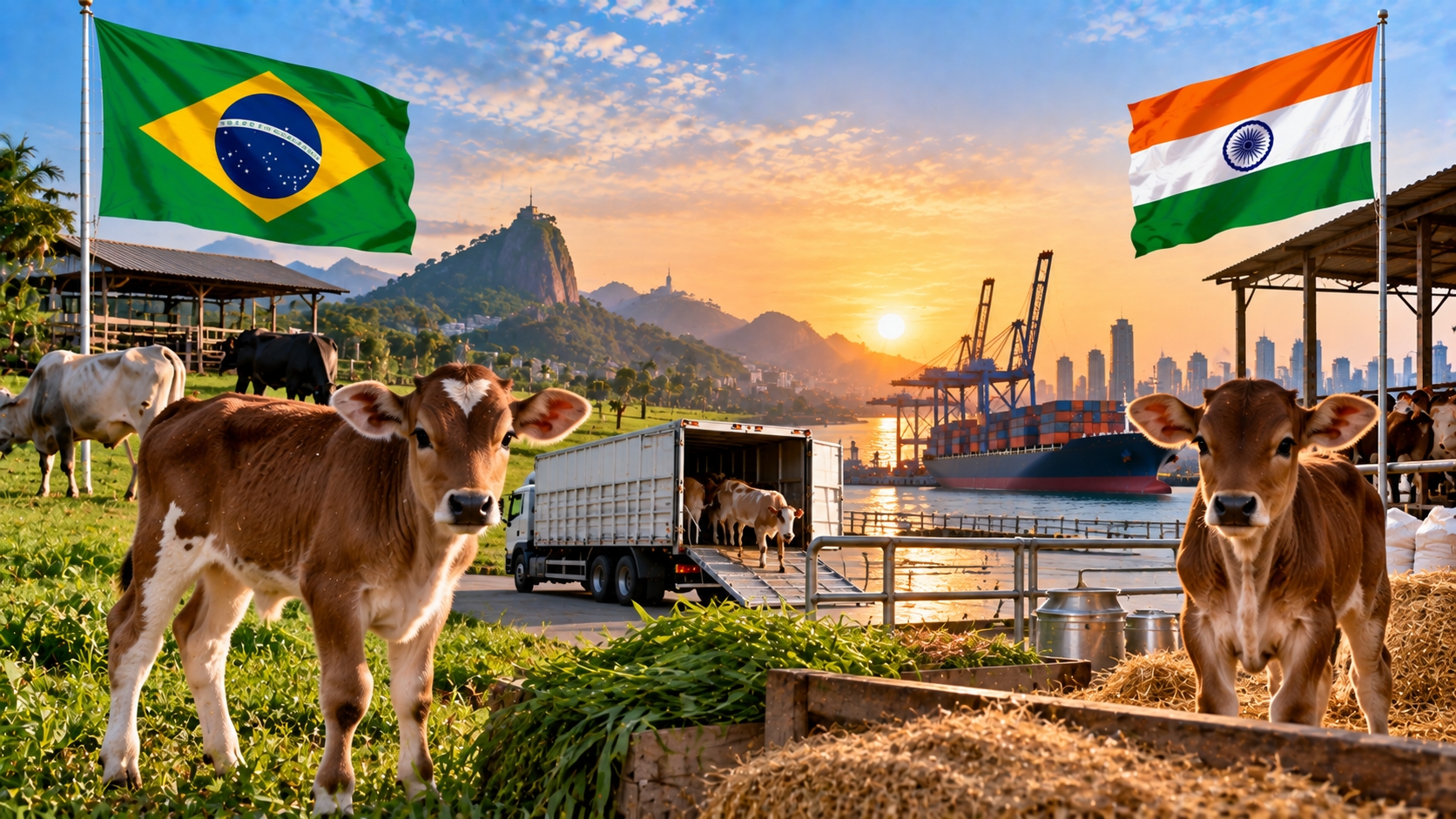
Calf Price Trend: Why Brazil and India Are Worlds Apart Right Now
Pull up the calf price trend for October 2026 and the first thing you’ll notice isn’t the number itself. It’s the gap between them. Brazil’s calf price sits at USD 674.86 per unit, EXW. India’s comes in at USD 181.81 per unit, also EXW. That’s not a small spread. That’s nearly four times the price, same product, same incoterm basis, two different worlds of livestock economics.
If you’re buying, selling, or just trying to make sense of where global livestock costs are heading, that gap tells you something worth paying attention to.
Calf Latest Prices October 2026
Product | Region | Incoterm Basis | Price | Last Updated |
|---|---|---|---|---|
Calf | Brazil | EXW | USD 674.86/Unit | October 2026 |
Calf | India | EXW | USD 181.81/Unit | October 2026 |
Price Source: Procurement Resource
Both figures are EXW, so freight, insurance, and export handling aren’t baked into either number. What you’re seeing is close to the raw farm-gate cost in each country. And honestly, that makes the gap even more interesting, because it strips away the usual excuse of “oh, shipping made it expensive.”
Why Brazil’s Calves Cost So Much More
Brazil runs a large-scale, export-oriented cattle industry. Genetics, feed quality, breeding programs, veterinary infrastructure, all of it is built around producing animals that meet international beef and dairy standards. That infrastructure isn’t cheap to maintain, and the cost shows up at the farm gate.
There’s also demand pressure. Brazilian beef exports have been strong for years, and when export demand pulls on the supply chain, domestic calf prices tend to climb right along with it. Ranchers raising calves destined for feedlots know their animals are competing for space in a market with real international buyers at the other end.
Land and labor costs matter too. Large cattle operations in Brazil aren’t working with the same cost base as smallholder farms elsewhere. Scale brings efficiency in some areas, but it also brings higher input costs tied to formal labor, compliance, and logistics across a massive country.
Why India’s Prices Sit So Much Lower
India’s dairy and livestock sector works on a completely different model. Millions of smallholder farmers, often with just a handful of animals, dominate the supply side. That structure keeps overhead low. There’s no equivalent to Brazil’s large commercial feedlot system driving up input costs across the board.
Domestic consumption patterns play a role as well. India’s cattle economy leans heavily toward dairy, not beef export, which changes what buyers are actually paying for. A calf raised for dairy purposes doesn’t carry the same cost structure as one being fattened for export-grade beef.
Currency and purchasing power differences factor in too, but honestly, that’s only part of the story. The deeper reason is structural. Smaller farms, lower labor costs, a domestic-first market. Put all three together and USD 181.81 per unit starts to make sense.
What This Spread Actually Means for Buyers
If you’re sourcing livestock or advising a client who does, this isn’t just a curiosity. A few things worth thinking through:
Buyers looking at India’s lower price point need to factor in that the product itself may not be equivalent to what Brazil offers in terms of breed quality or export readiness. Comparing EXW prices without comparing use-case is a mistake procurement teams make more often than they’d like to admit.
For investors watching livestock markets, Brazil’s higher price reflects a more mature, export-driven system, one with established infrastructure and demand. That’s not necessarily a bad thing. It often signals reliability over cheap volatility.
Anyone advising clients on sourcing strategy should flag that currency movements, feed costs, and seasonal breeding cycles can shift these numbers within a few months. October 2026 figures are a snapshot, not a locked-in forecast.
What To Watch Going Forward
The calf price trend between these two markets probably won’t converge anytime soon. The structural differences run too deep. Brazil’s system is built for scale and export. India’s is built for domestic dairy supply through smallholder farming. Those are two different economic models producing two very different price points, and that’s likely to stay the case through the rest of 2026.
What could shift things is feed cost volatility (grain prices have a real effect on raising costs in both countries) and any changes in export demand out of Brazil specifically. If global beef demand softens, Brazilian calf prices could ease slightly. If it strengthens, expect the gap to widen further rather than close.
For procurement teams tracking calf price movements across global markets, keeping an eye on both feed cost trends and export demand signals will matter more than watching the headline number alone.
FAQ Section
What is the current calf price trend for October 2026?
As of October 2026, Brazil’s calf price stands at USD 674.86 per unit EXW, while India’s is USD 181.81 per unit EXW. Both figures exclude freight and insurance, reflecting close to farm-gate cost in each country.
Why is Brazil’s calf price so much higher than India’s?
Brazil’s export-oriented cattle industry, higher input costs, and strong international beef demand push prices up. India’s smallholder-dominated, dairy-focused livestock sector operates with far lower overhead, which keeps its calf prices significantly lower by comparison.
Can buyers compare Brazil and India calf prices directly?
Not really, not without context. The two markets serve different purposes, export-grade beef cattle versus domestic dairy stock, so the price gap reflects more than just cost of production. Use case and breed quality matter just as much as the raw number.
How often do calf prices change?
Livestock prices shift with feed costs, seasonal breeding cycles, and export demand, sometimes within a few weeks. October 2026 figures are a useful benchmark, but anyone negotiating a purchase should confirm current rates rather than relying on older data.
Will the Brazil-India calf price gap close anytime soon?
Unlikely in the near term. The gap comes from structural differences, Brazil’s export-scale system versus India’s smallholder dairy model, not short-term market noise. Expect the spread to persist, and possibly widen, depending on global beef demand trends.





