Non-fungible tokens (NFTs) have evolved from digital collectibles into a broader technology for representing unique digital and real-world assets. From artwork and gaming items to virtual assets, memberships, collectibles, and digital certificates, NFTs can provide businesses with new ways to create, manage, distribute, and monetize unique assets.
However, launching a successful NFT project requires more than simply minting a token. Businesses need a secure platform, intuitive user experience, reliable blockchain integration, smart contracts, wallet connectivity, scalable infrastructure, and a well-defined business model.
This is where professional NFT Platform Development becomes important.
By working with an experienced NFT Development Company, businesses can transform their NFT concepts into customized platforms designed around their specific requirements, target audience, blockchain ecosystem, and business objectives.
What Is NFT Platform Development?
NFT Platform Development is the process of creating a blockchain-powered ecosystem where users can create, mint, manage, buy, sell, transfer, and interact with non-fungible tokens.
An NFT platform can be designed for a specific industry or use case. For example, an organization may build an NFT marketplace for digital art, a gaming asset platform, a collectible ecosystem, an NFT launchpad, or an e-commerce platform that incorporates tokenized digital assets.
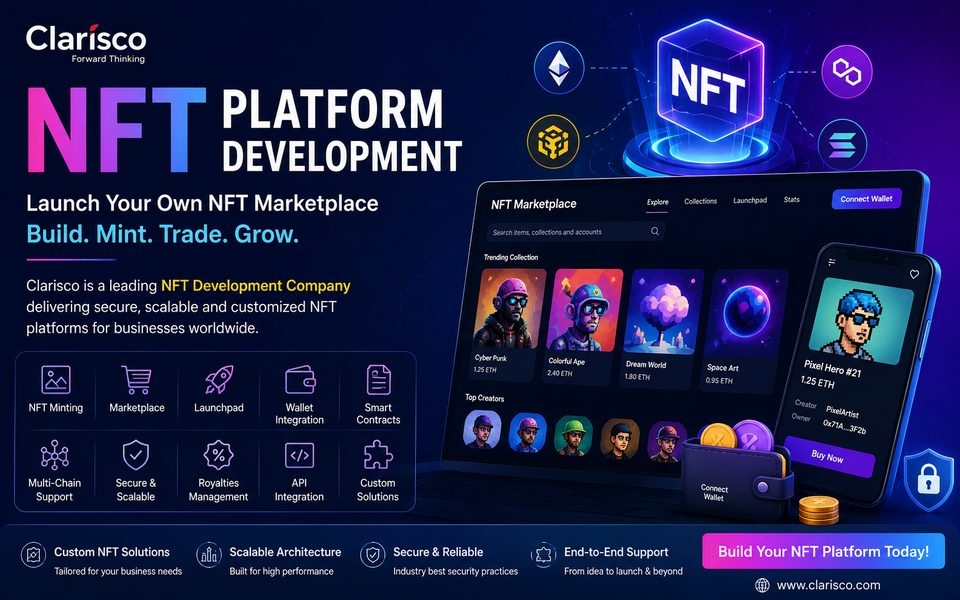
Unlike a basic NFT marketplace, a customized NFT platform can be designed around a complete business model. This may include creator tools, NFT minting, marketplace functionality, wallet integration, smart contracts, analytics, user management, and other Web3 features.
Clarisco describes its NFT development offering as a customizable platform approach with API and external wallet integration, interactive UI design, and infrastructure designed to handle traffic and provide transparency.
Why Businesses Are Investing in NFT Platforms
NFTs can provide businesses with a digital framework for establishing uniqueness and ownership around assets.
For creators, NFTs can provide new ways to distribute digital work. For gaming businesses, they can represent in-game assets. Brands can explore NFTs for digital collectibles and community engagement, while enterprises can investigate tokenization for selected digital or physical assets.
Some potential applications include:
Digital artwork
Gaming assets
Virtual collectibles
Metaverse assets
Music and entertainment
Sports collectibles
Brand memberships
Digital certificates
Event-based assets
E-commerce applications
Digital identity and access
Tokenized physical assets
The opportunity is not limited to one type of NFT. The underlying platform can be customized according to the business use case.
Key Components of an NFT Platform
A successful NFT Platform Development project requires several interconnected components.
1. NFT Minting
NFT minting converts digital assets into blockchain-based tokens according to the selected token standard and platform architecture.
A customized platform can provide creators with a streamlined process for uploading assets, adding metadata, defining attributes, and initiating the minting process.
2. NFT Marketplace
An NFT marketplace can allow users to list, discover, purchase, sell, and trade NFTs.
Depending on the business model, the marketplace can support fixed-price sales, auctions, collections, creator profiles, filters, search functionality, and transaction management.
3. Crypto Wallet Integration
Wallet connectivity is an essential part of many Web3 platforms.
Wallet integration allows users to connect their blockchain wallets, interact with smart contracts, authorize transactions, and manage NFT ownership.
Clarisco's NFT development page specifically highlights API and external wallet integration as part of its platform capabilities.
4. Smart Contract Development
Smart contracts can automate important NFT operations according to predefined rules.
They may be used for minting, transfers, marketplace transactions, royalty mechanisms, auctions, and other platform functions.
Smart contract architecture should be designed carefully, tested thoroughly, and audited where appropriate because vulnerabilities can create significant security and financial risks.
5. NFT Collection Management
Creators and businesses may need dedicated tools for managing multiple NFT collections.
Collection management functionality can include asset organization, metadata, pricing, royalty settings, ownership information, and collection-level analytics.
6. Search and Discovery
As an NFT ecosystem grows, users need simple ways to discover relevant assets.
Advanced search and filtering can organize NFTs by category, creator, collection, price, rarity, blockchain, popularity, or other attributes.
7. User Dashboard
A user dashboard can provide a centralized view of:
Owned NFTs
Created NFTs
Collections
Transaction history
Favorites
Listings
Bids
Wallet activity
A well-designed dashboard can make the platform easier to navigate for both experienced Web3 users and newcomers.
NFT Launchpad Development
An NFT launchpad can provide creators, artists, projects, and businesses with an environment for introducing new NFT collections.
The platform can be designed to support collection creation, minting campaigns, creator profiles, promotional activities, and NFT distribution.
Clarisco's published NFT development page highlights NFT launchpad development and describes creator-focused platform functionality intended to provide transparency and dedicated presentation for creators.
For businesses building an NFT ecosystem, a launchpad can become an important component for attracting creators and continuously introducing new collections.
NFT E-Commerce Platform Development
The growth of NFTs has also created opportunities for e-commerce businesses to explore blockchain-based digital assets.
An NFT-enabled e-commerce platform can combine traditional digital commerce concepts with tokenized assets. Depending on the use case, businesses can offer digital collectibles, membership assets, certificates, exclusive content, or other blockchain-based products.
Clarisco's NFT development offering specifically discusses NFT e-commerce solutions and customization for businesses looking to incorporate NFTs into their commercial platforms.
This approach can help businesses experiment with new digital ownership and customer engagement models.
Custom NFT Platform Development
Every NFT business has different requirements.
A gaming company may need an NFT platform for in-game assets, while an artist-focused marketplace may prioritize creator tools and auctions. A brand may require NFT-based memberships, whereas an enterprise may need integration with an existing application.
Custom NFT Platform Development allows businesses to build functionality around their specific requirements rather than relying entirely on a generic marketplace.
Customization can cover:
User interface
Blockchain network
Smart contract architecture
Wallet integration
Marketplace functionality
NFT standards
Royalty mechanisms
Admin controls
APIs
Analytics
Security features
Business-specific workflows
Clarisco presents custom NFT development as an option for businesses seeking tailored NFT marketplaces and solutions based on their requirements.
Security Should Be a Priority
NFT platforms interact with valuable digital assets, wallets, and blockchain networks. Security therefore needs to be considered throughout the development lifecycle.
A robust platform should consider:
Smart contract security
Wallet security
Authentication
Access control
API protection
Transaction validation
Data security
Fraud prevention
Vulnerability testing
Regular maintenance
Blockchain provides transparency, but the overall platform still needs secure application architecture.
Security should not be treated as a final-stage feature. It should be incorporated from the planning and architecture stages.
Choosing the Right NFT Development Company
Selecting the right NFT Development Company can have a major impact on the success of a Web3 project.
Before choosing a development partner, businesses should evaluate several factors.
Blockchain Expertise
Check whether the company has experience with the blockchain networks and standards required for your project.
Development Portfolio
Review previous NFT marketplaces, tokenization projects, Web3 applications, gaming platforms, and other blockchain products.
Customization Capabilities
A good development partner should be able to adapt the platform to your business model rather than forcing your requirements into a fixed solution.
Security Practices
Ask about smart contract development, testing, audits, wallet security, and application-level security.
UI/UX Experience
NFT platforms should not be unnecessarily complicated. An intuitive interface can help attract users who are unfamiliar with blockchain technology.
Scalability
The architecture should be capable of supporting increasing users, NFT collections, transactions, and integrations.
Post-Launch Support
Blockchain technology continues to evolve. Long-term maintenance, upgrades, security improvements, and technical support are important after launch.
Why Choose Clarisco for NFT Platform Development?
Clarisco positions itself as an NFT development provider offering customized NFT solutions for businesses. Its published service portfolio includes NFT platform development, NFT launchpad development, NFT e-commerce solutions, custom NFT development, and NFT-related marketplace solutions.
The company also highlights interactive UI design, customization, API integration, external wallet integration, and platform infrastructure designed for high traffic and resilience.
For businesses exploring NFT products, this type of full-cycle approach can help bring together blockchain technology, product design, smart contracts, wallet connectivity, and business-specific functionality under one development strategy.
The Future of NFT Platforms
NFT technology is continuing to expand beyond the initial focus on digital collectibles.
Future NFT platforms can potentially combine NFTs with gaming, artificial intelligence, metaverse environments, decentralized finance, e-commerce, digital identity, memberships, and real-world asset applications.
The most successful platforms are likely to focus on utility rather than simply creating tokens. Users need a clear reason to own, use, trade, or interact with an NFT.
This makes platform design, user experience, security, and business strategy just as important as blockchain technology.
Final Thoughts
NFTs offer businesses a new way to represent unique digital assets and create blockchain-based ownership ecosystems. However, turning an NFT concept into a reliable product requires careful planning, technical expertise, security, and a user-focused approach.
Professional NFT Platform Development can help businesses create customized ecosystems for marketplaces, gaming, digital art, e-commerce, collectibles, memberships, and other applications.