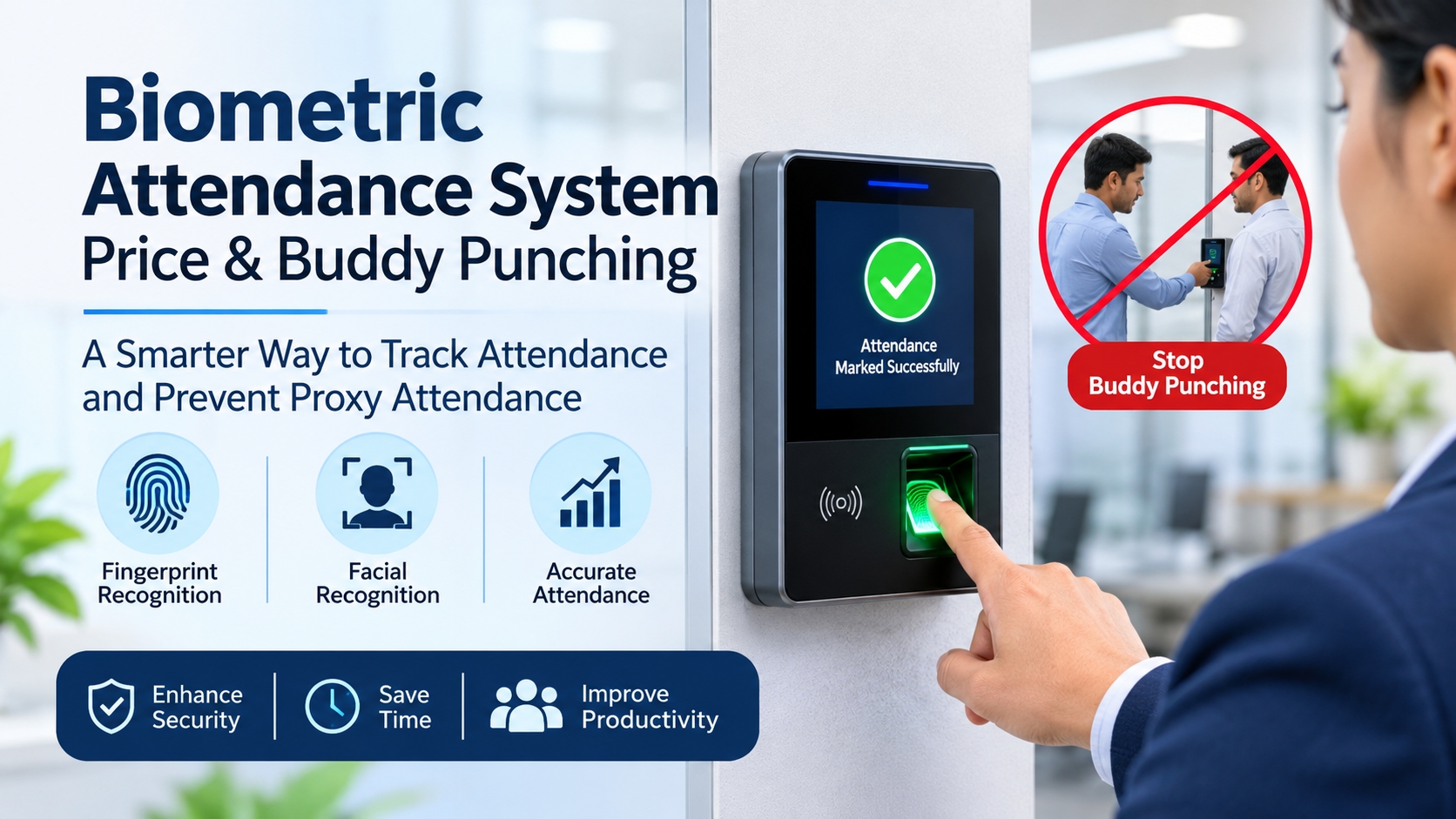
Managing employee attendance is an important part of running a successful business. Organizations need accurate attendance records to monitor working hours, maintain employee accountability, and manage payroll efficiently.
However, traditional attendance methods can create several problems. Employees may forget to sign attendance registers, HR teams may make manual errors, and some workplaces may experience buddy punching, where one employee marks attendance on behalf of another.
A biometric attendance system offers a technology-based approach to these challenges. By using fingerprint scanning and facial recognition, businesses can make attendance recording more organized and reliable.
In this article, we will explore how biometric attendance systems work, their benefits, biometric attendance machine prices, and how they help prevent buddy punching.
What Is a Biometric Attendance System?
A biometric attendance system is a digital solution that records employee attendance by verifying unique physical characteristics.
Instead of using paper registers or depending entirely on attendance cards, employees can verify their identity through biometric devices.
Common biometric identification methods include:
Fingerprint Recognition: Employees scan their fingerprints to record attendance.
Facial Recognition: The system identifies employees by analyzing their facial features.
Iris Recognition: The device uses unique patterns in the eye for identification.
Palm Recognition: Employees verify their identity through palm characteristics.
These systems help organizations maintain more accurate attendance records and reduce manual administrative work.
How Does a Biometric Attendance Machine Work?
A biometric attendance machine follows a simple process to record employee working hours.
Step 1: Employee Registration
The employee's biometric information is registered in the attendance system with their employee details.
Step 2: Identity Verification
When employees arrive at the workplace, they scan their fingerprint or face using the biometric device.
Step 3: Attendance Recording
After successful verification, the system records the employee's attendance along with the date and time.
Step 4: Data Management
Attendance information is stored and processed through connected attendance software.
Step 5: Report Generation
HR teams and managers can access attendance reports to monitor working hours, late arrivals, absences, and overtime.
What Is the Biometric Attendance Machine Price in India?
One of the most common questions businesses ask before adopting biometric technology is how much a biometric attendance machine costs.
The price depends on the device type, recognition technology, employee capacity, connectivity, software features, and manufacturer.
Here are indicative price ranges for the Indian market in 2026.
Machine type | Approximate price |
|---|---|
Basic fingerprint machine | ₹3,000–₹7,000 |
Advanced fingerprint machine | ₹7,000–₹12,000 |
Face recognition machine | ₹7,000–₹20,000 |
Advanced AI face recognition machine | ₹15,000–₹35,000+ |
Multi-biometric attendance device | ₹20,000–₹60,000+ |
Factors That Affect Biometric Attendance Machine Prices
Before purchasing a biometric device, businesses should understand the factors that influence its price.
1. Recognition Technology
Fingerprint machines are generally more affordable than advanced facial recognition devices. Multi-biometric machines may cost more because they support multiple verification methods.
2. Employee Capacity
A machine designed for a small office may not support the requirements of a large factory or enterprise. Higher employee capacity can increase the device price.
3. Connectivity Options
USB, Wi-Fi, LAN, and cloud connectivity affect how attendance information is transferred and accessed.
4. Software Integration
Some devices come with basic attendance software, while others support advanced reporting and integration with HRMS and payroll platforms.
5. Installation and Maintenance
Installation, cabling, warranty, annual maintenance, and technical support should also be considered when calculating the overall investment.
Businesses should compare the complete system cost rather than choosing a machine based only on its initial price.
What Is Buddy Punching in Employee Attendance?
Buddy punching is a common attendance-related problem in some workplaces.
It occurs when one employee marks attendance on behalf of another employee who is absent or arrives late.
For example, imagine an employee who is running late for work. Instead of recording their own arrival, they ask a colleague to punch their attendance card or enter their attendance details.
This creates inaccurate attendance records and makes it difficult for managers to understand actual employee working hours.
Why Is Buddy Punching a Problem?
Buddy punching can affect organizations in several ways.
Incorrect Attendance Records: Employee attendance information does not reflect actual working hours.
Payroll Errors: Businesses may pay employees for hours they have not worked.
Reduced Accountability: Employees may become less responsible about reporting to work on time.
Productivity Issues: Managers may find it difficult to monitor actual workforce availability.
Administrative Challenges: HR teams may spend additional time investigating attendance discrepancies.
For organizations with large workforces, repeated buddy punching can create significant administrative and payroll challenges.
How Does a Biometric Attendance System Prevent Buddy Punching?
A biometric attendance system helps reduce buddy punching by requiring employees to verify their identity using their registered biometric information.
Unlike traditional attendance cards or PIN-based systems, biometric verification connects attendance records to an individual's physical characteristics.
Here is how it helps:
1. Individual Identity Verification
Employees must use their own registered fingerprint or face to record attendance.
2. Reduced Attendance Manipulation
Colleagues cannot simply exchange attendance cards or share PINs to record attendance for one another.
3. More Reliable Attendance Records
Each successful verification creates an attendance entry associated with the registered employee.
4. Better Workforce Monitoring
Managers can review attendance information and identify unusual patterns that may require further investigation.
5. Improved Payroll Accuracy
More reliable attendance information helps HR teams prepare working-hour calculations and payroll records.
However, biometric systems are not completely foolproof. Organizations should choose devices with suitable anti-spoofing features, secure their employee data, and maintain clear attendance policies.
Benefits of Using a Biometric Attendance System
Biometric attendance technology offers several advantages for organizations of different sizes.
1. Improved Attendance Accuracy
Biometric verification helps reduce incorrect entries and provides a more reliable record of employee attendance.
2. Reduced Manual Work
Automated attendance recording reduces the need for paper registers and repetitive spreadsheet updates.
3. Better Employee Accountability
Employees become more responsible for recording their own attendance because identity verification is required.
4. Simplified Payroll Preparation
Accurate working-hour records help HR teams manage payroll-related calculations more efficiently.
5. Convenient Attendance Monitoring
Connected attendance software allows authorized managers to review employee attendance information through centralized dashboards.
6. Better Workforce Management
Organizations can combine attendance tracking with leave management, shift scheduling, overtime monitoring, and reporting.
How to Choose the Right Biometric Attendance System
Selecting the right biometric attendance solution requires more than comparing machine prices.
Businesses should consider the following factors:
Selection factor | What to consider |
|---|---|
Employee capacity | Number of employees supported |
Security | Data protection and anti-spoofing features |
Recognition method | Fingerprint, face, or multiple biometrics |
Connectivity | Wi-Fi, LAN, USB, and cloud support |
Software | Attendance reports and HRMS integration |
Maintenance | Warranty and technical support |
Scalability | Ability to support future workforce growth |
The right solution should match the organization's workforce size, operational requirements, and budget.
How Attendance.ai Supports Modern Workforce Management
Managing employee attendance involves more than recording entry and exit times. Businesses also need to coordinate leave requests, shift schedules, working hours, and employee information.
Attendance.ai provides attendance management software designed to help organizations streamline these processes.
Its workforce management capabilities include biometric attendance tracking, facial recognition, mobile attendance, leave management, shift scheduling, overtime tracking, and automated reporting.
By bringing important attendance and workforce processes together, organizations can reduce repetitive administrative tasks and improve visibility into employee attendance.
Conclusion
A biometric attendance system can help businesses improve attendance accuracy, reduce buddy punching, and simplify employee time tracking.
Although biometric attendance machine prices vary depending on technology and features, organizations should evaluate the overall value of the solution rather than focusing only on hardware costs.
By choosing suitable biometric technology and connecting it with effective attendance management software, businesses can create a more organized, transparent, and efficient workplace.