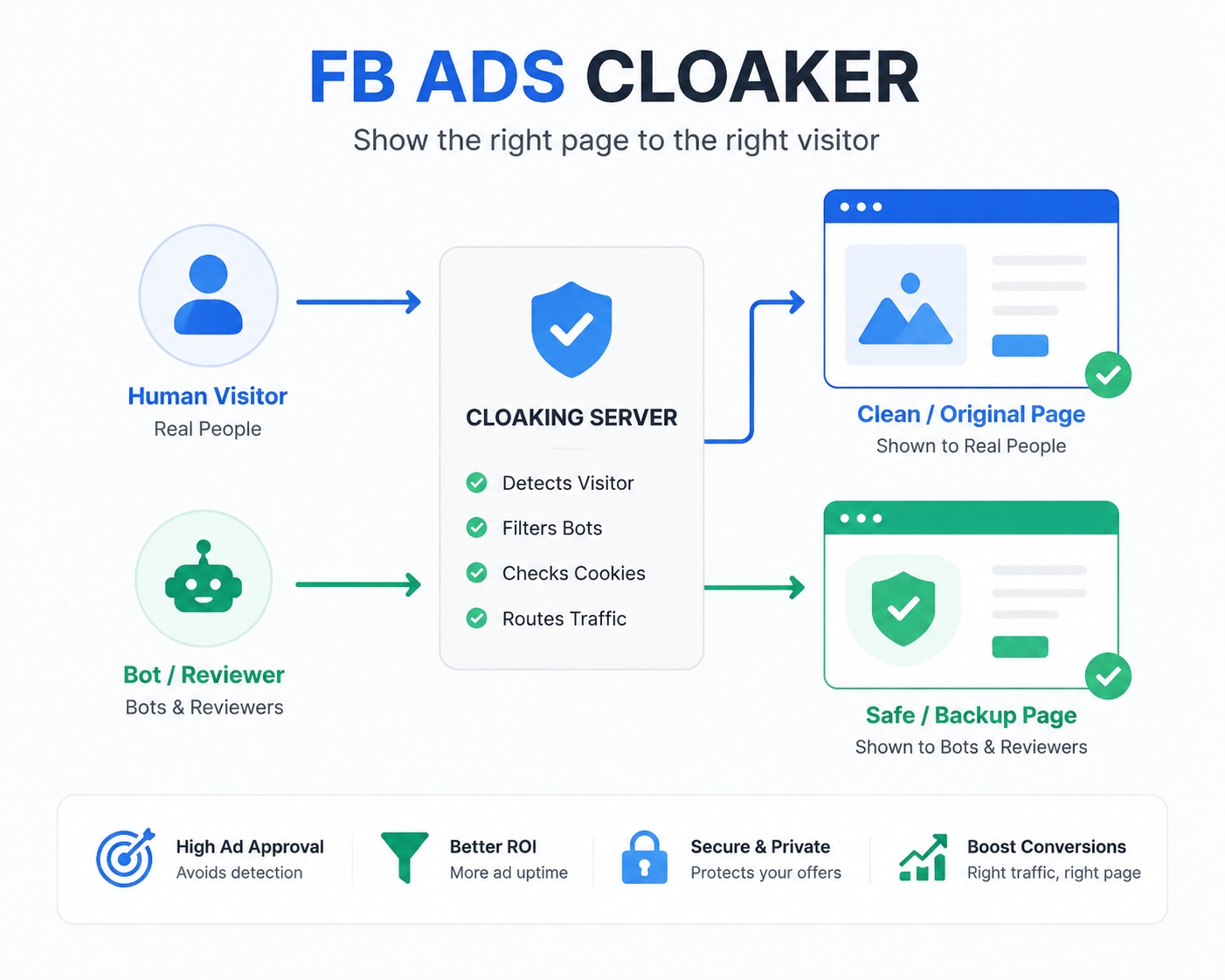
The selection of the right best cloaker for FB ads will depend greatly on your technical stack. Still, top tools like TrafficSaviour, JustCloakIt, Cloakerly, and FraudFilter meet these needs through real-time IP filtering, device fingerprinting, and server-side delivery of a safe page.
What Is Facebook Ads Cloaking and Why Do You Need It for Media Buyers?
Facebook Ads cloaking is a traffic-filtering technology that shows two different landing pages depending on the visitor: compliance bots see a fully compliant safe page, while the human lands on an offer page. This protects proprietary marketing angles from monitoring by competitors, ad review bots, and invalid bot clicks.
Advantages of Traffic Shielding in Your Campaigns
Intellectual Property Protection
Competitors are prevented from accessing your landing page design, ad copy, and offer structure.
Invalid Clicks Filtering
Non-human traffic (proxies, data centres, web crawlers) is filtered out.
Protect Your Budget From Being Wasted on Fake Traffic
The daily budget of your ads will not be spent on bots and automated click scripts.
Protection of the Longevity of Your Marketing Funnel
Custom-built marketing funnels are protected from flagging and scraping by competitors.
Statistics About Digital Ad Fraud
High Increase in Financial Losses
As shown in research by Juniper Research, in 2023, financial losses because of digital ad fraud amounted to $84 billion, which will reach $170 billion by 2028.
Non-Human Traffic Volume
Web traffic analytics of FraudScore showed that over 40% of paid non-search campaign clicks are generated by bots, crawlers, and proxy servers.
What Are the Main Capabilities of Top-Notch Cloaking Tools?
The first-class cloaking tool should be able to perform filter logic under 50 ms, update the database of reviewer IPs and do not lose any traffic. Consider processing speed, ability to fingerprint browsers and flexibility when choosing a platform.
Capability | Premium-Range Platforms | Basic Tools |
Filter Execution Time | < 50 ms (server-side) | > 150 ms (client-side JS) |
IP Reputation Updates | Real-Time (API-based) | Periodical |
Browser Fingerprinting | WebGL, Hardware, Proxies | Simple UA matching |
Safe-Pages Configuration | Dynamic Content Injection | Static URL redirects |
Real-time Dynamic IP Reputation
Checks visitor IP against the blacklist of ad review crawler tools, proxies, and hosting IPs.
Browser Fingerprinting Tools
Uses WebGL fingerprints and canvas fingerprints and checks hardware specifications and battery level for detecting headless bots.
Server-level Integration
Uses Nginx and PHP integrations in order to analyse visitor traffic pre-page load.
Fast Page Load
Ensures that redirection is made under 50 ms in order to have fast mobile page loading.
How to Set Up FB Ads Cloaking Tool in Four Simple Steps?
The process of setting up the cloaking solution consists of adjusting traffic routing on a web server to redirect crawlers to safe pages and let real people go to the offer page.
[Visitor]
↓
│ Server-side Checkup (APIs/PHP scripts) │
│ - checks visitor IP reputation
│ - analyses user agent and HTTP header
│ - cross-checks canvas and WebGL fingerprints
↓on
[ Ad Crawler ] [ Person ]
↓ ↓
[ Safe Page ] [ Offer Page ]
Developing a Safe Page
Create a quick-loading landing page at your main website, which will comply with all of the advertising guidelines from Meta.
Setting up routing rules for your campaign
Create a new project in your traffic software (e.g., TrafficSaviour) and set target countries, ISPs, and devices.
Connecting the code to the server
Add the server-side script (e.g., a .php file or Nginx rule) to the root folder of your web hosting.
Test routing
Test routing rules using residential proxy IPs and browser emulators to ensure correct routing of real users and crawler IPs.
What Are the Common Setup Mistakes You Should Be Aware Of?
The most common mistake in media buying is the full reliance on client-side JavaScript, exposing the page source code to scrapers until the script loads.
Full Reliance on Client-Side JavaScript
The client-side scripts load after HTML starts to load, making it possible for bots to access the landing page source code.
Using the Same Setup Template in Different Ad Accounts
If you use the same templates in different safe page setups, an automated system could easily find the link between different accounts.
Setting Threshold for IP Filtering Too High
Too aggressive risk scoring could lead to the blocking of your mobile visitors with changing IPs through cellular networks.
Neglecting the Processing Time for Servers
Slow API calls to third-party systems slow down your ads, causing the low-quality of the ad account.
What Are the Most Effective New Methods of Increasing Campaign Security?
Top-performing performance marketers combine server-side HTTP header validation and client-side browser canvas validation to stop sophisticated scrapers using residential proxies.
Implement Two Layers of Traffic Filtering
Combine server-side IP filtering and client-side WebGL canvas validation to detect headless browsers using residential IPs.
Dynamic Content Delivery
Deliver the landing page content without making 301/302 browser redirection to secure your ad campaigns.
Change the Setup of Safe Pages Regularly
Update the page text content, images, and HTML code regularly to avoid footprinting.
Frequently Asked Questions
What is the difference between server- and client-side traffic filtering?
Server-side traffic filtering works by analysing the requests to the server before HTML is loaded, securing the code of your page from crawlers. On the contrary, the client-side traffic filtering works via scripts that redirect the clients after page loading, leaving the page code exposed to scraping.
Can a cloaking script affect page load speed and ad relevancy?
A properly written server-side cloaking script would not influence the rendering time. Bad implementation could lead to the server timing out, slowing down rendering time.
Conclusion: Protecting Your Campaigns for Long-term ROI
Choosing a proper cloaker for Facebook ads is not about beating the system. It is about protecting your valuable marketing resources, saving your money on invalid traffic in your budget, and protecting your funnels from any competitors' scrapers. By setting up a server-side filtering system using a service as the TrafficSaviour platform, which combines IP and device fingerprinting technology, and keeping your safe pages clean, you build an infrastructure that will be around for a long time to come.
For your ad budget performance optimization, make sure you conduct regular traffic routing audits and keep your filters running without any server latency.