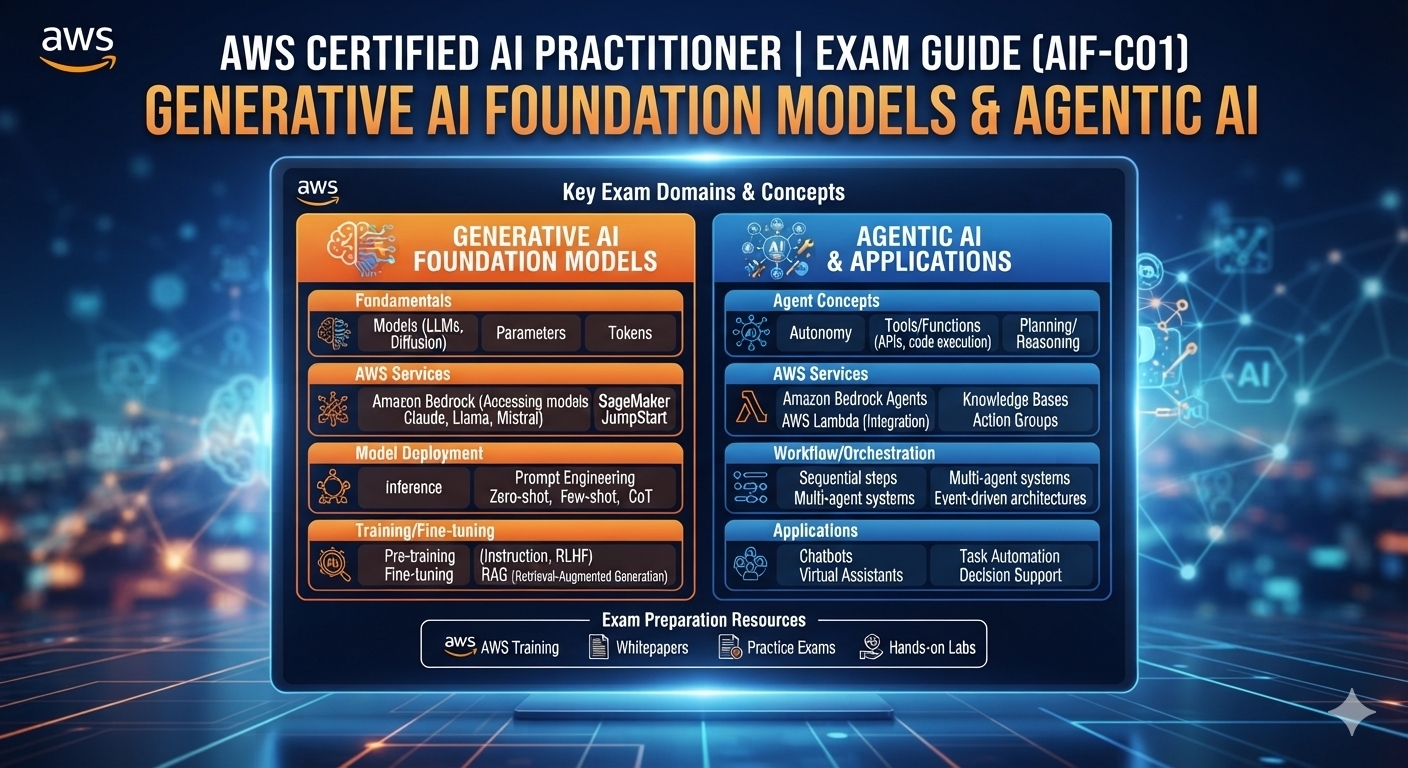
AI is increasingly coming together with cloud computing. Therefore, certification tests have changed too to match the trends. The AWS Certified AI Practitioner certification test evaluates your knowledge in the area of generative AI. It also evaluates you on foundation models, agentic AI, and responsible AI. Moreover, the basics of security are evaluated in this test as well.
This test will be suitable for students who apply AI capabilities in AWS Course. You do not need to construct your models from scratch. Therefore, only basic definitions will not help you. It is essential to understand clearly some key concepts such as how foundation models function and how agentic AI differs from automation.
What the Exam Actually Checks?
The exam has five weighted domains. So, knowing these percentages helps you plan better.
Domain | Weight | Focus Area |
|---|---|---|
Applications of Foundation Models | 28% | Selecting, using, and evaluating models |
Generative AI Fundamentals | 24% | Core GenAI concepts and terms |
AI and ML Fundamentals | 20% | Basic machine learning principles |
Responsible AI | 14% | Fairness, bias, and transparency |
Security, Compliance, and Governance | 14% | Data protection and access control |
Together, foundation models and GenAI cover more than half the exam. Therefore, most of your study time should go there.
Foundation Models and Generative AI Basics
Foundation models are pretrained models. This means that these models are flexible enough to perform different types of tasks. They can also be of different sizes. Therefore, you should not assume that the larger they are, the better. On the contrary, you need to pay attention to their full lifecycle from training to deployment and evaluation.
Here are the key terms you must know:
Tokens: small text pieces the models use as input and output
Embeddings: numeric values describing the meaning and relations
Prompting: writing inputs that guide the model's response
Multimodal models: systems that work with text, images, and sound simultaneously
Fine-tuning: adjusting the pretrained models for specific tasks
Therefore, the same model is applicable both for creating a summary of a report and marketing copy. This means that their flexibility makes them stand out against earlier models. Nevertheless, these concepts may appear to be somewhat vague at the beginning. Because of this fact, many students take part in training classes devoted to this issue. To put it simply, labs of AWS Training in Chennai offer just that.
Agentic AI and Why It Matters Here
Agentic AI systems can interpret goals. They also plan steps and use tools. However, this doesn't mean they act without limits. Instead, they work within set permissions. Plus, clearly defined workflows guide their actions too.
For example, picture an AI agent handling a support ticket. First, it checks the order details. Next, it updates internal records. Then, it drafts a reply for review. Overall, this is controlled agentic behaviour, not open-ended automation.
Where AWS AI Services Fit In?
It is assumed that one should have some knowledge about the services. But technical expertise is not expected in this section. So, it suffices to know the purpose of each service.
Amazon Bedrock: provides multiple foundation models in one location
Amazon SageMaker AI: assists in building, training, and deploying custom models
Bedrock AgentCore: supports agentic AI workflows and coordination
Amazon Nova: Amazon's own family of foundation models
Amazon Comprehend: pulls insights and sentiment from text
Amazon Textract: extracts text and data from scanned documents
Amazon Transcribe: turns speech into accurate written text
Amazon Translate: translates text between multiple languages
Once again, technical mastery is not expected in this section. It is enough to know which problem each of the services solves.
Generative AI Compared With Traditional Machine Learning
Many learners blur these two ideas together. As a result, this causes real confusion during the exam.
Aspect | Traditional Machine Learning | Generative AI |
|---|---|---|
Core Purpose | Function: Forecasting, classification, clustering or pattern recognition | Generation of new material |
Common Tasks | Forecasting, clustering, recommendations, anomaly detection | Text generation, summaries, code creation |
Approach to Data | Often trained on task-specific data | Trained on broad, general-purpose data |
Flexibility | Specialised towards performing one task | Good at performing multiple tasks |
In general, this table demonstrates a true difference with nuances, not strict categories. Therefore, these distinctions are always tested in exams. In fact, case studies test such knowledge very often. This information is particularly valuable for future cloud engineers who are planning to join AWS Certified Solutions Architect Course.
Responsible AI, Security, and Governance Matter Too
They have significant importance in the exam. Therefore, don't regard them as insignificant areas of study. In total, they cover 28% of the whole exam.
Focus your revision on:
Fairness and bias among output results of various AI models
Explainability of decisions based on AI algorithms
Data protection methods and access control practices
Compliance with regulations in implementing AI systems
Governance frameworks that guide responsible AI use
What Background Helps Before the Exam?
Having coding capabilities is not required for this exam. However, some fundamental knowledge regarding clouds can provide helpful background. In particular, an understanding of IAM will be useful. Furthermore, the basics of shared responsibility and cloud pricing should also be mentioned. At the same time, even a lack of initial knowledge will not create any difficulties. There are courses for AWS Cloud Practitioner Certification that provide such a background.
Conclusion
Generative AI and agentic systems are central to this exam. Hence, comprehension is much more important than rote learning in this case. Further, always work towards having an actionable strategy and keep practising. Moreover, you should also work on your weaknesses repeatedly. With continuous effort, the certification will be a reality for you.