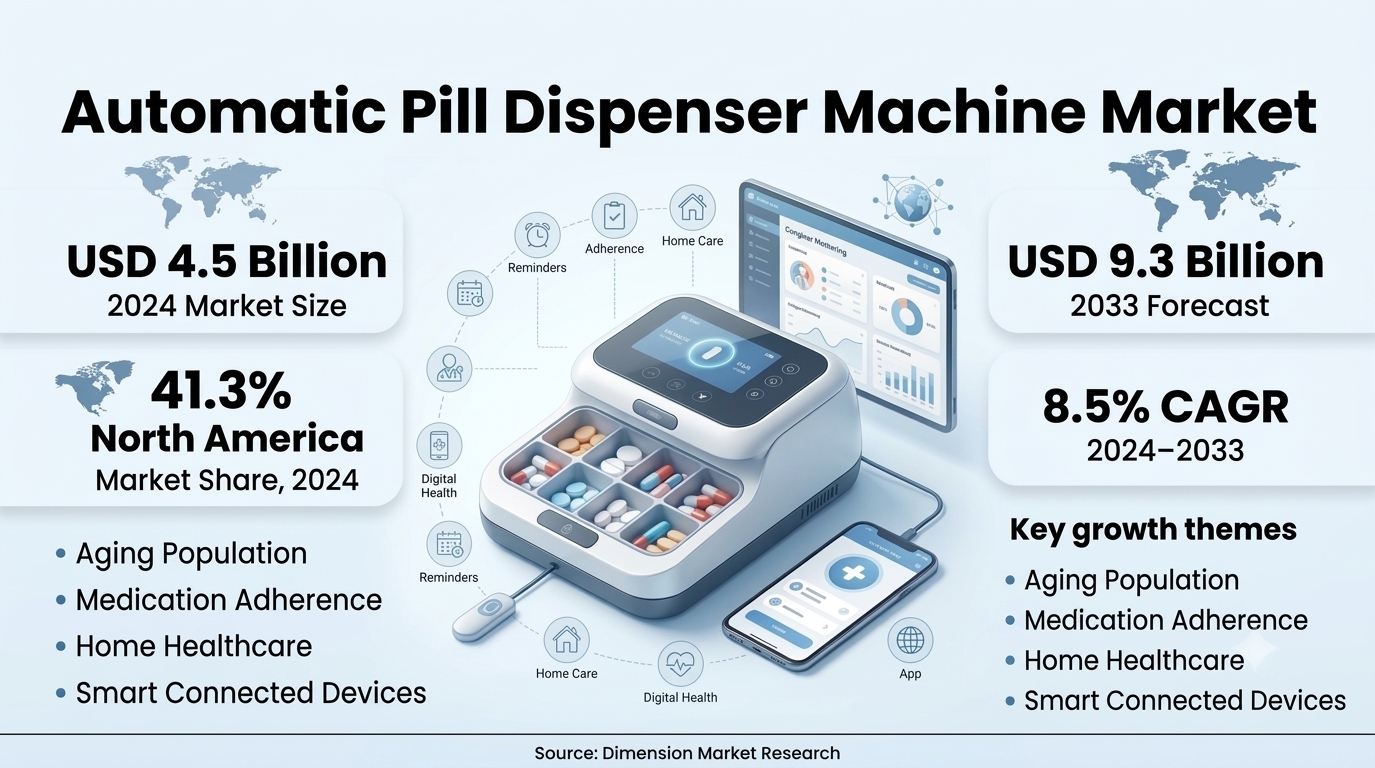
The Global Automatic Pill Dispenser Machine Market Size is expected to reach USD 4.5 billion in 2024 and is projected to expand to USD 9.3 billion by 2033, registering a CAGR of 8.5% during the forecast period. Automatic pill dispenser machines are increasingly becoming an important part of medication management as healthcare systems, patients, caregivers, pharmacies, and long-term care facilities seek more reliable methods to improve medication adherence and reduce dosing errors.
The market is gaining momentum as aging populations, chronic disease prevalence, polypharmacy, and home-based healthcare increase the complexity of medication schedules. Automatic dispensing systems can organize medicines according to prescribed schedules, provide reminders, restrict access to incorrect doses, and alert caregivers when medication is missed. These capabilities are particularly valuable for older adults and patients managing several prescriptions simultaneously.
Technological progress is also reshaping the industry. Connected dispensing systems equipped with mobile applications, cloud platforms, digital alerts, remote monitoring, and adherence analytics are moving medication management beyond basic pill organization. Manufacturers are increasingly focusing on user-friendly machines capable of supporting personalized dosing schedules, caregiver connectivity, refill notifications, and integration with broader digital health ecosystems.
Download a Complimentary PDF Sample Report:
https://dimensionmarketresearch.com/request-sample/automatic-pill-dispenser-machine-market/
Automatic Pill Dispenser Machine Market Overview
An automatic pill dispenser machine is designed to organize, schedule, and release medication at predetermined times. Depending on the product configuration, these devices may incorporate locked compartments, audible alarms, visual reminders, mobile notifications, dose tracking, and connectivity with caregivers or healthcare professionals.
The Global Automatic Pill Dispenser Machine Market is benefiting from the shift toward patient-centered care and preventive healthcare. Medication non-adherence can lead to treatment complications, avoidable hospitalizations, additional healthcare expenditure, and poorer outcomes. Automated medication dispensing provides a practical method of supporting patients who require structured medication routines.
Demand is particularly noticeable among elderly users, patients with chronic diseases, individuals with cognitive or mobility limitations, and people receiving home healthcare services. Healthcare providers and caregivers are also using connected dispensing systems to monitor compliance remotely.
Key Market Highlights
2024 market value: USD 4.5 billion
2033 projected value: USD 9.3 billion
Forecast CAGR: 8.5%
North America holds 41.3% share in 2024
Home medication management remains a major growth opportunity
Connected dispensers are improving remote patient monitoring
Elderly care is supporting demand for automated medication systems
Key Findings of the Automatic Pill Dispenser Machine Market
The market outlook reflects growing dependence on automation across medication management. Hospitals, pharmacies, assisted living facilities, and households are increasingly examining solutions capable of reducing the manual burden associated with complex treatment schedules.
One of the most important findings is the expanding role of automatic pill dispensers in home healthcare. Patients are increasingly managing chronic conditions outside conventional medical facilities, creating opportunities for automated systems that improve adherence without continuous physical supervision.
Another major finding is the growing importance of connectivity. The next generation of pill dispensers is becoming increasingly integrated with smartphones, cloud dashboards, remote caregiver platforms, and notification systems.
Smart medication reminders are becoming a core product feature
Aging populations are increasing demand for simplified dispensing
Remote caregiver monitoring improves visibility into missed doses
Subscription-based services may create recurring revenue models
Pharmacies can benefit from prefilled and connected dispensing systems
Digital adherence data may improve personalized patient support
Automatic Pill Dispenser Machine Market Dynamics
The market is shaped by demographic, clinical, technological, and behavioral factors. Rising chronic disease management requirements are increasing the number of patients taking several medications each day. As medication schedules become more complex, maintaining accurate timing and dosage becomes increasingly difficult without structured support.
At the same time, healthcare delivery is shifting toward home care, telehealth, remote patient monitoring, and decentralized care models. Automatic pill dispenser machines align well with this transition because they provide physical medication dispensing while simultaneously creating digital interaction points between patients and caregivers.
Affordability and ease of use remain important considerations. While technologically advanced systems offer better monitoring capabilities, higher costs may restrict adoption among lower-income consumers and healthcare systems with limited budgets.
Major Growth Drivers
Rising Aging Population and Polypharmacy
Older adults frequently manage multiple prescription medications, supplements, and condition-specific therapies. Maintaining several dosing schedules can become challenging, particularly for people experiencing memory difficulties, visual impairment, or reduced manual dexterity.
Automatic dispensing machines can simplify this process by presenting the correct dose at the appropriate time. This capability supports independent living while reducing the burden on family caregivers and professional care providers.
Growing Burden of Chronic Diseases
Diabetes, cardiovascular diseases, neurological disorders, hypertension, and other long-term conditions frequently require continuous medication. Patients who take medicines for several years can experience adherence fatigue or unintentionally miss scheduled doses.
Automatic medication dispensing provides reminders and controlled access to prescribed pills, supporting greater consistency in long-term treatment routines.
Expansion of Home Healthcare
Patients increasingly prefer receiving care at home when clinically appropriate. Home healthcare can reduce the need for extended hospitalization while improving convenience and comfort.
Automatic pill dispensers are becoming an important enabling technology within this model because they allow medication routines to be structured without requiring a caregiver to be physically present at every scheduled dose.
Increased Focus on Medication Adherence
Improving medication adherence remains a significant healthcare priority. Missing doses, taking medicines at incorrect times, or accidentally repeating medication can reduce treatment effectiveness.
Timed dispensing helps reduce missed medication schedules
Locked compartments can minimize accidental double dosing
Audible alerts remind patients when medication becomes available
Mobile alerts provide additional support to remote caregivers
Dose history improves visibility into adherence behavior
Automatic Pill Dispenser Machine Market Trends
Integration with Digital Health Platforms
Automatic pill dispensers are increasingly functioning as connected healthcare devices rather than standalone machines. Mobile applications can provide adherence notifications, refill reminders, device status information, and medication histories.
This trend creates opportunities for stronger integration with telehealth platforms, remote patient monitoring programs, electronic health records, and digital care management systems.
Growth of Smart and Connected Dispensers
Wi-Fi and Bluetooth-enabled devices are becoming more important as households demand continuous visibility into medication schedules. Connected systems can alert caregivers when a medication window is missed or when the machine needs refilling.
This capability is particularly relevant for older adults living independently and patients whose relatives manage care remotely.
Personalized Medication Scheduling
Future products are expected to support increasingly flexible scheduling. Patients may require medication once daily, several times each day, on selected days, or according to changing prescription instructions.
Manufacturers are therefore focusing on programmable systems capable of handling complex regimens while remaining simple enough for non-technical users.
Caregiver-Centered Technology
Product design is increasingly expanding beyond the patient. Caregiver portals, remote alerts, adherence summaries, refill notifications, and emergency escalation features are helping families monitor medication routines without constant physical supervision.
Challenges in the Automatic Pill Dispenser Machine Market
Despite favorable demand conditions, several challenges can restrict market expansion. High initial pricing remains one of the most important barriers for advanced connected machines. Consumers may compare these products with low-cost pill organizers and hesitate to pay for digital functionality.
Technology adoption among older adults also creates usability challenges. Devices that require complicated setup procedures, frequent software updates, or extensive smartphone interaction may reduce adoption among the population most likely to benefit.
Another challenge involves reliability. A medication dispensing system must work consistently because mechanical failure, incorrect loading, power interruptions, or connectivity problems can affect access to essential medicines.
High device prices can limit mass-market penetration
Complex interfaces may discourage elderly users
Incorrect loading can compromise dispensing accuracy
Connectivity failures can disrupt remote notifications
Data security becomes important for connected health devices
Product maintenance can create additional ownership costs
Market Segmentation Overview
The Automatic Pill Dispenser Machine Market can be assessed across product type, application, end user, distribution channel, and technology. These segments help illustrate how medication dispensing requirements differ across households, healthcare institutions, pharmacies, and long-term care environments.
By Product Type
Automatic dispensers may include centralized automated units, portable dispensers, countertop machines, and smart connected medication systems. Portable and compact solutions are particularly suitable for household users, while larger automated systems may be adopted by institutional environments.
By Application
Major applications include medication scheduling, chronic disease management, elderly care, assisted living, post-discharge medication management, and home healthcare.
Chronic disease management represents an important application because many patients require several medications over extended periods.
By End User
The market serves:
Hospitals
Pharmacies
Home healthcare users
Assisted living facilities
Long-term care centers
Individual patients and caregivers
Home healthcare is expected to remain an important growth environment as consumers increasingly seek tools that support independent medication management.
By Distribution Channel
Automatic pill dispenser machines are distributed through healthcare equipment suppliers, pharmacies, specialty retailers, online platforms, and direct manufacturer channels.
Online channels are becoming increasingly important for consumer-oriented products because buyers can compare functionality, capacity, connectivity, and pricing before purchase.
Competitive Landscape
The competitive landscape is becoming increasingly technology-focused as manufacturers differentiate their products through connectivity, dispensing accuracy, ease of use, medication capacity, caregiver features, and software integration.
Companies are investing in devices capable of combining hardware with mobile applications and cloud-based services. Rather than competing solely on machine design, manufacturers are increasingly building broader medication management ecosystems.
Product innovation is likely to concentrate on automation, compact design, touch-free interaction, voice notifications, caregiver dashboards, remote monitoring, and simplified loading mechanisms. Partnerships between device manufacturers, pharmacies, healthcare providers, insurers, and digital health companies could further expand commercial opportunities.
Competition may also increase around service models. Companies can potentially generate recurring revenue through subscription plans, medication packaging services, monitoring software, technical support, and pharmacy integration.
Regional Analysis
Purchase the report for comprehensive details:
https://dimensionmarketresearch.com/checkout/automatic-pill-dispenser-machine-market/
North America Automatic Pill Dispenser Machine Market
North America is projected to dominate the Global Automatic Pill Dispenser Machine Market with 41.3% of the market share in 2024. The regional market benefits from advanced healthcare infrastructure, high healthcare expenditure, technology adoption, and increasing emphasis on digital healthcare solutions.
The region also has substantial demand for chronic disease management, assisted living, elderly care, and home healthcare. These factors create a favorable environment for connected medication dispensing technologies.
Consumers across North America are increasingly familiar with app-connected healthcare devices, smart home technologies, wearables, and remote monitoring platforms. This digital readiness supports the adoption of advanced automatic pill dispensers.
Europe
Europe represents another important market due to aging demographics, well-developed healthcare systems, and growing focus on independent living for elderly populations. Automatic medication dispensing can help reduce caregiver workload while supporting structured medication schedules.
Digital healthcare programs and home-based care models can further support product adoption across major European healthcare markets.
Asia-Pacific
Asia-Pacific offers significant long-term potential due to its large population, expanding healthcare expenditure, growing chronic disease burden, and rapidly developing digital health ecosystem.
Rising disposable income and growing awareness of home healthcare technologies may support increasing demand for smart medication management solutions across urban populations.
Latin America and Middle East & Africa
These markets are at relatively earlier stages of adoption but can create future opportunities as healthcare modernization, digital connectivity, and private healthcare investment increase.
Affordability will remain an important factor influencing penetration across emerging economies.
Future Market Outlook
The Global Automatic Pill Dispenser Machine Market is expected to expand steadily through 2033 as medication management becomes increasingly automated and connected. Growth will be supported by aging populations, chronic disease prevalence, rising home healthcare adoption, and greater emphasis on improving medication adherence.
The market is also likely to evolve toward integrated digital ecosystems. Automatic pill dispensers may increasingly communicate with healthcare platforms, caregivers, pharmacies, and remote monitoring systems.
Artificial intelligence may eventually contribute to smarter medication reminders, adherence pattern recognition, refill forecasting, and personalized engagement. However, ease of use, affordability, reliability, and patient trust will remain essential for widespread adoption.
Future innovation is expected to focus on:
Voice-enabled medication reminders
Automated refill monitoring
Remote caregiver dashboards
Personalized dose scheduling
Mobile and cloud connectivity
Compact home-friendly designs
Pharmacy-linked dispensing services
Adherence analytics and reporting
Frequently Asked Questions
What is the Automatic Pill Dispenser Machine Market size in 2024?
The Global Automatic Pill Dispenser Machine Market is expected to reach USD 4.5 billion in 2024, supported by rising medication management needs, elderly care requirements, and increased adoption of home healthcare technologies.
How large will the market become by 2033?
The market is projected to reach approximately USD 9.3 billion by 2033, expanding at a compound annual growth rate of 8.5% from its 2024 value.
Which region dominates the Automatic Pill Dispenser Machine Market?
North America is projected to lead the global market with approximately 41.3% market share in 2024, supported by advanced healthcare infrastructure, higher healthcare spending, and strong adoption of innovative medical technologies.
What factors are driving market growth?
Major growth factors include aging populations, chronic disease prevalence, polypharmacy, medication adherence concerns, home healthcare expansion, and increasing adoption of connected digital health technologies.
What is the future of automatic pill dispenser machines?
The future is expected to involve greater use of cloud connectivity, caregiver monitoring, personalized scheduling, pharmacy integration, adherence analytics, and intelligent medication management capabilities.
Summary of Key Insights
The Global Automatic Pill Dispenser Machine Market is transitioning from traditional medication organization toward connected and automated medication management. Valued at USD 4.5 billion in 2024, the market is expected to reach USD 9.3 billion by 2033, growing at a CAGR of 8.5%.
North America is projected to account for 41.3% of global revenue in 2024, reflecting strong healthcare spending, advanced digital infrastructure, and widespread adoption of healthcare technologies.
Long-term growth will be driven by aging populations, increasing chronic disease management requirements, home healthcare expansion, and the need to reduce medication errors. As manufacturers enhance connectivity, usability, remote monitoring, and personalized scheduling, automatic pill dispenser machines are expected to become increasingly important within modern medication management and digital healthcare ecosystems.