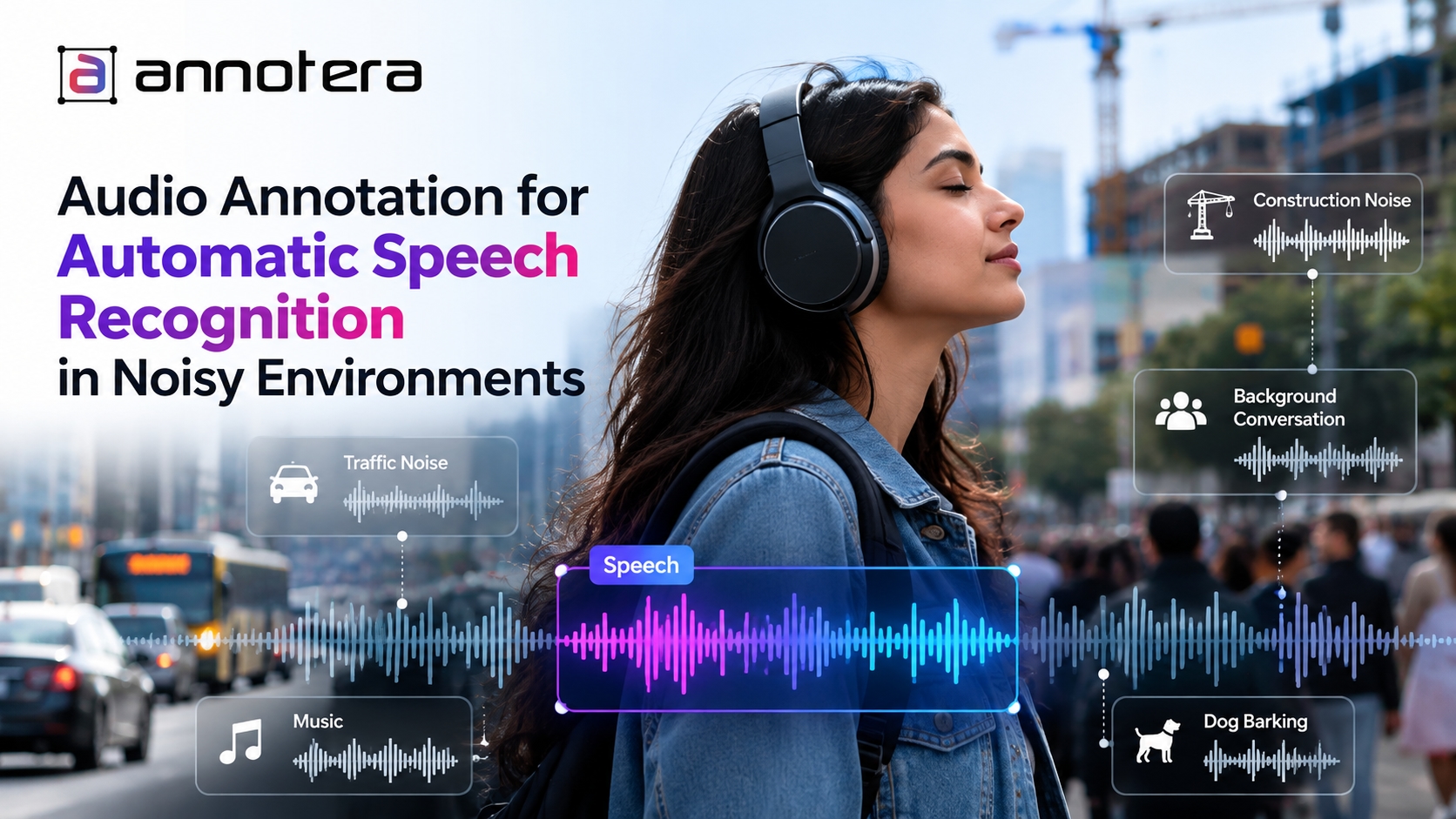
Automatic Speech Recognition (ASR) has become an essential component of voice assistants, call-center automation, transcription platforms, conversational AI, automotive systems, and accessibility technologies. However, recognizing speech in a quiet studio is very different from understanding it in the real world. Traffic, background conversations, machinery, music, household appliances, echoes, and sudden sounds can significantly affect speech recognition accuracy.
For this reason, developing reliable ASR systems requires training datasets that represent realistic acoustic conditions. Audio annotation for automatic speech recognition in noisy environments helps AI models learn how human speech behaves when competing sounds are present, enabling them to distinguish meaningful speech from irrelevant audio signals.
Why Noise Is a Major Challenge for ASR
Speech recognition models process acoustic patterns to identify words, phonemes, pauses, and other characteristics of human speech. Background noise can interfere with these patterns, making certain sounds difficult to distinguish.
Consider someone giving a voice command while walking beside a busy road. A vehicle horn, engine noise, wind, and surrounding conversations may overlap with the speaker's voice. Similarly, a customer speaking to a virtual agent from a busy office may have colleagues talking in the background.
Traditional ASR datasets often contain a substantial amount of relatively clean speech. While such data is valuable, it does not fully represent real-world usage. Research and recent datasets increasingly emphasize naturally occurring noise, including precisely timestamped noise events, because the timing and interaction between speech and noise provide valuable information for robust speech AI.
What Is Audio Annotation for Noisy Speech?
Audio annotation involves adding structured information to recorded sound so machine learning systems can understand what occurs within an audio file.
For noisy ASR datasets, annotation can include:
Speech transcription: Converting spoken words into accurate text.
Speech timestamps: Identifying the exact beginning and ending of speech segments.
Speaker identification: Distinguishing between different speakers.
Noise classification: Identifying sounds such as traffic, music, machinery, animals, or conversations.
Noise timestamps: Marking precisely when background sounds occur.
Overlapping speech: Identifying instances where multiple people speak simultaneously.
Acoustic condition labels: Recording information about reverberation, microphone distance, or recording environments.
Quality and confidence labels: Flagging unclear, incomplete, or difficult-to-transcribe segments.
This level of annotation allows developers to build datasets that represent the complexity of real-world speech rather than treating every recording simply as "clean" or "noisy."
How Annotation Improves Noise-Robust ASR
1. Helps Models Separate Speech From Background Sounds
A well-structured dataset can teach an ASR model to recognize which acoustic signals represent speech and which belong to the surrounding environment.
For example, if a recording contains a speaker talking while traffic passes in the background, annotations can identify both the spoken content and the traffic event. Over time, these examples can help models become less dependent on ideal acoustic conditions.
2. Captures Real-World Noise Patterns
Not all noise behaves in the same way. Continuous sounds such as air-conditioning differ from intermittent sounds such as horns, alarms, barking dogs, or footsteps.
Timestamped annotation makes these distinctions useful for model development. A recent VAANI dataset, for example, adds fine-grained timestamps to naturally occurring noise events in multilingual field recordings, including traffic, animals, appliances, music, and non-speech human sounds.
This demonstrates why simply adding a generic "noise" label may not be sufficient for advanced speech AI applications.
3. Supports Better Training and Evaluation
Annotated noisy audio can be divided into meaningful categories based on noise type, intensity, environment, language, speaker characteristics, and recording conditions.
Developers can then evaluate ASR performance across specific scenarios rather than relying on a single overall accuracy score. This can reveal whether a model performs well in quiet environments but struggles with traffic, overlapping speakers, or distant microphones.
Established ASR research datasets such as CHiME and ASpIRE have similarly focused on speech recognition under challenging conditions involving background noise, reverberation, and far-field recording.
Important Annotation Considerations for Noisy Audio
Creating a high-quality noisy-speech dataset requires more than simply collecting difficult recordings. Annotation guidelines should be designed around the intended ASR application.
Define Clear Noise Taxonomies
Annotators should know how to classify different sounds consistently. Categories might include traffic, machinery, music, human conversation, household sounds, weather, animals, and electronic signals.
Preserve Precise Timing
Timestamp accuracy becomes particularly important when noise overlaps with speech. Start and end points should be consistently marked so models can learn when specific acoustic events occur.
Account for Overlapping Sounds
Real environments frequently contain multiple sounds simultaneously. A street recording could include speech, traffic, music, and horns at the same time. Annotation systems should support overlapping labels instead of forcing every audio segment into one category.
Include Linguistic Diversity
ASR systems increasingly need to support multiple languages, accents, dialects, and code-switching. Noisy datasets should therefore reflect the linguistic diversity of the target users.
Establish Strong Quality Control
Inconsistent transcripts or incorrect noise labels can introduce misleading signals into training data. Multi-level review, annotator agreement checks, sampling audits, and clear escalation procedures can improve dataset reliability.
The Role of Audio Annotation Outsourcing Services
Building a large-scale noisy speech dataset internally can require substantial annotation capacity, specialized expertise, quality-control resources, and project management.
Audio annotation outsourcing services can help organizations scale these workflows while maintaining structured annotation standards. An experienced provider can support transcription, segmentation, speaker labeling, noise classification, timestamping, and quality assurance across large volumes of audio.
Outsourcing can also be valuable when projects require multilingual annotators or specialized knowledge of particular acoustic environments. The objective is not simply to increase annotation volume, but to create training data that is consistent, representative, and suitable for the intended ASR application.
Why Choose an Audio Annotation Company?
Working with an experienced audio annotation company can provide access to trained annotators, scalable workflows, annotation platforms, and dedicated quality-control processes.
For ASR projects, the right partner should understand that noisy audio requires more detailed annotation than conventional speech transcription. It should be capable of handling overlapping sounds, speaker changes, difficult speech, background events, timestamps, and application-specific labeling requirements.
At Annotera, structured audio annotation workflows can help organizations transform complex recordings into machine-learning-ready datasets designed around their specific AI objectives.
Building More Reliable Speech AI With Better Data
Noise robustness ultimately depends on how well an ASR system has been exposed to the conditions it will encounter after deployment. A model trained primarily on clean recordings may struggle when users speak from vehicles, offices, streets, homes, factories, or crowded public spaces.
High-quality annotation provides the contextual information needed to make noisy audio useful for machine learning. By labeling speech, background events, speakers, timestamps, and acoustic conditions, organizations can create richer datasets for developing and evaluating robust speech recognition systems.
As voice AI moves into increasingly diverse real-world environments, audio annotation for automatic speech recognition in noisy environments will remain an important part of building systems that can listen accurately—not only under laboratory conditions, but wherever people actually speak.