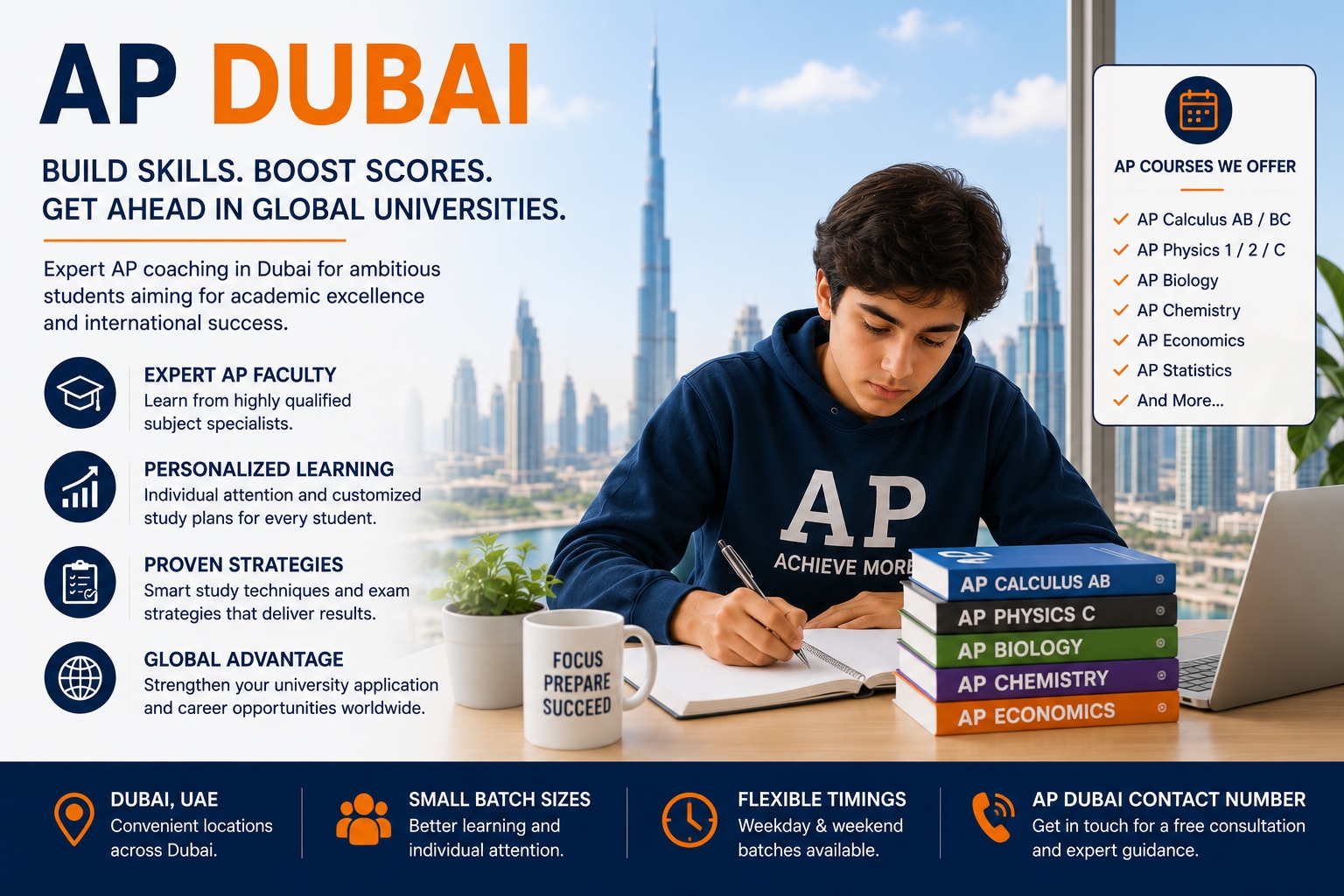
The world of Advanced Placement education continues to change and evolve as students become ever more deliberate in the subjects that they choose. AP course trends reflect changing academic interests, university pathways, emerging fields of study, and the increasing importance of skills such as analytical thinking, data interpretation, communication, and problem solving abilities.
For students considering the education options in Dubai, understanding AP Course Trends can be valuable when it comes to the subjects that merit particular attention. At the same time, trends should be seen as a starting point and the most suitable AP course will depend on the students’ interests, preparation, future goals and ability to manage the demands of an advanced curriculum.
The College Board currently lists AP courses in arts, English, history and social sciences, mathematics and computer science, sciences, world languages and cultures, AP Capstone and AP Career Kickstart. This is a considerable degree of flexibility but at the same time it can be overwhelming to students.
The Increasing Importance of Making the Most Useful Selection of AP Courses
One important aspect of AP Course Trends is the fact that students are increasingly seeking to make AP selections in which individual subjects contribute towards a wider academic plan.
Rather than simply choosing the AP course ‘because it’s hard or cool,’ students can think about how a particular subject fits with their intended university major.
A student considering engineering could explore calculus, physics, chemistry or computer science. Someone considering business or economics may think about mathematics, statistics, economics or related social sciences. A student interested in medicine may think about biology and chemistry and students exploring a career in law or the humanities may explore history, English, government or related social sciences.
This approach makes AP selection more personal and it also allows students to focus on the development of specific skills, not simply the examination results.
Mathematics and Data Continue to Be Important in AP Courses
Mathematics continues to have a prominent place in AP Course Trends. The AP Calculus AB, AP Calculus BC, AP Statistics and AP Precalculus subjects offer students a considerable range of options, with different levels and approaches.
Calculus can be a useful preparation for students considering fields of study that rely heavily on quantitative reasoning. Statistics provides a different perspective (focused on data, probability, interpretation and statistical reasoning) and the increasing relevance of data in all fields has made statistical thinking increasingly valuable.
However, the value of calculus and statistics cannot be taken for granted – students need to consider their preparation and interest in quantitative problem solving when approaching these subjects.
Computer Science Remains an Important Area for AP Course Selection
Technology continues to drive education and career options, which has contributed to the increased popularity of computer science-related AP subjects.
AP Computer Science A is very focused on programming, while AP Computer Science Principles gives students an introduction to the broad subject of computing. Both can be valuable, but they are different in focus.
Students who are considering a computer science or technology-related university course might find these subjects particularly relevant. At the same time, students who are simply curious about technology can use an introductory computing course as an opportunity to find out if the field is truly interesting to them.
The trend towards technology should be seen as an invitation to explore.
Science Courses Remain Highly Popular in the Advanced Placement Program
Science continues to have a prominent place in AP Course Trends. Students have the option of taking a wide range of science courses, including AP Biology, AP Chemistry, AP Environmental Science, and multiple AP Physics courses.
Biology can be an important subject for students considering life sciences and healthcare, chemistry can be relevant for students considering medicine, pharmacy or engineering, and physics can provide valuable preparation for students considering engineering and other quantitative fields.
Environmental science presents a different perspective that draws together scientific principles and environmental issues.
The interesting point is that these courses require students to apply knowledge and reasoning, rather than simply memorizing facts. Students need to think about whether they enjoy scientific reasoning (and whether their preparation is sufficient) before committing to one of these subjects.
Social Sciences Are Becoming Increasingly Popular in the AP Program
AP Course Trends include the broad range of history and social sciences subjects. AP Psychology allows students to develop an early understanding of psychology, while AP Microeconomics and AP Macroeconomics examine economics from divergent perspectives. History and government subjects encourage students to consider evidence, context, compare different viewpoints and develop arguments.
These are useful skills for any student considering a career in law, business, international relations, psychology, communications, humanities, and social sciences.
Students who enjoy reading, discussion, writing and understanding how society works may find these courses particularly rewarding.
Making Sense of Complementary AP Courses
Students might benefit from thinking not only about individual AP courses but also at how these courses can complement each other. College Board identifies a number of pairs of complementary AP courses, including AP Biology and AP Environmental Science, AP Physics 1 and AP Precalculus, AP Research and AP Statistics, and AP Computer Science Principles and AP Computer Science A.
This is not necessarily a suggestion that students commit to a ‘paired programme,’ but it is a recognition that AP subjects can be combined to support wider learning.
For example, a student looking into research could combine analytical and statistical courses, or a student looking to develop a strong understanding of computing could combine the different computer science courses.
The Importance of Making Selections Based on Workload
A number of students tend to think in terms of the number of AP courses that they can take, but there is no magic number that applies to every student. In fact, College Board actually recommends that students think through the selection of courses and balance with teachers and counselors.
This is an important point, because AP courses are highly demanding and students need to set aside time for lessons, practice, independent study, and preparation for examinations. A balanced selection of fewer courses may well be more rewarding than trying to take too many difficult courses and underperforming.
What Students in Dubai Should Think About
AP Course Trends can be incredibly helpful to students exploring AP courses in Dubai but it is important to recognize that every school has different options. Some courses require prerequisites. College Board has indicated that students should discuss their course selection with a counselor or teacher and explore the options available at their school.
Students can also gain valuable insight by visiting AP subject courses to learn more about each of the different subjects and approaches.
For some students, Option AP Dubai may be simply one of the many resources that they explore on their journey of discovery when it comes to the AP program. The more important point is whether the selected subject and preparation approach is suitable for the student.
Thinking About Preparations for Changing Academic Expectations
Looking at AP Course Trends indicates that students are increasingly exposed to a mix of traditional academic subjects and newer fields of study that are linked to technology and career development. The AP program now covers a broad range of subjects from mathematics and sciences to languages, arts, humanities and new career-related subjects such as AP Cybersecurity and AP Business with Personal Finance.
This broader selection provides students with more opportunity to find subjects that are truly interesting to them.
Preparation should begin with curiosity – students can read through course descriptions, learn about prerequisites, explore assessment expectations and think through how a course could support their future goals.
AP Course Trends provide valuable insight into the changing interests of students and the expanding range of academic opportunities. Mathematics, science, computer science, economics, psychology, humanities, languages and new career-related subjects offer students the opportunity to develop advanced academic skills in a range of fields.
However, trends should not dictate personal choices and the best course of action for a student will depend on their interests, preparation, university direction and available time.
Students who are considering AP courses in Dubai can use current course information as a starting point, and then discuss their options with their school or academic advisor. With a thoughtful approach, students can build an AP schedule that is both challenging and manageable and prepare themselves for the next stage of their education.