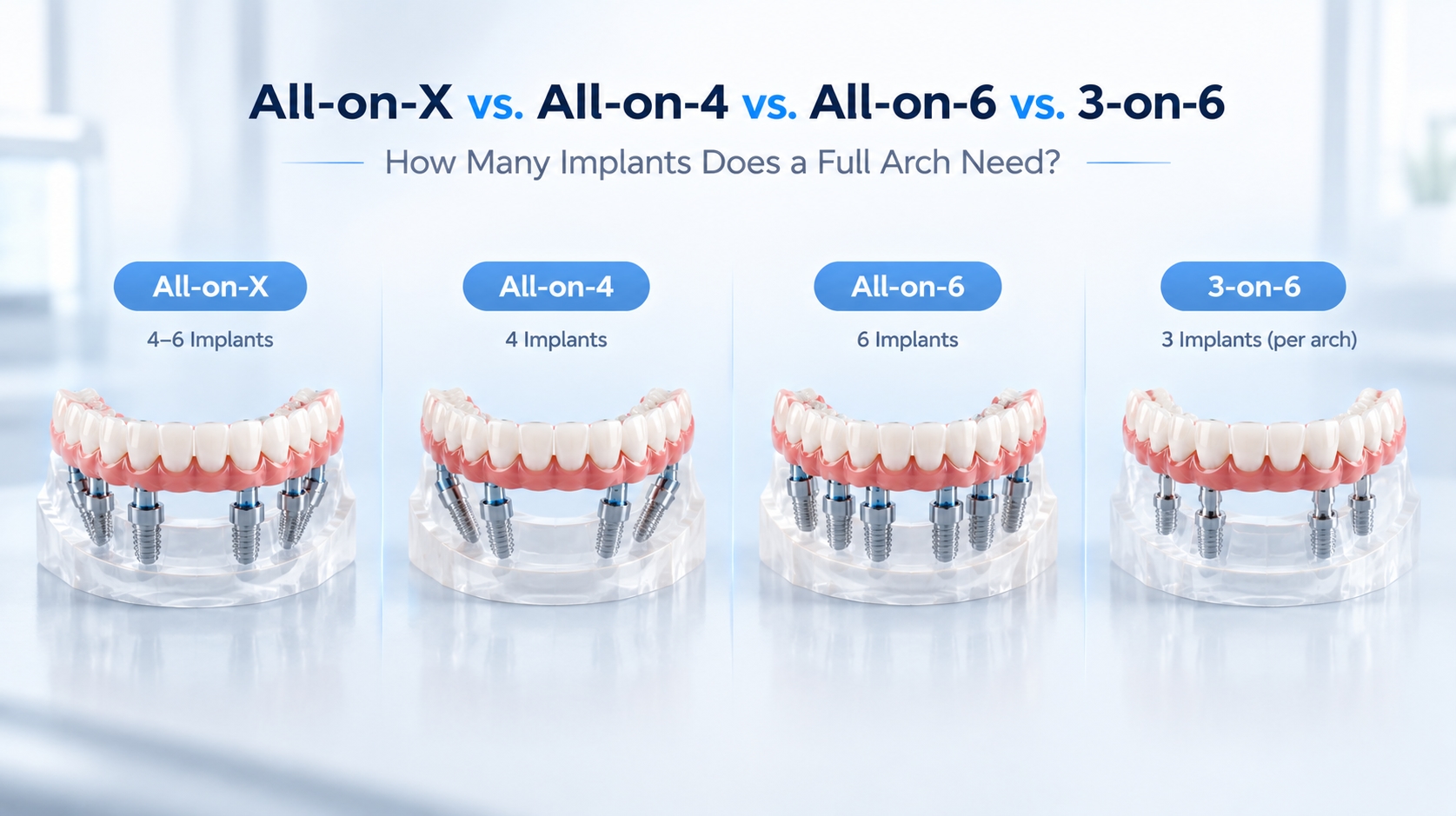
There's no single number of implants a full arch needs. A large review found no significant survival difference between fewer than five and five or more implants per arch, so the count is a design choice, not a ranking. Few questions split a planning meeting faster than "four or six?", and the answer depends on bone, bite force and prosthesis design.
Teams building around digital full-arch workflows, including Digital Arches with its digital full-arch implant solutions, see the same pattern: whatever the count, each implant position still has to be recorded and fitted accurately.
How Many Implants Does a Full Arch Need?
There's no fixed number. In the largest review we found, the most commonly reported counts ran from three to six implants per arch, and survival didn't differ significantly between the groups.
Ever had a patient ask why a friend got six implants when they were quoted four? It's a fair question, and the honest answer starts with bone, bite and prosthesis design.
The rest of this guide covers what each label means, what the evidence shows and where it runs out. For a plain primer first, see what All-on-X means.
What Is the Difference Between All-on-X, All-on-4, All-on-6 and 3-on-6?
All-on-X is the umbrella term, and the other three are specific designs under or beside it. Spear Education's All-on-X guide calls it a catch-all for a fixed, implant-supported prosthesis on four or more implants, with the number set by anatomy and biomechanics.
All-on-4® is a registered mark of Nobel Biocare. Nobel Biocare's All-on-4 page describes two straight anterior implants and two posterior implants tilting up to 45°, with a fixed provisional on surgery day only if patient criteria are met. Its 98% survival figure is listed as company data on file, so it can't be checked independently.
The sources we read don't define All-on-6 formally. In everyday use it means a fixed arch on six implants, which sits inside the All-on-X definition.
Concept | Implants | Prosthesis | Evidence |
All-on-X | Four or more | Fixed full arch | Pools many designs |
All-on-4 | Four, two tilted | One fixed arch | Published studies plus company data |
All-on-6 | Six | Usually one fixed arch | Counted in five-or-more studies |
3-on-6 | Six | Three segmented bridges | Developer account only |
Why Do Some Clinicians Place More Than Four Implants?
Extra implants add redundancy and share the bite load. The same guide says most clinicians now place more than four implants in many cases, with the count shaped by available bone, esthetic requirements, occlusal forces and long-term prognosis.
Nobody wants to explain a failed implant in an arch that had no spare. The guide repeats a saying in the field: "All-on-4, but none-on-3." If one implant fails in a four-implant case, three can't reliably support a fixed full-arch prosthesis, so additional surgery and a new prosthesis are typically needed.
Not everyone moves the same direction. Some teams try to reduce the count instead. An FDI World Dental session listing from 2024 describes cross-arch splinting and tripod support as ways to stabilize full-arch cases and extend cantilever capacity. It lists learning objectives, not data, so treat it as a direction of work and not a result.
Does Using More Implants Improve Survival?
Not in the best evidence we found. A 2018 review of 93 studies in Clinical Oral Implants Research found no significant difference in implant or prosthesis survival between fewer than five and five or more implants per arch.
Follow-up ran from 1 to 15 years, with a median of 8. In the smaller group the most commonly reported counts were four in the upper arch and three or four in the lower arch. In the larger group they were six upper and five lower.
Three limits matter:
Only nine trials were randomized
Three and four were grouped together
No difference can mean low power
So the finding doesn't prove four and six are equal. It means the data couldn't separate them.
Is 3-on-6 Better Than All-on-4?
There's no independent evidence to say so. 3-on-6 was developed by Dr. Randy Roberts and first performed in 2014, according to an Implant Practice US cover story. It places six implants and restores them with three separate zirconia bridges: one anterior and one in each posterior quadrant, two implants per bridge.
The article reports no survival figures and cites no independent studies. Its appearance claim rests on a street survey with no stated sample size or method. It also says segmented bridges place significantly higher forces on implants and abutments.
Benefits claimed for the design, such as hygiene and repair, are the developer's account and not trial results. A cover story about a developer is useful for understanding the concept. It isn't outcome data.
What Should a Team Weigh Before Choosing the Number?
A team should weigh the case first and the label second. The sources we read name bone, bite force and prosthesis design as the drivers, and none gives a universal threshold.
Factors to weigh:
Available bone volume
Bite force and habits
Cantilever length needed
Prosthesis material and design
Hygiene access
Redundancy if one implant fails
Fear of the failed implant is real, but so is the cost of adding implants with no proven benefit. Both belong in the planning conversation.
How Does Implant Count Affect Accuracy and Fit?
Every added implant is another position that has to be recorded, designed around and fitted. That's general reasoning, not a finding from the reviews above, but it explains why capture and verification matter at any count.
More positions mean more chances for a small error to add up. Scannable verification tools such as the OPTISPLINT® verification system join scan bodies so the whole set can be checked before the framework is made.
FAQs
Is All-on-4 better than All-on-6?
The review found no significant survival difference between fewer than five and five or more implants. It grouped three and four together, though, so it can't isolate four against six. Bone, bite and prosthesis design decide the case.
Can three implants support a full arch?
Spear Education's guide says three implants can't reliably support a fixed full-arch prosthesis if one fails in a four-implant case. 3-on-6 is different, because it uses six implants in three pairs.
Is All-on-4 a trademark?
Yes. Nobel Biocare marks All-on-4® as a registered trademark on its page. All-on-X is the broader, generic term.
Is 3-on-6 proven by research?
We found no independent outcome data. The main source is a cover story about its developer, with no survival figures.
Do the upper and lower arch need different numbers?
Reported counts in the review were higher in the upper arch, with six upper and five lower in the larger group. That describes what clinicians reported, not a required rule.
Final Insight
The "X" in All-on-X is a variable, not a target. The evidence so far says four and six haven't been separated on survival, which moves the real decision back to the case: bone, load and the prosthesis the patient can keep clean.
As more long-term and randomized data arrives, expect the conversation to shift from counting implants to fitting them accurately.
This is general information for clinicians. Decisions depend on the individual case and the treating team's judgment.







