
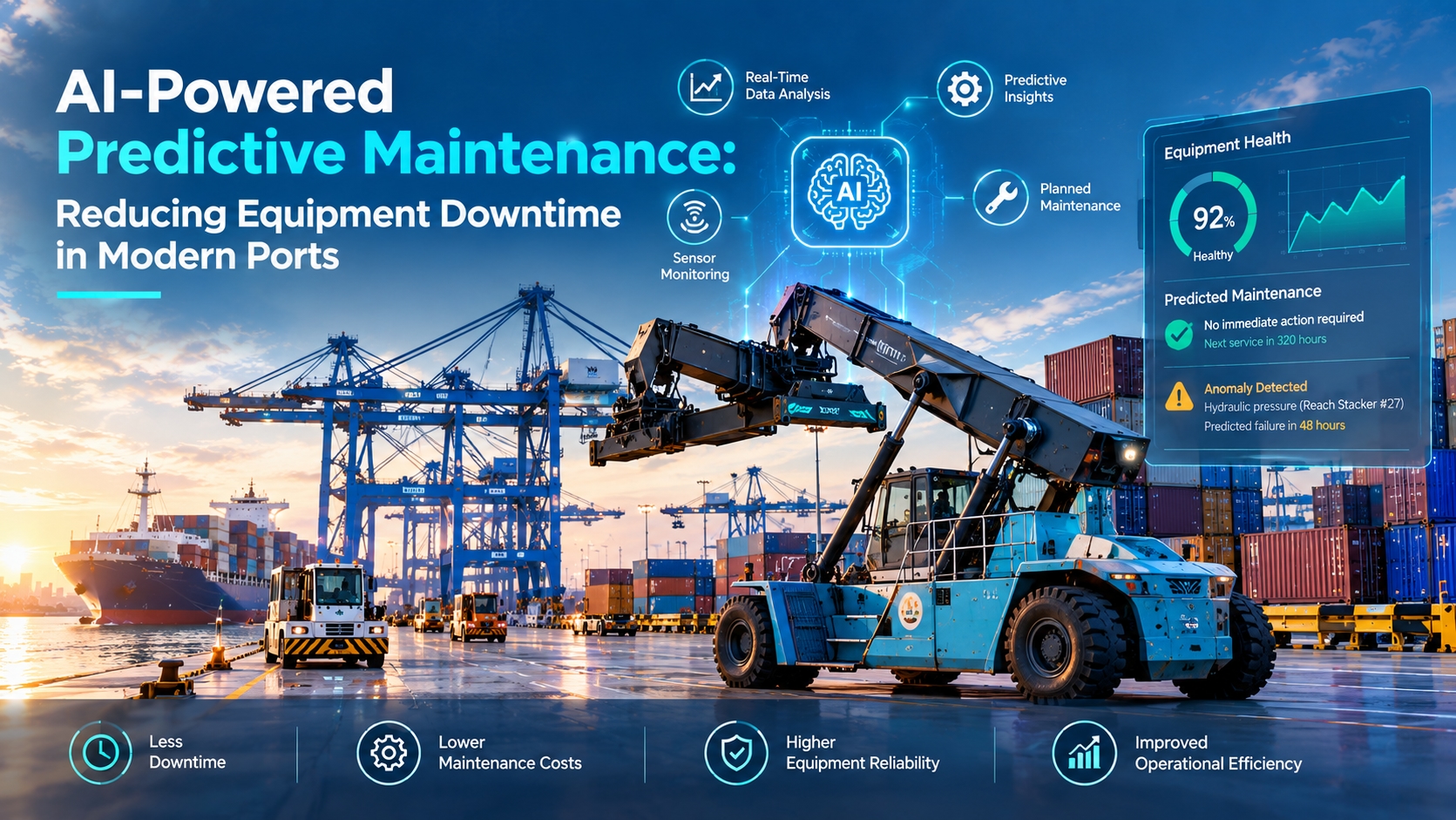
Port terminals depend on large amounts of equipment to move cargo efficiently.
Cranes, automated guided vehicles, stacking cranes, trucks, conveyors, and other assets operate continuously in demanding environments.
When critical equipment fails unexpectedly, the impact can extend beyond the individual machine. A crane breakdown, for example, can affect vessel operations, yard planning, container movement, and delivery schedules.
This is why predictive maintenance is becoming an important area of port digitalization.
Modern port automation research highlights the growing integration of IoT sensors, AI, digital twins, and data-driven maintenance approaches.
What Is Predictive Maintenance?
Traditional maintenance often follows fixed schedules.
Predictive maintenance uses data to estimate when equipment may require attention.
Sensors can monitor parameters such as:
Temperature
Vibration
Pressure
Energy consumption
Operating cycles
Motor performance
Hydraulic conditions
AI and analytics can then identify unusual patterns.
The objective is to detect potential problems earlier.
Why Maintenance Matters in Ports
Port equipment often operates under high workloads.
Unexpected downtime can create:
Vessel delays
Yard congestion
Reduced throughput
Emergency repair costs
Equipment scheduling problems
Increased operational pressure
A predictive approach can help maintenance teams move from reactive repair toward proactive intervention.
IoT as the Foundation
Predictive maintenance requires reliable operational data.
IoT sensors can continuously collect equipment information and transmit it to centralized systems.
For example, sensors installed on a crane could monitor vibration and temperature.
If readings begin to differ significantly from normal operating patterns, an analytics system could flag the equipment for inspection.
AI for Anomaly Detection
AI can analyze large volumes of equipment data much faster than manual monitoring.
Instead of simply identifying whether a sensor reading is high or low, AI can look for combinations of signals.
For example:
Temperature increase + vibration change + higher energy consumption
could indicate a potential mechanical issue.
This type of pattern recognition can help maintenance teams prioritize inspections.
Digital Twins and Predictive Maintenance
Digital twins can make predictive maintenance even more useful.
A digital representation of equipment can combine:
Current condition
Historical performance
Maintenance records
Sensor data
Operating cycles
Operators can then monitor asset health in a broader operational context.
Research on intelligent port operations highlights digital twins as a way to connect real-time data with predictive analytics and operational decision-making.
Integrating Terminal Automation Solutions
Predictive maintenance becomes especially important in automated terminals.
Automated cranes and vehicles depend on high equipment availability.
When a critical automated asset goes offline, other machines may also be affected.
This is why Terminal automation solutions should increasingly consider equipment health alongside operational scheduling.
A maintenance alert could potentially be connected to the terminal's planning system so that upcoming work can be adjusted.
Improving Spare-Parts Planning
Predictive maintenance can also support inventory management.
If analytics indicate that a component may require replacement, maintenance teams can prepare the required part in advance.
This can reduce the risk of waiting for parts after a breakdown occurs.
It can also help organizations make better decisions about spare-parts inventory.
Energy Efficiency
Equipment condition can influence energy consumption.
An asset operating inefficiently may consume more energy than expected.
Monitoring energy patterns alongside mechanical performance can therefore provide another way to identify potential issues.
For modern ports pursuing sustainability objectives, this can make predictive maintenance part of a broader efficiency strategy.
Challenges of Predictive Maintenance
Implementing predictive maintenance requires more than installing sensors.
Ports need:
Reliable data
Connectivity
Historical maintenance records
Analytics capabilities
Integration with existing systems
Skilled maintenance teams
Cybersecurity controls
Poor-quality data can lead to inaccurate predictions.
Human expertise also remains important because AI alerts should support—not blindly replace—engineering judgment.
The Future of Port Equipment Management
Predictive maintenance is moving port maintenance toward a more data-driven model.
Instead of waiting for equipment to fail or servicing every asset according to the same schedule, operators can use condition information to prioritize maintenance.
INTECH Creative Services can support organizations exploring digital transformation strategies involving AI, automation, software integration, and data-driven operational solutions.
As Ports and Terminals Solutions become increasingly connected, predictive analytics can become an important part of maintaining equipment availability and operational continuity.
The combination of AI, IoT, digital twins, and Terminal automation solutions creates opportunities for ports to manage equipment more proactively while improving visibility across operations.