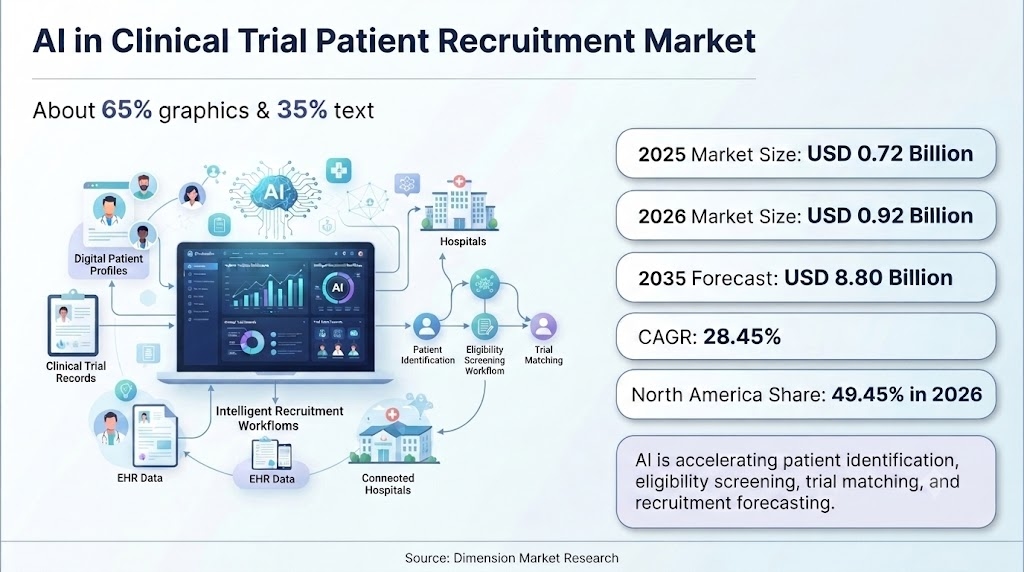
The Global AI in Clinical Trial Patient Recruitment Market Size was valued at USD 0.72 billion in 2025, reached USD 0.92 billion in 2026, and is projected to reach USD 8.80 billion by 2035, expanding at a strong CAGR of 28.45%. Artificial intelligence is increasingly changing how pharmaceutical companies, biotechnology firms, contract research organizations, and clinical sites identify, screen, engage, and retain suitable participants for clinical studies.
Patient recruitment has historically been one of the most time-consuming stages of clinical development. Complex eligibility criteria, fragmented health records, low patient awareness, geographic barriers, and high screening failure rates often delay study enrollment. AI-powered recruitment platforms address these issues by analyzing large clinical datasets, electronic health records, medical histories, demographic information, and protocol requirements to identify potentially eligible patients more efficiently.
The rapid expansion of decentralized clinical trials, digital health ecosystems, electronic health record integration, real-world data analytics, and precision medicine is further strengthening demand. AI solutions can reduce manual screening workloads, improve site selection, enhance diversity planning, and provide sponsors with clearer visibility into recruitment feasibility before and during a clinical study.
📄 Looking for Specific Data? Get a Free Customized Sample:
https://dimensionmarketresearch.com/request-sample/ai-in-clinical-trial-patient-recruitment-market/
Market Overview
AI in clinical trial patient recruitment refers to the application of technologies such as machine learning, natural language processing, predictive analytics, intelligent matching algorithms, and automated workflow tools to locate and enroll appropriate clinical trial participants.
Traditional recruitment methods frequently depend on physicians manually reviewing medical records, advertisements, site databases, patient referrals, and trial registries. AI introduces a more scalable approach by processing both structured and unstructured healthcare information and comparing patient characteristics against complex inclusion and exclusion criteria.
The market is moving beyond simple patient identification. Modern platforms increasingly support feasibility assessment, enrollment forecasting, site optimization, patient engagement, retention monitoring, and recruitment performance analytics.
● 2025 market size stood at USD 0.72 billion.
● 2026 market value reached USD 0.92 billion.
● 2035 revenue is projected at USD 8.80 billion.
● Forecast CAGR from 2026 to 2035 is 28.45%.
This growth reflects the increasing economic importance of accelerating clinical development. Every delay in participant recruitment can extend trial timelines, increase operational spending, and postpone potential product commercialization. As a result, sponsors are increasingly treating intelligent recruitment technology as a strategic clinical development capability rather than a standalone digital tool.
Key Findings
The AI in Clinical Trial Patient Recruitment Market is entering a high-growth phase as sponsors prioritize faster enrollment, greater protocol precision, and improved patient access.
● North America held 49.45% of the market in 2026.
● AI supports faster identification of trial-ready patients.
● EHR integration is becoming central to recruitment workflows.
● Predictive analytics improves enrollment forecasting.
● NLP simplifies complex protocol eligibility screening.
● Decentralized trials are expanding digital recruitment channels.
A major market shift is occurring from reactive recruitment toward predictive recruitment. Instead of waiting for sites to struggle with enrollment, sponsors can use AI to estimate eligible patient populations, identify recruitment bottlenecks, and prioritize sites before trial activation.
Market Dynamics
Growth Drivers
One of the strongest growth drivers is the increasing complexity of clinical trial protocols. Precision therapies, targeted oncology treatments, rare disease studies, and biomarker-driven trials frequently require highly specific patient populations. Manually identifying these participants across large clinical datasets can be extremely resource intensive.
AI can process multiple patient characteristics simultaneously, including diagnosis history, medications, laboratory values, procedures, demographic factors, biomarkers, and disease progression indicators. This improves the ability to discover candidates who may otherwise remain unidentified.
Another important driver is the growing adoption of electronic health records. Digitized patient information provides AI systems with larger searchable datasets and allows clinical research teams to move from broad advertising toward data-driven participant identification.
● Complex eligibility criteria increase demand for automation.
● EHR adoption expands searchable patient populations.
● Precision medicine requires more targeted recruitment.
● Trial delays strengthen demand for predictive tools.
● Decentralized trials improve digital patient access.
Increasing pharmaceutical R&D activity is also supporting market expansion. As pipelines grow and competition for suitable study participants intensifies, sponsors are investing in technologies that can reduce competition between overlapping studies and improve enrollment productivity.
Market Challenges
Despite its potential, AI-based recruitment faces significant barriers. Healthcare data is fragmented across hospitals, laboratories, physician practices, insurers, registries, and research institutions. Inconsistent data structures and limited interoperability can restrict algorithm performance.
Patient privacy represents another major challenge. Recruitment systems often process sensitive medical information, making strong consent frameworks, cybersecurity controls, access governance, and regulatory compliance essential.
Algorithmic bias also requires careful management. AI systems trained on historically unbalanced datasets may unintentionally underrepresent certain demographic or clinical populations, potentially affecting both trial diversity and research outcomes.
● Fragmented healthcare data can limit AI accuracy.
● Privacy rules increase implementation complexity.
● Algorithmic bias may affect participant representation.
● Clinical validation remains essential for AI recommendations.
● Smaller sites may face technology adoption barriers.
AI should therefore support rather than completely replace clinical judgment. Investigators and research teams remain responsible for confirming eligibility, reviewing patient suitability, and ensuring ethical recruitment practices.
Market Trends
The market is shifting toward integrated recruitment ecosystems rather than isolated patient-matching applications. Sponsors increasingly prefer platforms that connect feasibility analysis, site selection, patient identification, enrollment tracking, and trial performance monitoring.
Natural language processing is another important trend. Clinical eligibility criteria and medical records frequently contain unstructured text. NLP technologies can interpret physician notes, pathology reports, discharge summaries, radiology findings, and protocol documents, making previously difficult-to-search information usable for recruitment.
Generative AI is also creating opportunities to simplify communication between clinical research teams and potential participants. Carefully governed systems can assist with patient-friendly trial explanations, pre-screening interactions, multilingual communication, and administrative workflow automation.
● NLP converts clinical text into recruitment intelligence.
● AI matching is becoming more personalized.
● Recruitment forecasting is moving toward real-time models.
● Patient engagement tools support enrollment continuity.
● Multilingual AI can widen participant accessibility.
Trial diversity is becoming another major application area. Sponsors can analyze recruitment patterns across demographic and geographic groups and identify underserved populations earlier in the study lifecycle.
Market Segmentation Overview
The market can be assessed across components, technology, deployment, application, end user, therapeutic area, and geography.
By Component
Software platforms are expected to represent a major portion of market demand because recruitment workflows increasingly depend on centralized analytics, automated patient matching, data integration, and enrollment management.
Services remain important for system implementation, customization, data integration, consulting, clinical validation, and ongoing platform optimization.
● Software supports scalable patient identification.
● Services enable deployment and workflow integration.
By Technology
Machine learning plays a central role in eligibility prediction, patient prioritization, site performance analysis, and enrollment forecasting. Natural language processing is particularly important where eligibility decisions depend on physician notes or other unstructured clinical data.
Predictive analytics allows sponsors to estimate recruitment timelines and identify potential enrollment risks before they become major operational problems.
By Application
Patient identification and matching represent core applications. Other important uses include trial feasibility assessment, site selection, enrollment forecasting, patient engagement, retention analysis, and diversity optimization.
The ability to combine these functions within one analytical environment is expected to become increasingly important as clinical trial operations become more digitally connected.
By End User
Pharmaceutical and biotechnology companies represent major users because recruitment directly influences clinical development timelines and commercialization strategies.
Contract research organizations are also significant adopters because AI can improve recruitment services across multiple sponsors, therapeutic areas, and geographies. Hospitals, research centers, and specialized clinical trial sites are increasingly integrating AI into site-level patient identification.
Competitive Landscape
Competition in the AI in Clinical Trial Patient Recruitment Market is centered on data access, algorithm quality, interoperability, therapeutic specialization, workflow integration, and measurable enrollment performance.
Technology providers are developing platforms capable of combining patient records, trial protocols, real-world clinical information, site databases, and predictive analytics. Competitive differentiation increasingly depends on whether these platforms can fit naturally into existing clinical workflows rather than requiring research teams to adopt completely separate systems.
Partnerships are likely to remain important because no single organization controls all relevant patient data. Collaboration among technology developers, healthcare institutions, sponsors, clinical research organizations, and trial sites can expand addressable patient networks while improving data quality.
● Data interoperability is a major competitive factor.
● Clinical validation strengthens platform credibility.
● Larger patient networks improve matching opportunities.
● Therapeutic specialization can improve recruitment precision.
● Workflow integration reduces operational friction.
The competitive environment is also moving toward outcome-based value propositions. Sponsors increasingly expect measurable improvements such as shorter recruitment timelines, better screening efficiency, higher site productivity, lower recruitment costs, and stronger participant diversity.
Regional Analysis
Purchase the report for comprehensive details:
https://dimensionmarketresearch.com/checkout/ai-in-clinical-trial-patient-recruitment-market/
North America
North America held approximately 49.45% of the AI in Clinical Trial Patient Recruitment Market in 2026, making it the largest regional market.
The region's leadership reflects its large pharmaceutical and biotechnology industry, mature clinical research ecosystem, extensive electronic health record infrastructure, high concentration of trial sites, and strong availability of digitized patient information.
Large clinical research networks operating across numerous countries collectively provide access to patient datasets covering well above 100 million individuals, with a substantial proportion of sponsor activity centered on North American clinical programs. This level of data availability gives AI recruitment platforms a stronger foundation for patient matching and feasibility analysis.
The region also benefits from continued investment in decentralized trials, real-world data, precision medicine, and digital health infrastructure. These factors create a reinforcing market cycle in which greater patient data availability encourages platform investment, while stronger platforms improve trial efficiency and further accelerate technology adoption.
Europe
Europe represents an important market due to its established pharmaceutical research ecosystem and broad network of hospitals, academic institutions, and clinical research centers.
The region offers significant opportunities for AI-supported recruitment across oncology, cardiovascular disease, neurological disorders, rare diseases, and immunology. However, cross-border data governance and differences between healthcare systems can create integration complexity.
Asia Pacific
Asia Pacific is positioned for strong long-term growth as sponsors expand clinical trial activity across major population centers. Large patient pools, increasing healthcare digitization, expanding pharmaceutical R&D, and growing participation in multinational studies are improving the region's attractiveness.
AI can be especially valuable in this region by helping sponsors identify eligible patient populations across geographically diverse healthcare systems.
Latin America, Middle East and Africa
These regions offer emerging opportunities as global clinical trial sponsors seek broader patient diversity and new recruitment pools. Expansion will depend on digital health infrastructure, healthcare data accessibility, regulatory development, and site readiness.
Future Market Outlook
The future of the AI in Clinical Trial Patient Recruitment Market will increasingly revolve around connected clinical intelligence. Patient recruitment is likely to become embedded within broader clinical development platforms rather than remaining an independent activity.
AI systems will increasingly assess trial protocols before launch, estimate addressable patient populations, identify optimal sites, forecast enrollment speeds, and recommend recruitment interventions. Real-time models may continuously update these predictions as new site and patient information becomes available.
Integration with decentralized trial technologies could create another major growth opportunity. Remote consent, telehealth, digital biomarkers, wearable devices, electronic clinical outcome assessments, and home-based trial services can enable sponsors to recruit individuals who previously faced geographic barriers.
● Recruitment will become increasingly predictive.
● Real-time analytics will improve enrollment visibility.
● Decentralized trials will widen patient access.
● AI can strengthen diversity planning.
● Integrated clinical platforms will gain importance.
By 2035, the market's projected value of USD 8.80 billion indicates that AI-enabled recruitment is likely to become a core component of digital clinical trial strategy.
Frequently Asked Questions
1. What is the AI in Clinical Trial Patient Recruitment Market size?
The market was valued at USD 0.72 billion in 2025 and reached approximately USD 0.92 billion in 2026.
2. How large will the market be by 2035?
The market is projected to reach approximately USD 8.80 billion by 2035, reflecting strong adoption of AI-powered patient identification, screening, and enrollment technologies.
3. What is the expected market CAGR?
The AI in Clinical Trial Patient Recruitment Market is expected to expand at a CAGR of 28.45% from 2026 to 2035.
4. Which region dominates the market?
North America dominated the market with approximately 49.45% share in 2026, supported by extensive clinical research activity, mature EHR infrastructure, strong pharmaceutical investment, and large patient data networks.
5. Why is AI important for clinical trial recruitment?
AI can analyze large volumes of clinical information, compare patients against complex eligibility criteria, forecast enrollment, improve site selection, and reduce manual screening workloads. These capabilities can help sponsors accelerate trial recruitment while improving participant identification and operational efficiency.
Summary of Key Insights
The Global AI in Clinical Trial Patient Recruitment Market is positioned for substantial expansion as pharmaceutical companies, biotechnology developers, research organizations, and healthcare institutions seek faster and more data-driven approaches to enrollment.
The market's rise from USD 0.92 billion in 2026 to USD 8.80 billion by 2035, at a 28.45% CAGR, highlights the growing strategic importance of artificial intelligence within clinical development.
North America remains the leading region with a 49.45% market share in 2026, supported by extensive clinical research infrastructure, large patient datasets, advanced EHR adoption, and strong sponsor activity.
Machine learning, natural language processing, predictive analytics, EHR integration, decentralized trials, and automated patient matching will remain important growth areas. At the same time, privacy, data fragmentation, interoperability, algorithmic bias, and clinical validation will continue to shape adoption strategies.
Ultimately, AI is shifting clinical trial recruitment from a largely manual and reactive process toward a more predictive, targeted, and continuously optimized model. Organizations that successfully combine reliable patient data, validated algorithms, strong clinical oversight, and seamless workflow integration are likely to play an increasingly important role in the next generation of clinical research.
Related Reports:
https://dimensionmarketresearch.com/report/ai-enabled-clinical-laboratory-analyzer-market/
https://dimensionmarketresearch.com/report/generative-ai-in-clinical-trial-market/
https://dimensionmarketresearch.com/report/ai-in-clinical-trials-market/
https://dimensionmarketresearch.com/report/ai-clinical-trial-optimization-market/