An organisation may have a dozen ideas for using artificial intelligence. One department wants to automate document handling. Another is looking at an AI assistant for customer enquiries. Management may be interested in using company data to support faster decisions.
The challenge begins when these ideas move from discussion to development. Which problem deserves attention first? Is the available data good enough? Should the application use an existing AI model or require a customised solution? And what needs to be completed before employees can start using it?
Without answers to these questions, projects can lose direction. Development teams may build features that have little connection to business priorities, while important requirements surface only after work has started.
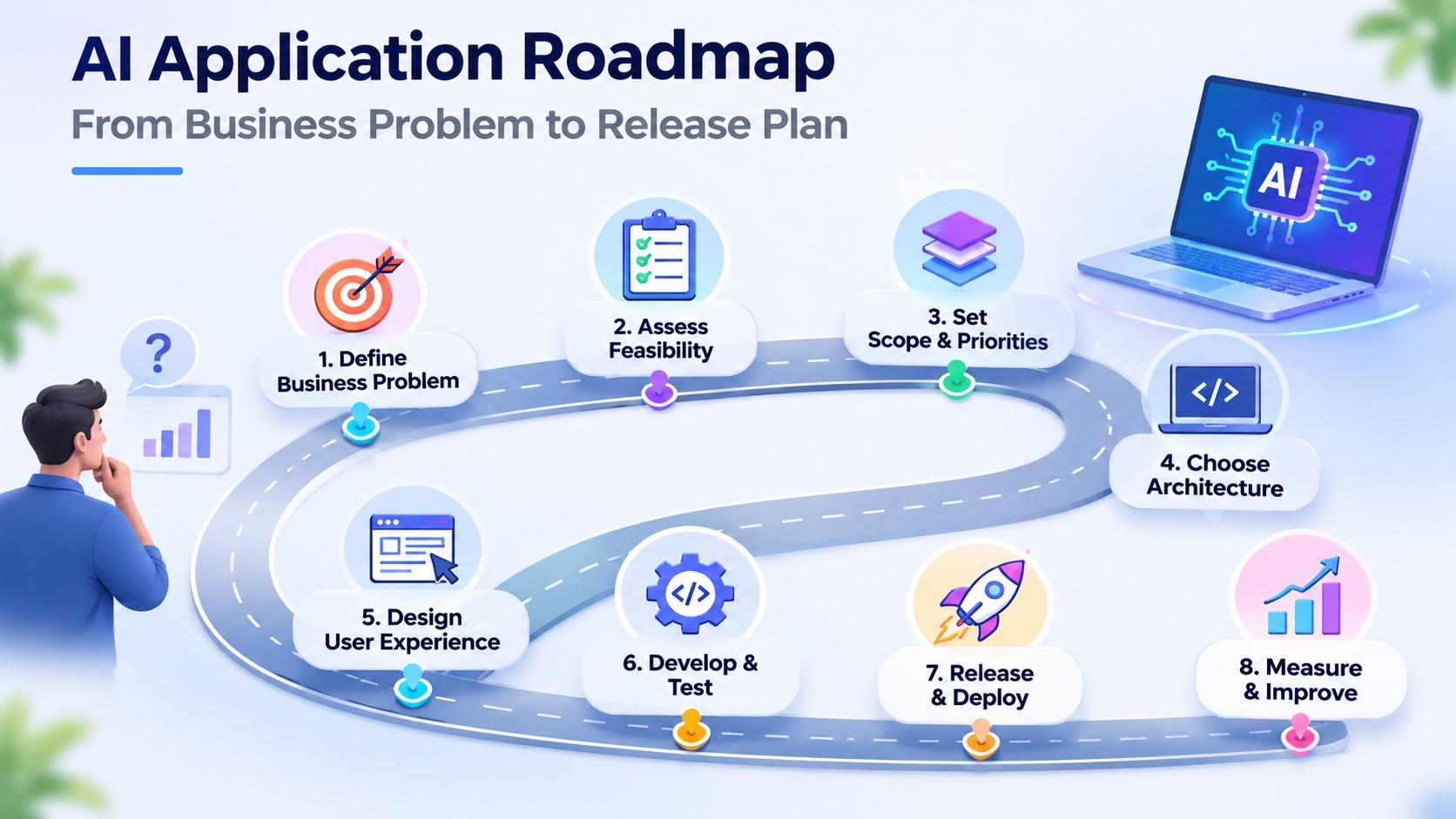
An AI application roadmap brings these decisions into one plan. It establishes the project priorities, technical direction and release milestones before development gathers pace.
Begin With the Work That Needs to Improve
Technology selection should not be the first item on an AI project checklist. The starting point should be an existing business activity that consumes time, creates delays or requires too much manual effort.
Take an insurance company that receives hundreds of documents every day. Employees must read the files, identify important details and enter information into internal systems. An AI-based document processing application might reduce some of this work. However, the team first needs to understand the document types, existing approval process and information that must be extracted.
The same thinking applies to customer support, financial operations, manufacturing and internal knowledge management.
Establish the Actual Business Requirement
Before discussing models or frameworks, collect information from the people who handle the process.
Find out:
Where does the current workflow slow down?
Which activities are repeated most often?
What information do employees need to complete their work?
Which errors create additional costs?
What should improve after the application is introduced?
These discussions help turn a broad idea into a development requirement. They also give project stakeholders a reference point when evaluating the finished application.
Assess the Data, Cost and Technical Requirements
An AI use case may look attractive on paper but prove difficult to implement. The organisation might lack the necessary data, have limited integration options or face restrictions on how information can be processed.
A feasibility review brings these issues to the surface before the project moves into full development.
Three Areas That Deserve Attention
Business value: Estimate the expected improvement and compare it with development and operating costs. Consider whether the problem occurs frequently enough to justify an AI solution.
Data availability: Examine the information required by the application. Check its quality, format, accuracy, ownership and access permissions.
Technical readiness: Review the existing infrastructure, databases, APIs, security requirements and third-party dependencies.
Questions to Resolve Before Approving the Project
Can the application access the information it needs?
Does the available data require cleaning or restructuring?
Which existing systems must exchange information with it?
How will incorrect or incomplete AI responses be handled?
Who will manage the application after deployment?
Companies evaluating an AI App Development Company in Saudi Arabia should look beyond the proposed technology. Experience with business analysis, data integration, application security and post-release support is equally relevant when choosing a development partner.
Decide What the First Version Must Deliver
One reason AI projects become difficult to manage is the steady addition of new features. A proposal that begins with one business requirement can gradually include chat interfaces, voice commands, reporting dashboards, multilingual support and several external integrations.
Some of these features may be useful later. They do not all need to be part of the first release.
A minimum viable product (MVP) gives the team a smaller, testable starting point.
Consider an internal company knowledge assistant. Its first version could allow employees to sign in, search approved documents, ask questions and view the information used to generate an answer. The organisation can evaluate how employees use it before investing in additional capabilities.
Separate Release Requirements From Future Ideas
A simple prioritisation exercise can help:
Release requirement: Features without which the main business problem cannot be addressed.
Next development phase: Improvements that make the application more useful after initial validation.
Long-term consideration: Features that require further research, investment or user demand.
This keeps the initial development scope manageable and makes project progress easier to assess.
Select Technology Based on the Intended Application
There is no single architecture that suits every AI application. A document assistant, an image recognition solution and a predictive maintenance platform have different technical requirements.
The development team should identify the capabilities needed before choosing its technology stack.
For example, a company that wants employees to search internal documents using natural language may consider retrieval-augmented generation (RAG). This approach retrieves relevant information from approved sources and provides it to a language model when generating an answer.
A document extraction system may instead combine optical character recognition (OCR), classification and structured data extraction.
Architecture Decisions to Discuss
AI model: Evaluate response quality, speed, operating cost, language support and deployment options.
Data connections: Identify the databases, documents, APIs and business systems the application must access.
Application infrastructure: Plan hosting, storage, API management, scalability and monitoring.
Access controls: Decide who can view information, submit requests and manage application settings.
Human involvement: Identify outputs that require review or approval before an action is completed.
The technical design should reflect the actual workload. A complex architecture does not automatically produce a better application.
Design the Interface Around How People Will Use It
Users should not need technical knowledge to operate an AI application. The interface must make its capabilities clear and guide people through the tasks they need to complete.
A conversational assistant, for example, should indicate when a request is being processed. If it cannot find an answer, it should explain the limitation rather than display an unrelated response. Users should also have a way to correct their input or ask a follow-up question.
Wireframes and clickable prototypes can help teams review these interactions before the complete application is developed.
For Custom AI Application Development in Dubai, the intended audience and operating environment should influence interface decisions. Language preferences, existing business processes and integration requirements can all affect how users interact with the application.
Development Should Move Through Reviewable Milestones
Once the requirements and architecture are agreed upon, development can begin. Breaking the work into smaller stages makes it easier to identify problems and discuss changes with stakeholders.
A typical sequence may include:
Establishing the application structure and development environment.
Building the user interface and backend services.
Connecting the selected AI model.
Integrating databases and external systems.
Implementing authentication and access controls.
Testing the complete workflow.
Reviewing the working version with intended users.
Businesses considering Mobile App Development Services in Bangalore India should also plan for device coverage, operating system compatibility, network variations and mobile performance testing. These requirements should be part of the project plan rather than last-minute checks before launch.
Testing Must Cover AI Behaviour Too
A conventional software test checks whether a feature performs its intended function. AI application testing also needs to examine the quality of generated responses.
For example, a knowledge assistant may open correctly and accept questions, yet return information that is incomplete or unrelated to the source material.
The test plan should cover:
Functional behaviour and complete user workflows.
AI response relevance and factual accuracy.
Retrieval quality and source references.
API failures and unavailable services.
User permissions and data protection.
Response time under expected workloads.
Recovery from incomplete or interrupted requests.
Teams should prepare realistic test questions and review the results against defined acceptance criteria. For sensitive business processes, human approval may remain necessary even after the application is released.
Prepare the Application for Its First Production Release
A successful demonstration does not mean a system is ready for everyday use. Production deployment introduces responsibilities that may not have been part of the prototype.
The organisation needs to confirm that the application has suitable infrastructure, stable integrations, approved access controls and a support process. It should also decide how errors will be reported and who will investigate them.
A Practical Release Sequence
Project stage | Work involved | Expected result |
|---|---|---|
Requirement discovery | Interviews and workflow review | Agreed business problem |
Feasibility review | Data, cost and technology assessment | Approved scope |
Solution design | Architecture and interface planning | Development specification |
Implementation | Application and AI integration | Working application |
Quality review | Functional, AI and security testing | Approved release candidate |
Production launch | Deployment and user access | Live application |
Post-release review | Monitoring and improvement | Planned updates |
The duration of each stage will vary. A focused internal application may have relatively few dependencies, while an enterprise solution connected to several departments will require additional planning and validation.
Measure What Changes After Deployment
Once users begin working with the application, the project team needs evidence that it is delivering the intended result.
Suppose the original objective was to reduce the time employees spend reviewing documents. The organisation can compare processing times before and after deployment. If the application was introduced to support customer enquiries, the team can review response times, resolution rates and user feedback.
Useful indicators include:
Number of active and returning users.
Percentage of tasks completed successfully.
AI response quality.
Average processing time.
Application availability and failure frequency.
Cost per request.
Reduction in repetitive manual work.
User feedback and support incidents.
For Custom AI Application Development in Dubai, the financial review should include model usage, hosting, maintenance, integration costs and the operational benefits achieved after launch. The same principle applies to projects in other markets: evaluate the actual results against the original business case.
Where AI Application Planning Often Goes Wrong
Some development problems begin long before the first line of code is written.
A project may have an unclear objective, an unrealistic timeline or no agreement about who owns the data. Another may focus heavily on model selection while overlooking security, user access and ongoing support.
Common planning mistakes include:
Choosing technology before understanding the workflow.
Assuming existing data is ready for AI use.
Expanding the first release without reviewing its impact.
Testing the interface but overlooking AI response quality.
Leaving security requirements until deployment.
Failing to plan for model and infrastructure costs.
Measuring project completion instead of business improvement.
These issues are easier to address during discovery than after an application has become part of daily operations.
Questions Businesses Ask Before Starting an AI Application Project
What should an AI application roadmap include?
It should cover the business requirement, intended users, feasibility, data readiness, application scope, architecture, development milestones, testing, deployment and post-release evaluation.
Is a prototype necessary before developing the complete application?
A prototype is useful when the team needs to test an idea or examine a technical uncertainty. It can help stakeholders understand the proposed workflow before approving a larger investment.
How is an MVP different from a prototype?
A prototype demonstrates an idea or interaction. An MVP includes a limited set of working features intended for real users so the organisation can evaluate the application in an actual business setting.
What affects the cost and timeline of AI application development?
The main factors include application complexity, model selection, data preparation, integrations, infrastructure, security requirements and testing effort. Changes in project scope can also affect both cost and delivery time.
How can businesses determine whether an AI application is successful?
Success should be linked to the original business objective. Reduced processing time, fewer manual tasks, improved service response and stronger user adoption are examples of outcomes that can be measured.
Give the Development Team a Clear Route to Release
An AI project needs more than an interesting concept and a suitable model. It needs a defined problem, accessible data, a realistic feature list and a team that understands what production deployment involves.
Planning these elements early gives business stakeholders a clearer view of the investment and helps developers make decisions with fewer assumptions. The roadmap can evolve as users provide feedback, but each release should have a defined purpose and a way to assess its contribution to the business.