Key Takeaways
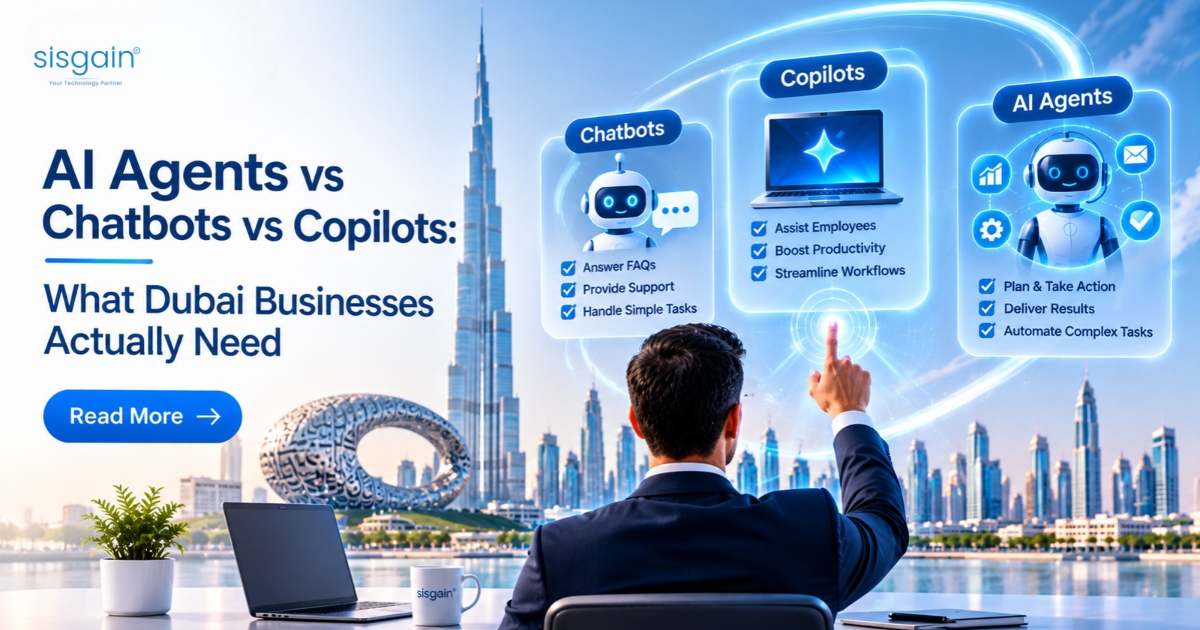
AI agents, chatbots, and copilots serve different business purposes and should not be treated as interchangeable technologies.
Chatbots handle customer conversations and routine enquiries.
Copilots help employees complete everyday tasks more efficiently.
AI agents can execute multi-step tasks and interact with connected business systems.
Dubai businesses should select AI technology according to operational requirements, customer expectations, and measurable business goals.
Combining these technologies can create a more connected and efficient business environment.
Introduction
Artificial intelligence is changing how businesses operate, serve customers, and manage everyday activities. Across Dubai and the wider UAE, organisations are exploring AI to improve productivity, reduce manual work, deliver faster customer experiences, and remain competitive.
However, one common challenge is understanding which technology is actually required. AI agents, chatbots, and copilots are frequently discussed together, but they are designed for different purposes. Choosing the wrong solution can result in unnecessary development costs, limited adoption, and technology that fails to solve the original business problem.
For example, a retail company may need a chatbot to answer customer questions, while a financial services organisation may benefit from a copilot that helps employees review documents. A logistics company, on the other hand, might need an AI agent capable of coordinating several operational tasks.
Understanding these differences helps businesses make better technology decisions and identify where AI can deliver practical value.
1. What Is an AI Chatbot?
An AI chatbot is a conversational application designed to interact with users through text or voice. It understands questions, identifies user intent, and provides relevant responses based on its training, knowledge sources, or connected business information.
Traditional chatbots generally follow predefined rules and decision paths. Modern AI-powered chatbots can use natural language processing and large language models to understand more flexible questions and generate conversational responses.
Where businesses use chatbots
Customer support: Answering frequently asked questions about products, services, payments, and policies.
Lead generation: Collecting contact information and directing enquiries to sales teams.
Appointment scheduling: Helping customers submit booking requests.
E-commerce assistance: Providing product information and order updates.
Internal support: Helping employees find answers to common HR and IT questions.
Businesses can also extend chatbot functionality through websites and mobile applications. For organisations planning these digital experiences, a mobile app development company in UAE can help build applications that connect customers with intelligent assistance and relevant business services.
Example for a Dubai business
Consider a healthcare provider in Dubai receiving hundreds of enquiries about appointments, consultation timings, and available services. An AI chatbot on its website can answer common questions, collect patient details, and guide visitors towards appointment booking.
The chatbot reduces repetitive enquiries and provides customers with assistance outside normal working hours. However, if a task requires multiple decisions, coordination between systems, or independent execution, a basic chatbot may not be sufficient.
Best suited for: Businesses that want faster communication, automated responses, and better customer engagement.
2. What Is an AI Copilot?
An AI copilot is an intelligent assistant designed to support employees while they perform their work. Unlike a customer-facing chatbot, a copilot is generally integrated into internal applications, business platforms, or employee workflows.
It helps users complete tasks more efficiently by generating content, summarising documents, analysing information, suggesting actions, and retrieving relevant data.
A copilot usually works alongside a human employee rather than independently managing an entire business process. The employee remains responsible for reviewing information and approving important decisions.
Where businesses use copilots
Sales: Preparing proposals, summarising customer conversations, and generating follow-up emails.
Human resources: Drafting job descriptions and answering employee policy questions.
Finance: Summarising financial documents and organising reports.
Marketing: Creating campaign drafts and generating content ideas.
Operations: Summarising reports and helping employees access internal knowledge.
Example for a Dubai business
A real estate company managing multiple property enquiries may use an AI copilot to help sales representatives prepare property descriptions, summarise customer preferences, and draft personalised follow-up messages.
Instead of replacing the sales team, the copilot reduces administrative work and allows employees to spend more time communicating with potential buyers and tenants.
Best suited for: Organisations that want to improve employee productivity, support decision-making, and reduce time spent on repetitive knowledge-based tasks.
3. What Is an AI Agent?
An AI agent is an intelligent system designed to pursue a defined goal by understanding instructions, evaluating available information, selecting actions, and interacting with connected tools or systems.
Unlike a conventional chatbot that primarily responds to questions, an AI agent can perform tasks. Depending on its permissions and integration capabilities, it may retrieve information, update records, trigger workflows, coordinate activities, and monitor task progress.
Businesses exploring AI development services in Dubai can consider agent-based solutions for processes that require more than basic conversational support.
Where businesses use AI agents
Customer service operations: Retrieving account information and initiating approved service workflows.
Sales operations: Qualifying leads, updating CRM records, and scheduling follow-ups.
Finance operations: Extracting invoice information, checking records, and routing approvals.
Supply chain management: Monitoring inventory and identifying potential shortages.
IT operations: Classifying support tickets and escalating issues according to defined rules.
Example for a Dubai business
Imagine a UAE-based logistics company receiving shipment enquiries from customers. An AI agent connected to its customer relationship management platform and logistics system could retrieve shipment information, check delivery status, identify delays, and send updates through approved communication channels.
If a shipment requires additional attention, the agent can create a support ticket and assign it to the relevant team.
For more complex requirements, custom AI agent development services in the UAE can help businesses design agents around their specific workflows, business rules, and system integrations.
Best suited for: Businesses that want to automate multi-step workflows, connect different systems, and reduce manual coordination.
4. AI Agents vs Chatbots vs Copilots: The Main Differences
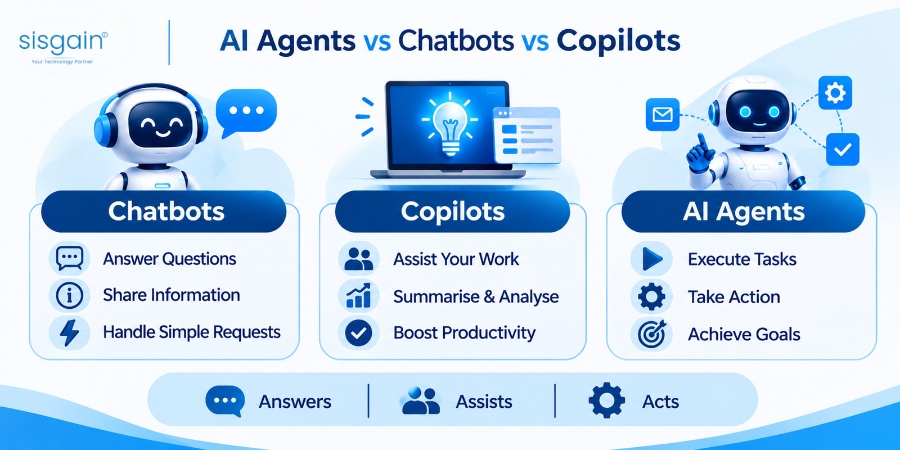
Although all three technologies use AI, their capabilities and business roles are different.
Chatbots: Conversation and assistance
Primarily designed to communicate with users.
Answer questions and provide information.
Handle repetitive customer interactions.
Collect information and initiate simple requests.
Usually operate within a defined conversational scope.
Copilots: Employee productivity
Designed to assist employees with their work.
Generate, summarise, and organise information.
Support analysis and everyday decision-making.
Work alongside human users.
Usually require employees to review important outputs.
AI agents: Task execution and workflow automation
Designed to achieve specific objectives.
Can perform multiple steps in a workflow.
Interact with connected business applications.
Make decisions within defined rules and permissions.
May complete tasks with limited human intervention.
The simplest way to understand the difference is this: a chatbot answers, a copilot assists, and an AI agent acts.
However, these capabilities can overlap. A modern chatbot may connect to business tools, and an AI agent may use a conversational interface. The actual distinction depends on how the solution is designed, integrated, and authorised to operate.
5. Which AI Technology Should Dubai Businesses Choose?
The right solution depends on the problem a business wants to solve. Organisations should avoid selecting technology simply because it is popular. Instead, they should identify the business process, expected outcome, and level of automation required.
Choose a chatbot when customer communication is the priority
A chatbot is a practical starting point when a business receives repetitive enquiries and wants to provide faster responses.
Consider a chatbot if your organisation needs to:
Answer common customer questions.
Provide 24/7 website assistance.
Capture and qualify leads.
Support basic appointment requests.
Reduce repetitive customer support interactions.
Choose a copilot when employee productivity is the priority
A copilot is suitable when employees spend considerable time searching for information, preparing documents, reviewing content, or completing repetitive knowledge-based tasks.
Consider a copilot if your organisation needs to:
Help employees prepare reports and proposals.
Summarise large volumes of business information.
Improve access to internal knowledge.
Assist sales, finance, HR, or marketing teams.
Support employees without removing human oversight.
Choose AI agents when workflow execution is the priority
AI agents are useful when a business process involves several steps, multiple applications, and repeated manual coordination.
Consider AI agents if your organisation needs to:
Automate multi-step business workflows.
Connect CRM, ERP, finance, or support systems.
Process requests and update business records.
Coordinate tasks across departments.
Monitor activities and trigger approved actions.
Businesses with more complex requirements may benefit from combining all three technologies.
6. How Dubai Businesses Can Combine AI Agents, Chatbots, and Copilots
These technologies do not necessarily need to operate separately. A connected AI ecosystem can use each technology for the task it handles best.
For example, consider a Dubai-based e-commerce business:
Chatbot: A customer asks about an order through the website.
AI agent: The system retrieves the order details, checks delivery information, and initiates an approved action if the order requires attention.
Copilot: A customer service employee receives a summary of the interaction and suggested next steps if the issue needs human intervention.
A similar approach can be applied across healthcare, retail, real estate, banking, logistics, and professional services.
For a healthcare organisation, a chatbot could guide visitors through general service enquiries, an AI agent could coordinate approved administrative workflows, and a copilot could help staff summarise operational information.
The key is to assign each technology a clearly defined responsibility. This reduces duplication and makes the overall solution easier to manage.
7. Important Considerations Before Implementing AI in Dubai
Before investing in AI, businesses should evaluate more than the technology itself. A successful implementation requires clear objectives, reliable information, secure integrations, and appropriate governance.
Working with an AI consultant in Dubai can help organisations assess their requirements, identify suitable use cases, and plan an implementation strategy that aligns with their business objectives.
Important considerations include:
Business objectives: Identify the specific process or customer problem the AI solution must address.
Data security: Define how business, customer, and employee information will be accessed, processed, and protected.
System integration: Check whether the solution can connect with existing CRM, ERP, websites, mobile applications, and other platforms.
Human oversight: Establish approval requirements for financial transactions, sensitive information, and important business decisions.
Accuracy and testing: Test responses, workflow execution, and exception handling before deployment.
Scalability: Choose an architecture that can support additional users, workflows, and business requirements.
Performance measurement: Track relevant indicators such as response time, task completion, employee productivity, and operational costs.
Businesses operating in regulated sectors should also review applicable UAE data protection requirements and sector-specific rules before processing sensitive information through AI systems.
8. How SISGAIN Helps Businesses Build AI-Powered Solutions
Selecting the right AI technology is only the first step. Businesses also need a solution that fits their workflows, existing infrastructure, and long-term objectives.
SISGAIN Technologies helps organisations explore and develop AI-powered applications, intelligent automation solutions, and connected digital systems based on their operational requirements.
The focus should be on identifying practical opportunities for AI adoption, selecting suitable technologies, and developing solutions that support business operations. This includes considering integration requirements, user experience, security, scalability, and ongoing performance.
Whether an organisation needs an intelligent customer support solution, an employee copilot, or an AI agent for workflow automation, the implementation should be aligned with a clearly defined business outcome.
9. Conclusion
AI agents, chatbots, and copilots offer different ways for businesses to improve productivity, customer experience, and operational performance. Chatbots are effective for conversations, copilots support employees, and AI agents help execute multi-step tasks.
For Dubai businesses, the right choice depends on the level of automation required, the complexity of existing workflows, and the systems that need to be connected.
Organisations with simple customer support requirements may begin with chatbots. Businesses looking to improve employee productivity can explore copilots, while those aiming to automate complex processes may benefit from AI agents.
The most effective strategy is to start with a clear business objective, select the appropriate technology, and expand implementation based on measurable results.
Ready to identify the right AI solution for your business? Connect with SISGAIN to explore AI development, intelligent agents, and tailored digital solutions for your organisation.
Frequently Asked Questions
1. What is the main difference between AI agents and chatbots?
Chatbots primarily answer questions and support conversations, while AI agents can perform tasks, interact with connected systems, and execute multi-step workflows.
2. Are AI copilots better than AI agents?
Neither is universally better. Copilots assist employees with tasks, while AI agents are designed to execute defined actions. The right choice depends on business requirements.
3. Can Dubai businesses use AI agents in existing systems?
Yes. AI agents can be integrated with compatible CRM, ERP, customer support, and other business applications, depending on system access and integration capabilities.
4. Are AI agents suitable for small businesses?
Yes. Small businesses can use AI agents to automate repetitive activities such as lead management, customer enquiries, and administrative workflows.
5. How can businesses choose the right AI solution?
Businesses should evaluate their objectives, workflow complexity, integration requirements, data security needs, and expected outcomes before selecting a chatbot, copilot, or AI agent.