
For the last few years, most companies have met artificial intelligence through chatbots: a window on a website that answers questions, sometimes well and sometimes not. In 2026 the conversation has moved on. The question businesses now ask is not "can AI answer a customer?" but "can AI actually finish the task?" That shift is what people mean when they talk about agentic AI.
This article explains what agentic AI is, how it differs from a classic AI assistant, where it is already useful, and what to look for if you plan to build AI agents for your own company.
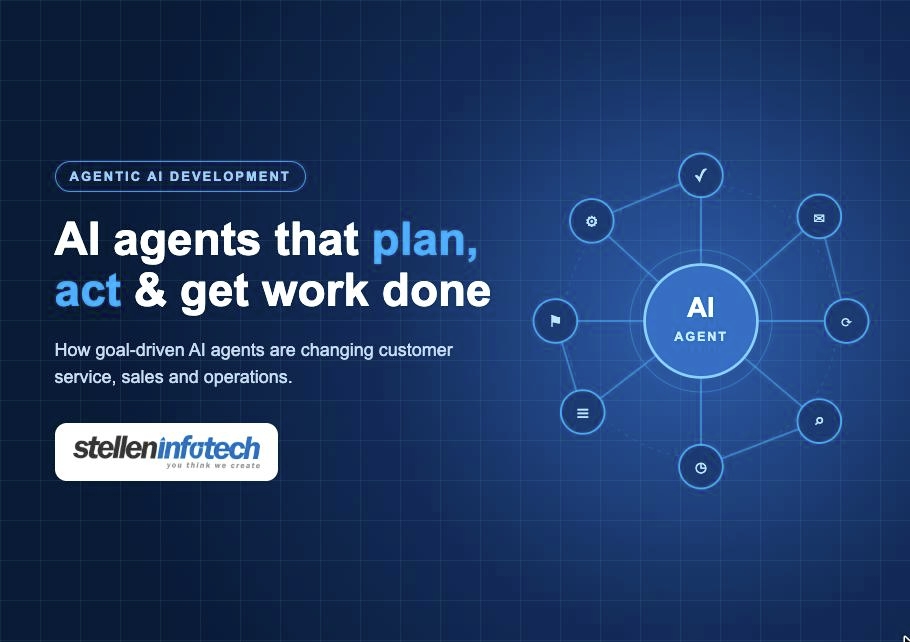
From chatbots to AI agents: what has changed
A traditional chatbot works in a simple loop: a person asks, the model answers. It has no goal of its own beyond the next reply, and it usually cannot touch the systems where work really happens — the CRM, the ERP, the help desk, the internal document storage.
An AI agent is built differently. It receives a goal ("qualify this new lead", "prepare a weekly sales report", "resolve this refund request"), breaks the goal into steps, uses tools and APIs to carry those steps out, checks the result and, when something is unclear or risky, hands the decision to a human. In short, it moves from talking about work to doing work.
AI agents vs agentic AI: is there a difference?
The two terms are often used as synonyms, but there is a useful distinction:
An AI agent is a single software worker focused on a defined task, for example answering support tickets or updating CRM records.
Agentic AI describes the wider approach: systems that plan, make decisions and complete multi-step workflows, often by coordinating several specialised agents that pass work to each other.
A simple way to remember it: an agent is the worker, agentic AI is the way the whole team of workers is organised.
Four qualities of a well-built AI agent
Goal-driven. It works toward a business outcome, not just a single response.
Tool-enabled. It can use the company's software, APIs and data instead of living in a separate chat window.
Context-aware. It understands the relevant history, documents and rules of the business.
Human-controlled. It escalates important or sensitive decisions to people instead of guessing.
Where agentic AI is already useful
Customer service. Agents can look up an order, check a policy, resolve routine requests and pass complex cases to a specialist with a clear summary attached.
Sales. Agents research prospects, qualify incoming leads, draft personalised follow-ups and keep CRM records up to date, so the sales team spends time on conversations rather than data entry.
Operations. Agents move information between systems, monitor tasks, generate routine reports and flag problems early.
Research and internal knowledge. Agents search approved sources, compare information and turn policies and manuals into an assistant any employee can query.
Industries with a lot of repetitive, rule-based work — healthcare administration, banking and finance, e-commerce and real estate — tend to see the clearest results first.
How an agentic AI project usually runs
Discover. Understand the goals, the process, the users, the data and the existing systems.
Design. Define the agent's role, the tools it may use, its knowledge sources and its limits.
Prototype. Build the single most valuable workflow first and check it with real users.
Develop. Engineer the agent logic, integrations and interfaces.
Test. Check accuracy, reliability, edge cases, security and guardrails.
Scale. Launch, monitor performance and gradually extend the agent to new workflows.
Starting small matters. One well-chosen process automated properly teaches a company more than an ambitious project that tries to automate everything at once.
Guardrails are not optional
An agent that can act inside business systems needs clear boundaries. Good practice includes limiting each agent to the minimum permissions it needs, logging every action, requiring human approval for payments, deletions or anything customer-sensitive, and testing the agent on unusual cases before it goes live. These controls are what make an agent trustworthy enough to use every day.
How to choose a development partner
If you do not have an in-house AI team, the choice of partner will shape the result. Useful questions to ask:
Do they start from your business problem, or from a ready-made product they want to sell?
Can they integrate agents with the tools you already use (CRM, ERP, help desk, internal APIs)?
How do they handle testing, security and human oversight?
Will they support and improve the agent after launch?
One example is Stellen Infotech, an agentic AI development company that builds custom AI agents, multi-agent systems and LLM integrations for businesses in Dubai, the wider GCC and other markets. The company follows a discovery-to-scale process similar to the one described above and focuses on connecting agents with the systems teams already use.
Conclusion
Agentic AI is not about replacing people. It is about giving teams software workers that take over repetitive, multi-step tasks while humans keep control of the decisions that matter. Companies that begin with one clear process, set firm guardrails and measure results will be best placed to benefit as the technology matures.
Disclosure: this publication contains promotional material about Stellen Infotech.