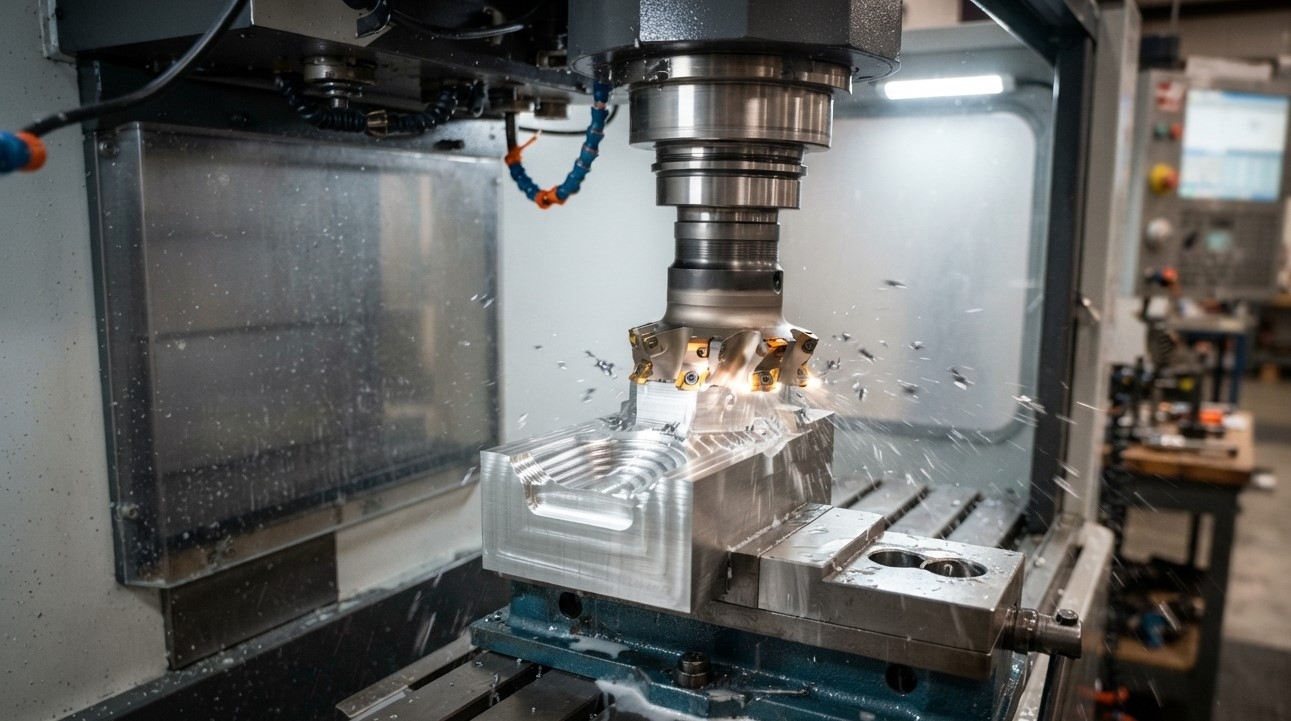
Face milling is one of the most widely used machining operations in modern CNC manufacturing. It is primarily used to produce flat, accurate surfaces on a workpiece while achieving efficient material removal and consistent surface quality. The performance of a face milling operation depends heavily on selecting the correct cutter, insert geometry, tool holder, cutting parameters, and machining strategy. For manufacturers using CNC machining tools, understanding different face milling tools and their applications can help improve productivity, tool life, and machining accuracy. Khokhawala Trading LLC, an experienced Industrial Tools Supplier in Dubai, provides industrial tooling, cutting solutions, and machining accessories for manufacturing, engineering, and CNC applications.
What Is Face Milling?
Face milling is a machining process in which the cutting edges of a rotating cutter remove material from the surface of a workpiece. Unlike peripheral milling, where the cutting edges around the circumference perform most of the cutting, face milling primarily uses cutting edges located on the face of the cutter.
Face milling is commonly used to:
Create flat surfaces
Remove excess material
Prepare surfaces for subsequent machining
Improve surface finish
Establish accurate reference surfaces
Machine shoulders and steps
Prepare components for assembly
Face milling can be performed on CNC machining centers as well as conventional milling machines, depending on the application.
Why Is Face Milling Important in CNC Machining?
A properly selected face milling tool can remove material quickly while maintaining consistent cutting conditions.
Effective face milling can provide:
High material removal rates
Good surface finish
Accurate flatness
Consistent dimensions
Efficient stock removal
Improved production productivity
Reduced machining time
However, poor tool selection or unsuitable cutting conditions can result in chatter, uneven surfaces, excessive tool wear, and dimensional problems.
Types of CNC Face Milling Tools
There are several types of face milling cutters available for different machining applications.
Indexable Face Mills
Indexable face mills use replaceable cutting inserts mounted around the cutter body.
When an insert becomes worn, it can be replaced or rotated rather than replacing the entire cutter.
Advantages include:
Replaceable inserts
Cost-effective maintenance
Flexible insert grades
High material removal capability
Suitability for production machining
Indexable face mills are commonly used for steel, cast iron, stainless steel, aluminum, and other industrial materials.
Shell Mills
Shell mills are larger-diameter cutters designed for mounting onto a suitable arbor or tool holder.
They are often used for machining large flat surfaces because their diameter allows them to cover a broad area in fewer passes.
Solid Carbide Face Mills
Solid carbide cutters provide high rigidity and wear resistance and may be used for specific high-performance applications.
They are particularly useful when the application requires:
High cutting speeds
Precision
Rigidity
Consistent cutting performance
The appropriate carbide grade and geometry should be selected according to the workpiece material and machining conditions.
High-Speed Steel Face Mills
High-speed steel tools are traditionally used for general-purpose milling and certain lower-speed applications.
Although carbide is widely used in modern CNC production, HSS can still be suitable for specific machining requirements where cutting speeds and production conditions justify its use.
Understanding Face Milling Inserts
In indexable face milling systems, the insert is one of the most important components.
Insert selection should consider:
Workpiece material
Cutting speed
Feed rate
Depth of cut
Roughing or finishing
Required surface finish
Machine rigidity
Different insert geometries and grades are designed for different machining conditions.
A positive cutting geometry may help reduce cutting forces in certain applications, while stronger edge geometries may be preferred for heavier or interrupted cuts.
Choosing the Right Face Milling Tool
Selecting the correct face milling cutter requires evaluating the complete machining application.
Consider the Workpiece Material
The material being machined has a major influence on tool selection.
Aluminum often benefits from sharp cutting edges and efficient chip evacuation. Steel may require appropriate carbide grades and coatings. Stainless steel may require geometry designed to manage heat and work hardening.
Cast iron can require wear-resistant tooling because of its abrasive machining characteristics.
Consider the Required Surface Finish
Roughing operations generally prioritize material removal, while finishing operations focus more heavily on surface quality and dimensional consistency.
A cutter with suitable insert geometry and spacing should be selected according to the required finish.
Consider Cutter Diameter
The cutter diameter should provide appropriate coverage of the workpiece without unnecessarily increasing cutting forces.
For broad surfaces, a larger cutter may reduce the number of passes.
For smaller areas or restricted machine access, a smaller cutter may be more practical.
Consider Machine Capability
The CNC machine must be capable of handling the cutter diameter, spindle speed, power requirement, and cutting forces.
Machine rigidity is especially important during heavy face milling.
Face Milling Tool Geometry
Tool geometry strongly influences machining performance.
Important factors include:
Rake Angle
Rake angle affects cutting forces, chip formation, and cutting action.
Clearance Angle
Clearance prevents unwanted rubbing between the tool and machined surface.
Lead Angle
The lead angle affects cutting force distribution and chip thickness.
Insert Shape
Different insert shapes provide different combinations of edge strength, accessibility, and cutting performance.
Nose Radius
Nose radius affects surface finish and edge strength. A larger radius can provide a stronger cutting edge but may increase cutting forces under certain conditions.
Face Milling Cutting Parameters
Correct cutting parameters are essential for achieving good results.
Cutting Speed
Cutting speed determines how quickly the cutting edge moves through the workpiece.
It should be selected based on:
Tool material
Insert grade
Workpiece material
Cutter diameter
Machine capability
Feed Rate
Feed rate affects productivity, chip thickness, cutting forces, and surface finish.
The correct feed should be determined using the tool manufacturer's recommendations.
Depth of Cut
Depth of cut determines the amount of material removed in each pass.
Heavy roughing cuts require sufficient machine power and rigidity.
Radial Engagement
Radial engagement refers to how much of the cutter diameter is engaged with the workpiece.
Controlling engagement can help manage cutting forces and tool temperature.
Face Milling Techniques
Different machining strategies can be used depending on the component.
Conventional Face Milling
The cutter moves across the workpiece in a standard linear pattern.
This method can be suitable for general-purpose machining.
High-Efficiency Face Milling
Modern CNC machining can use optimized toolpaths to maintain consistent cutter engagement and reduce unnecessary tool loading.
Finishing Face Milling
Finishing passes use controlled cutting conditions to improve flatness and surface quality.
A finishing pass may remove a small amount of remaining material after roughing.
Common Problems During Face Milling
Chatter and Vibration
Chatter can occur when the machine, workholding, tool, or cutting parameters are insufficiently rigid.
Possible solutions include:
Reducing tool overhang
Improving workholding
Adjusting cutting speed
Reducing cutting engagement
Using a more rigid tool holder
Selecting suitable insert geometry
Poor Surface Finish
Poor surface finish may result from:
Worn inserts
Excessive runout
Incorrect feed
Vibration
Improper cutter selection
Damaged tool holders
Uneven Surface
An uneven surface may indicate cutter runout, incorrect machine setup, insert height variation, or workpiece movement.
Excessive Tool Wear
Tool wear can be caused by unsuitable cutting speed, excessive cutting forces, incorrect insert grade, inadequate coolant, or abrasive workpiece material.
The Role of CNC Tool Holders
A face milling cutter needs a rigid connection to the CNC machine.
High-quality CNC tool holders help maintain:
Tool stability
Concentricity
Repeatability
Low runout
Reliable cutting performance
The holder and spindle interface should be kept clean and inspected regularly.
Tool overhang should also be minimized where practical.
Face Milling and Precision Measurement
After face milling, manufacturers may need to verify flatness, thickness, dimensions, and surface-related requirements.
Precision measuring tools can be used to check finished components.
Depending on the application, manufacturers may use:
Micrometers
Digital calipers
Dial indicators
Height gauges
Surface measurement equipment
Measurement helps confirm whether the selected machining process is producing the required results.
Applications of CNC Face Milling Tools
CNC face milling tools are used across many industries and manufacturing applications.
Common applications include:
Automotive Manufacturing
Used for machining engine components, brackets, housings, and other metal parts.
Aerospace Manufacturing
Used for precision machining of structural components and complex metal parts.
General Engineering
Face milling is widely used for preparing flat surfaces and machining components for assembly.
Tool and Die Manufacturing
Face milling tools can be used for preparing mold bases, plates, and other tooling components.
Fabrication and Industrial Machinery
Manufacturers use face milling to prepare mounting surfaces, machine plates, and produce accurate component dimensions.
Best Practices for Face Milling
For consistent results, CNC workshops should follow these practices:
Select the cutter according to the workpiece material.
Choose suitable insert geometry and grade.
Use the recommended cutting speed and feed rate.
Maintain a rigid setup.
Minimize tool overhang.
Use suitable CNC tool holders.
Control tool runout.
Keep inserts and cutter bodies clean.
Monitor insert wear.
Use coolant or lubrication where appropriate.
Maintain stable workholding.
Inspect finished surfaces using precision measuring tools.
Benefits of Using the Right Face Milling Tools
Selecting the appropriate face milling system can provide several benefits:
Faster material removal
Improved surface finish
Better dimensional consistency
Longer tool life
Reduced machining time
Improved production efficiency
Lower tool replacement costs
More predictable machining performance
The best results come from treating the cutter, insert, tool holder, machine, workpiece, and cutting parameters as one complete machining system.
Conclusion
CNC face milling tools play an important role in producing flat, accurate, and high-quality surfaces across modern manufacturing applications. From indexable face mills and shell mills to specialized carbide cutters, each tooling solution has specific advantages depending on the material, machining operation, surface requirements, and production environment.
Selecting the right CNC machining tools, optimizing cutting parameters, maintaining rigid CNC tool holders, and monitoring tool condition can help manufacturers improve machining performance. Regular inspection with precision measuring tools also ensures that finished components meet the required dimensional specifications.
For businesses looking for reliable industrial tooling solutions, Khokhawala Trading LLC is an experienced Industrial Tools Supplier in Dubai, offering industrial cutting tools, carbide cutting tools, CNC machining tools, CNC tool holders, precision measuring tools, and other machining accessories for manufacturing and engineering applications.