
Learn 10 practical customer acquisition strategies, from referrals and local SEO to packaging, plus how to choose the right mix for your budget
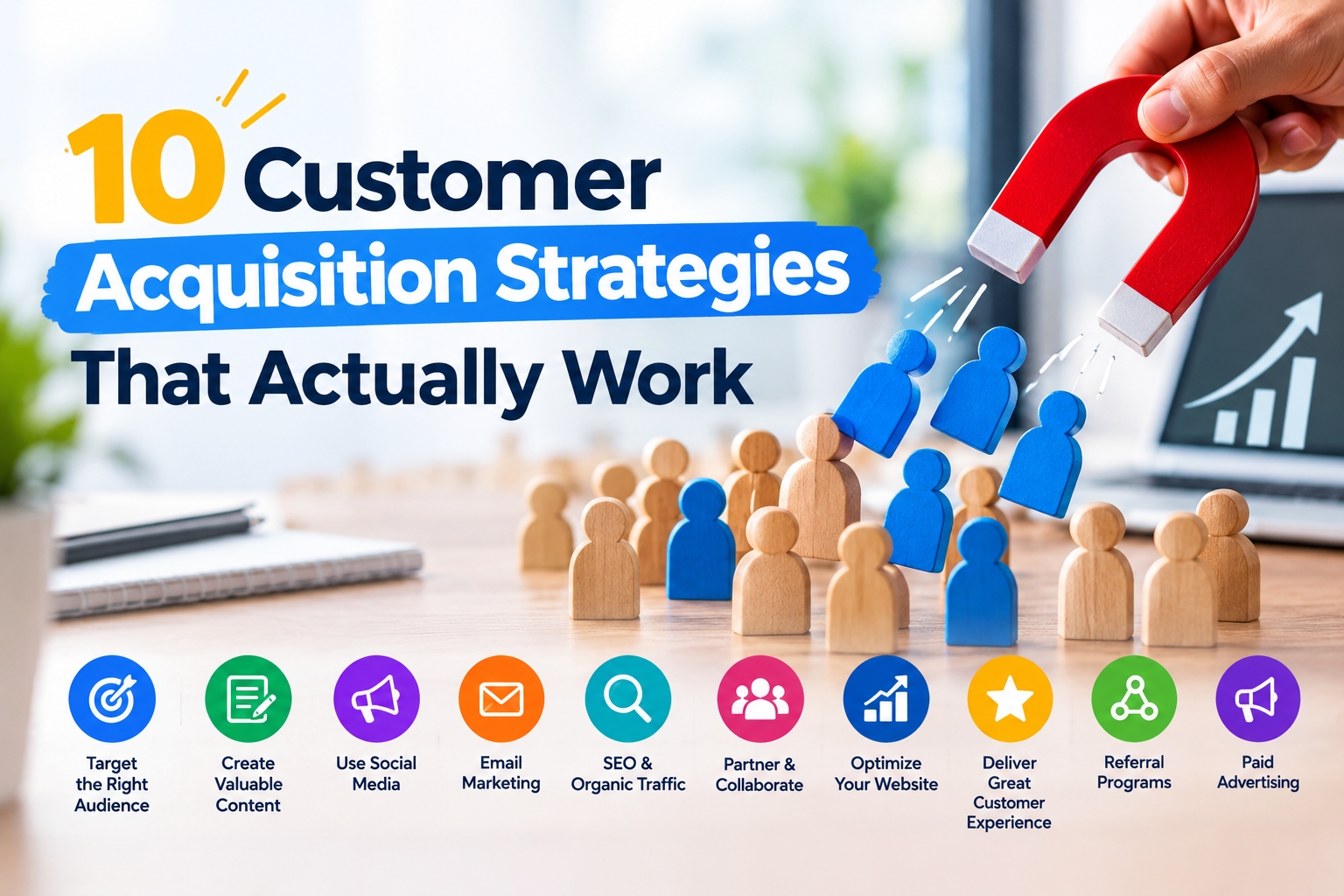
10 Customer Acquisition Strategies That Work (and How to Pick the Right Ones)
Why do some businesses pour money into ads and still struggle to find buyers, while a competitor with a quieter presence signs new customers every week? The difference is rarely the budget. It usually comes down to knowing where your buyers already are and giving them a reason to trust you.
What Customer Acquisition Actually Means
Customer acquisition is the process of turning strangers into paying customers. It covers everything from the first time someone hears about you to the moment they hand over money. It is not the same as marketing in general. Marketing builds awareness, while acquisition is measured by outcomes: leads captured, trials started, orders placed, and what each of those cost you.
Why It Matters
A business that can't acquire customers predictably can't plan hiring, inventory, or cash flow. Good acquisition also shows you which channels deserve more money and which are quietly draining it. Tracking customer acquisition cost (CAC) against customer lifetime value (LTV) is the simplest way to see whether your growth is healthy or just expensive.
10 Strategies Worth Your Attention
1. Search-Focused Content
People search for answers before they search for vendors. Publishing detailed, honest guides that answer real buyer questions puts you in front of them early. It's slow to build, but it keeps working long after publication.
2. Referral Programs
Dropbox famously grew by rewarding users with extra storage for inviting friends. The lesson is that the reward should match what your customers value. A discount works for retail, while a free month suits software.
3. Local SEO and Reviews
For service businesses, a well-maintained Google Business Profile often outperforms paid ads. Ask every satisfied customer for a review, and reply to the critical ones calmly. Prospects read how you handle complaints.
4. Targeted Paid Advertising
Ads work best once you know your message converts. Start small, test one audience and one offer at a time, and watch cost per acquisition rather than clicks. Scaling an untested ad is how budgets disappear.
5. Email Capture and Nurturing
Most visitors aren't ready to buy on the first visit. Offer something useful in exchange for an email address, such as a checklist, a sample, or a calculator, then follow up with relevant messages instead of constant promotions.
6. Partnerships and Co-Marketing
Find businesses that serve your audience without competing with you. A bookkeeper partnering with a business lawyer is a classic pairing. Joint webinars, shared newsletters, and mutual referrals reach warm audiences at low cost.
7. Free Tools and Trials
HubSpot built much of its early audience with free tools that solved small problems. Letting people experience value before paying lowers the barrier to trust, as long as the free version is genuinely useful.
8. Social Proof and Case Studies
Buyers want evidence that someone like them succeeded. Specific case studies, with real problems and measurable results, persuade better than adjectives. Ask permission, use real names where possible, and keep the numbers honest.
9. Community and Social Engagement
Showing up in the places your customers gather, such as niche forums, LinkedIn groups, or subreddits, builds credibility. Answer questions without pitching. People remember who helped them.
10. Product and Packaging Experience
For physical products, the first impression is often the package itself. Food, supplement, and cannabis brands see this clearly: resealable, odor-resistant, well-printed mylar packaging bags protect freshness, signal quality on a crowded shelf, and give customers something worth photographing and sharing. That kind of unprompted attention costs far less than an ad. When you evaluate packaging, check barrier properties, minimum order quantities, and whether it meets labeling rules for your category.
Common Challenges
Rising ad costs push many businesses to over-rely on one channel, which is risky when platform rules change.
Attribution confusion is another problem. A customer may read your blog, see a review, and click an ad before buying, so crediting only the last click distorts your decisions.
Impatience hurts too. Content and community take months to show results, and many teams quit just before they pay off.
Expert Tips From the Field
Interview five recent customers before changing your strategy. Ask what they searched for, who they compared you against, and what almost stopped them from buying. Their answers often reveal the cheapest channel you've been ignoring.
Fix your conversion path before buying more traffic. A confusing checkout wastes every dollar sent to it.
Pick two or three channels and do them well rather than spreading thin across ten.
Document what works. A simple spreadsheet of channel, cost, and customers acquired beats intuition.
Factors to Consider Before You Choose
Your audience. B2B buyers research and compare for weeks, while impulse purchases need fast, visual persuasion.
Your margins. If your profit per sale is small, expensive channels won't pay back.
Your capacity. Don't generate demand you can't fulfil. A flood of orders with late shipping creates bad reviews that undo your progress.
Your timeline. Paid ads and partnerships bring faster results, while content and community compound over time. A balanced mix protects you.
Where to Go From Here
Acquiring customers isn't about finding one perfect tactic. It's about understanding your buyers well enough to meet them with the right message at the right moment, and then checking the numbers honestly. Start with the strategies that fit your audience and budget today, such as reviews, a referral offer, or better packaging. Measure each one for a few months, keep what pays for itself, and drop what doesn't. Businesses that grow steadily tend to treat acquisition as a habit of small, tested improvements rather than a single big campaign.