
A clicking speed test is a simple way to find out how fast you can click your mouse. It is useful for gamers, beginners, and anyone who wants to check their clicking speed. You only need a mouse and a few seconds to get started.
The test counts your clicks during a set time and calculates your CPS score. You can try different test times, compare your results, and practice different clicking methods to work on your speed.
What Is Clicks Per Second?
Clicks per second means the number of mouse clicks you make in one second. It is commonly shortened to CPS. A clicking test measures your clicking speed over a selected time. You can use it to check CPS, see your current score, and compare it with your results later. The test is easy to use and does not require any special skills.
How Does a Clicking Test Work?
A clicking test is simple to use. First, choose how long you want to click. Then start the test and click the mouse as many times as you can before the timer ends. The test counts your clicks and calculates your clicks-per-second score. You can repeat the test to check your progress and see whether your score improves with practice.
Choose Your Test Time
First, choose how long you want the test to last. Short tests, such as 1 or 5 seconds, are useful when you want a quick result. Longer tests, such as 30 or 60 seconds, give you more time to click and check your performance. Using the same test time each time also makes it easier to compare your scores.
Start Clicking
After choosing the test time, start clicking your mouse as quickly as you comfortably can. Try to keep your clicks under control instead of focusing only on speed. You can use your usual clicking style or try another method to see how it affects your result. Make sure your hand feels comfortable while clicking.
Check Your Score
When the timer reaches zero, the test stops counting your clicks and displays your result. Your clicks per second score shows the average number of clicks you made per second during the test. You can write down your result or take the test again to check your progress. Comparing scores from the same test duration can help you see changes in your clicking speed.
Different Clicking Test Durations
Different test times help you check your clicking speed in different ways. A short test gives you a quick result, while a longer test lets you click for more time. You can try several durations and compare your scores to understand how your clicking speed changes. Choose a test length that matches your practice goals.
1-Second Click Test
The 1-second click test is a very short speed test. You need to click as many times as possible before the timer ends. Since the test lasts only one second, even one extra click can change your result. It is useful when you want to check how many clicks you can make in a very short time.
5-Second Click Test
The 5-second click test gives you more time to click than the 1-second test. It is a useful choice for quick practice because you can focus on your speed without clicking for too long. You can repeat the test several times and compare your scores to see whether your clicking technique helps you get better results.
10-Second Click Test
The 10-second click test gives you more time to find a clicking pace you can maintain throughout the test. It helps you check your performance over a longer period than the 1-second or 5-second tests. You can also use it to compare different clicking methods and see which one gives you a better result.
30-Second Click Test
The 30-second click test is useful when you want a longer practice session. You need to keep clicking for half a minute, so your result shows your average clicking speed over that time. Try to maintain control instead of forcing your fingers to move faster. If your hand feels tired, stop and rest before taking another test.
Different Clicking Methods
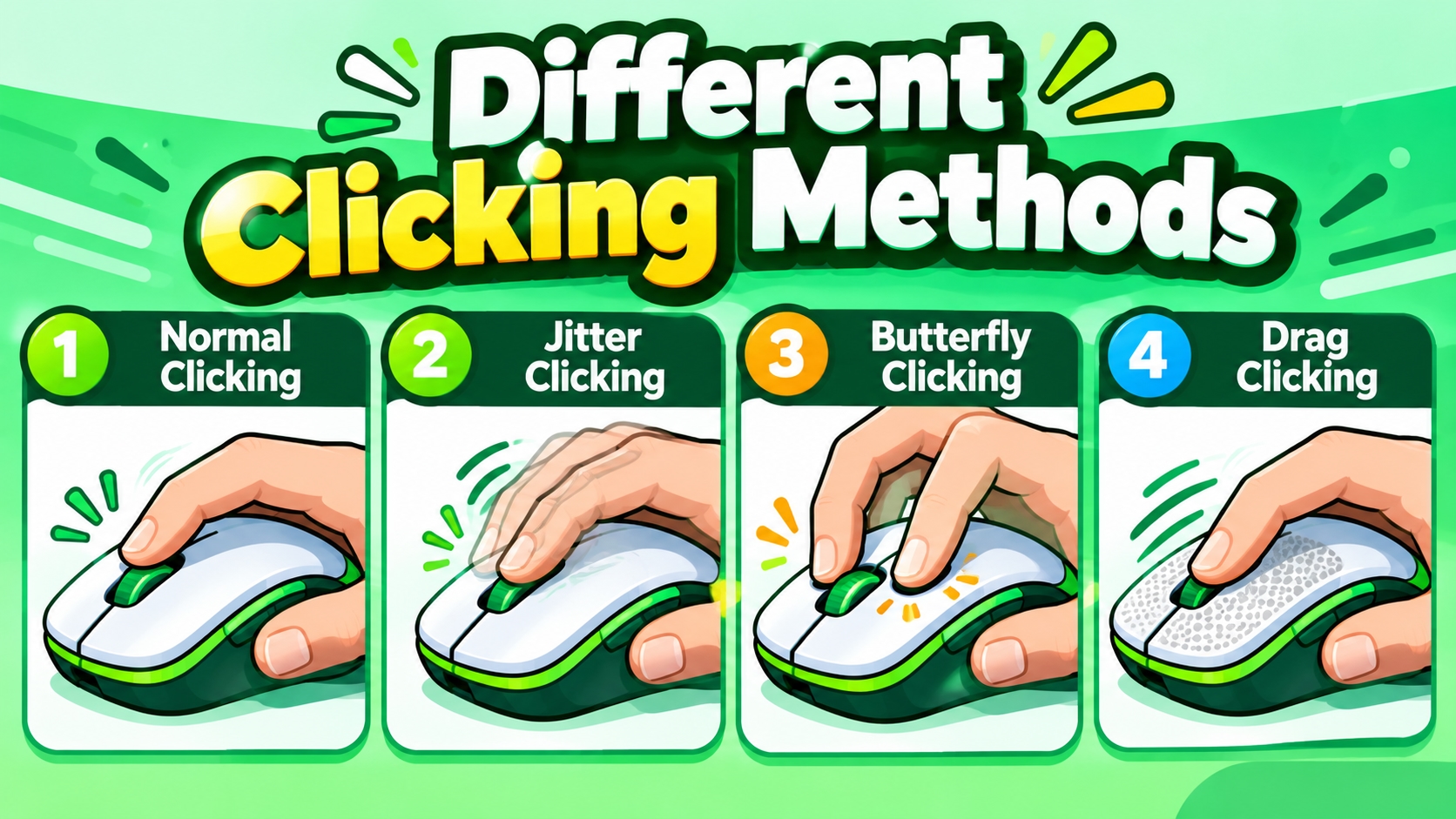
There are several ways to click a mouse, and each method uses a different finger or hand movement. Your clicking speed can change depending on the technique you use, your mouse, and your comfort level. Trying different methods can help you find one that suits your needs. You can compare your results with the same test duration to see how each method affects your score.
Normal Clicking
Normal clicking is the simplest method. You use one finger, usually your index finger, to press and release the mouse button one click at a time. It is easy to learn and works well for everyday computer use and gaming. If you play Minecraft, you can also learn more about Minecraft mouse controls to understand the basic mouse actions used in the game.
Jitter Clicking
Jitter clicking uses quick, small movements of the hand or arm while your finger presses the mouse button. This technique can help you make more clicks in a short time than normal clicking. It takes practice to control the movement and keep your aim where you want it. Avoid putting too much tension on your hand, and stop if you feel discomfort.
Butterfly Clicking
Butterfly clicking uses two fingers, usually the index and middle fingers, on the same mouse button. You press the button with one finger and then the other in quick turns. This method can produce a higher clicks-per-second score on some mice. However, the result depends on the mouse and how well it registers each click.
Drag Clicking
Drag clicking involves moving your finger across the mouse button while keeping light contact with its surface. Friction between your finger and the button can cause the mouse switch to register several clicks. The result depends on the mouse surface, button design, and finger movement. Not every mouse works well for this method, and it may take time to learn the technique.
How to Improve Your Clicking Speed
Improving your clicking speed takes practice and patience. You do not need to click as fast as possible from the start. Begin at a comfortable pace, focus on your clicking method, and work on improving your results over time. Regular practice can help you understand your current speed and find areas where you can improve.
Practice Regularly
Regular practice can help you become more comfortable with clicking. Try short practice sessions instead of clicking for a long time without a break. Check your score after each session and compare your results over time. Using the same test duration can also help you understand whether your clicking speed is improving.
Try Different Clicking Methods
Different clicking methods can give you different results. Try normal clicking, jitter clicking, butterfly clicking, and drag clicking to see which technique feels best for you. Your mouse can also affect how well each method works. Compare your scores using the same test duration to get a clearer idea of the results.
Focus on Speed and Control
A high score is not the only thing to focus on during a clicking test. Try to make quick clicks while keeping your hand and fingers under control. Good mouse control can help you click more comfortably and use your chosen technique with greater confidence. Do not force your fingers to move faster if the movement feels uncomfortable.
Take Short Breaks
Give your hands and fingers time to rest between practice sessions. Clicking for too long without a break can make your hand feel tired. If you feel pain, numbness, or discomfort while clicking, stop and rest. You can continue practising later when your hand feels comfortable again. Short sessions can help you practice without putting too much strain on your fingers.
Conclusion
Clicks per second is a simple way to measure your mouse clicking speed and check how your results change with practice. You can try different test durations and clicking methods to find what works best for you. Comparing your scores can help you understand your clicking performance over time.
Focus on improving your speed while keeping your clicks controlled and your hand comfortable. With regular practice and short breaks, you can work on your clicking skills at your own pace. Choose a suitable test duration, check your results, and keep practising when you feel ready.